Anchang Ancient Town
⭐ 4.60
Anchang Ancient Town, Zhuji City, Shaoxing, Zhejiang Province, China
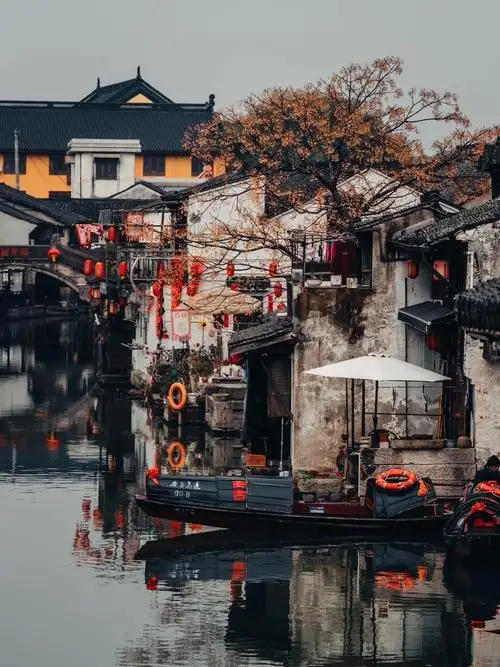 Anchang was founded during the Northern Song Dynasty (960–1127 CE), placing it squarely in the era when Europe's great canal-trading hubs—Bruges, Lübeck, and the Italian maritime republics—were flourishing. Perched along the ancient Hangzhou-Ningbo Canal, a branch of China's UNESCO-listed Grand Canal, Anchang grew wealthy from rice, wine, and silk trade. Designated one of Zhejiang's first historic cultural towns and a National AAAA scenic area (China's mid-tier rating), it remains unique among Jiangnan water towns: residents still live and work here, and entry to the historic streets is completely free. This is "living Jiangnan," not a museum piece.
The town follows a classic Jiangnan layout—one canal flanked by two streets, linked by seventeen stone bridges—much like Venice's network of waterways or Amsterdam's canal-ring houses. Stretching some 1,747 metres, the covered walkways (langpeng) shelter pedestrians from summer sun and winter rain, echoing the arcaded streets of Bologna or Bern. Along the canal, whitewashed walls, dark timber beams, and grey-tiled roofs create the iconic Jiangnan tableau. Three bridges—Fulu, Wan'an, and Ruyi ("Fortune," "Peace," and "Wishes")—are the most celebrated crossings, each a perfect spot for photographers.
Anchang's culinary fame rests on two pillars. Its winter sausages and pressed duck gained national celebrity after appearing on A Bite of China; during the twelfth lunar month festival, every household hangs rows of curing meats by the canal in a spectacular "meat forest" that has become the town's signature image. Equally important is Renchang Soy Sauce, brewed in century-old open-air vats through traditional spring-fermentation and autumn-sun-drying cycles that perfume the entire district. Don't miss the pulled white sugar demonstration—a Ming Dynasty craft where artisans stretch molten sugar into silky white ribbons by hand.
Anchang's most singular cultural treasure is its Museum of the Shaoxing Shiye—legal advisors who served behind the scenes in imperial Chinese courts. The saying "No Shaoxing advisor, no functioning yamen" reflects their enormous influence; comparable to the role of Roman legal scribes or Renaissance court secretaries, these men drafted documents, mediated disputes, and quietly shaped policy. Housed in a Qing-era residence, the museum offers rare insight into a profession with no real Western equivalent. Five other small museums cover local folklore, the City God Temple, and traditional customs.
The town is wonderfully budget-friendly: street access is free 24 hours, the six-museum combo ticket costs just ¥50, and a one-way ride on a traditional black-canopied boat (wupeng chuan) is only ¥10. Direct buses connect from Shaoxing's city centre in around 40 minutes. The prime season runs from the twelfth lunar month through the Lantern Festival (roughly January to February), when cured meats perfume the air and water weddings, street opera, and temple processions fill the calendar. Summer is quieter and hotter—aim for early morning or late afternoon. Allow half a day to a full day.
Unlike the heavily commercialised water towns near Shanghai and Suzhou, Anchang rewards those who linger. Slow down and you'll discover grandmothers pulling sugar in narrow alleys, elders sipping rice wine on canal-side steps, and shopkeepers who actually live above their storefronts. Take a wupeng boat through the low bridges, sample preserved-vegetable braised pork at a waterside eatery, and seek out the sugar-pulling master in his workshop. This is the Jiangnan water town as it has lived for a thousand years—unhurried, fragrant, and quietly enduring.
Anchang was founded during the Northern Song Dynasty (960–1127 CE), placing it squarely in the era when Europe's great canal-trading hubs—Bruges, Lübeck, and the Italian maritime republics—were flourishing. Perched along the ancient Hangzhou-Ningbo Canal, a branch of China's UNESCO-listed Grand Canal, Anchang grew wealthy from rice, wine, and silk trade. Designated one of Zhejiang's first historic cultural towns and a National AAAA scenic area (China's mid-tier rating), it remains unique among Jiangnan water towns: residents still live and work here, and entry to the historic streets is completely free. This is "living Jiangnan," not a museum piece.
The town follows a classic Jiangnan layout—one canal flanked by two streets, linked by seventeen stone bridges—much like Venice's network of waterways or Amsterdam's canal-ring houses. Stretching some 1,747 metres, the covered walkways (langpeng) shelter pedestrians from summer sun and winter rain, echoing the arcaded streets of Bologna or Bern. Along the canal, whitewashed walls, dark timber beams, and grey-tiled roofs create the iconic Jiangnan tableau. Three bridges—Fulu, Wan'an, and Ruyi ("Fortune," "Peace," and "Wishes")—are the most celebrated crossings, each a perfect spot for photographers.
Anchang's culinary fame rests on two pillars. Its winter sausages and pressed duck gained national celebrity after appearing on A Bite of China; during the twelfth lunar month festival, every household hangs rows of curing meats by the canal in a spectacular "meat forest" that has become the town's signature image. Equally important is Renchang Soy Sauce, brewed in century-old open-air vats through traditional spring-fermentation and autumn-sun-drying cycles that perfume the entire district. Don't miss the pulled white sugar demonstration—a Ming Dynasty craft where artisans stretch molten sugar into silky white ribbons by hand.
Anchang's most singular cultural treasure is its Museum of the Shaoxing Shiye—legal advisors who served behind the scenes in imperial Chinese courts. The saying "No Shaoxing advisor, no functioning yamen" reflects their enormous influence; comparable to the role of Roman legal scribes or Renaissance court secretaries, these men drafted documents, mediated disputes, and quietly shaped policy. Housed in a Qing-era residence, the museum offers rare insight into a profession with no real Western equivalent. Five other small museums cover local folklore, the City God Temple, and traditional customs.
The town is wonderfully budget-friendly: street access is free 24 hours, the six-museum combo ticket costs just ¥50, and a one-way ride on a traditional black-canopied boat (wupeng chuan) is only ¥10. Direct buses connect from Shaoxing's city centre in around 40 minutes. The prime season runs from the twelfth lunar month through the Lantern Festival (roughly January to February), when cured meats perfume the air and water weddings, street opera, and temple processions fill the calendar. Summer is quieter and hotter—aim for early morning or late afternoon. Allow half a day to a full day.
Unlike the heavily commercialised water towns near Shanghai and Suzhou, Anchang rewards those who linger. Slow down and you'll discover grandmothers pulling sugar in narrow alleys, elders sipping rice wine on canal-side steps, and shopkeepers who actually live above their storefronts. Take a wupeng boat through the low bridges, sample preserved-vegetable braised pork at a waterside eatery, and seek out the sugar-pulling master in his workshop. This is the Jiangnan water town as it has lived for a thousand years—unhurried, fragrant, and quietly enduring.