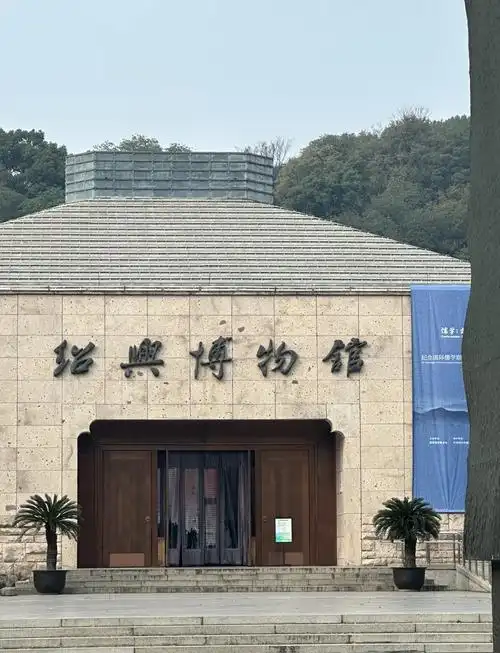
Shaoxing Museum
⭐ 4.60
No. 388, Luxun Middle Road, Yuecheng District, Shaoxing City, Zhejiang Province, China
 **Historical Context**
Shaoxing, anciently known as Kuaiji, ranks among China's oldest continuously inhabited cities, predating even the legendary Xia dynasty. The museum's narrative arc spans the Neolithic cultures of the Hemudu region through the fierce maritime kingdom of Yue—whose king Goujian famously humbled the state of Wu around 473 BCE, a drama Westerners might liken to the Hellenic conflicts chronicled by Thucydides. Later chapters cover the Southern Dynasties Buddhist flowering, the literati golden age of Wang Xizhi, and the tumult of the late Qing and Republican eras, presenting artifacts that anchor these epochs in tangible form.
**Architecture and Design**
The new 29,500-square-meter building marries Jiangnan water-town aesthetics with contemporary monumentality, recalling the confident civic modernism of Berlin's Museum Island or London's Barbican Centre. Seven permanent galleries, two thematic halls, six temporary exhibition spaces, and a digital theater unfold around courtyards and reflective pools. Nearly half the displayed objects appear publicly for the first time, with multimedia reconstructions and immersive projections animating everything from Bronze Age smelting to Song-dynasty scroll painting.
**Cultural Significance**
The signature "Ten Thousand Years of Yue" chronology weaves seven chapters into a single, lucid narrative—arguably the most systematic treatment of Yue civilization anywhere. Treasures include inscribed swords of Yue kings, the Weiwei Zun Buddha, ritual bricks from the Kuaiji kilns, and calligraphy by masters such as Xu Wei. For scholars of East Asian history, the collection fills gaps left by Beijing's imperial-focused museums; for general travelers, it illuminates the regional identity that shaped figures from the calligrapher Wang Xizhi to the modern writer Lu Xun.
**Practical Visit Information**
Entry is free but requires advance booking through the museum's official channels. Opening hours run Tuesday to Sunday, 9:00–16:30, with extended evening hours until 20:00 on Fridays, Saturdays, Sundays, and public holidays; the museum closes on Mondays except during festival periods. English and Japanese audio guides are available for rent, and foreign volunteer docents often lead weekend tours in English, Japanese, Korean, and French. The address is 566 Jiefang Avenue, Jinghu New District; take Metro Line 1 to Meishan Square Station and cycle 1.8 kilometers, or ride bus 158 to the Jiefang Avenue–Qunxian Road stop, a mere 50-meter walk from the entrance.
**Why Visit**
Beyond the collections themselves, the museum provides the historical scaffolding that transforms a stroll through Shaoxing's calligraphic lanes and Lu Xun's childhood home into something far richer. Allow 1.5 to 2 hours for the permanent galleries, then step next door into the Jinghu National Urban Wetland Park, a 2,000-year-old lake ecosystem where egrets and lotus connect the modern city to its ancient past.
**Historical Context**
Shaoxing, anciently known as Kuaiji, ranks among China's oldest continuously inhabited cities, predating even the legendary Xia dynasty. The museum's narrative arc spans the Neolithic cultures of the Hemudu region through the fierce maritime kingdom of Yue—whose king Goujian famously humbled the state of Wu around 473 BCE, a drama Westerners might liken to the Hellenic conflicts chronicled by Thucydides. Later chapters cover the Southern Dynasties Buddhist flowering, the literati golden age of Wang Xizhi, and the tumult of the late Qing and Republican eras, presenting artifacts that anchor these epochs in tangible form.
**Architecture and Design**
The new 29,500-square-meter building marries Jiangnan water-town aesthetics with contemporary monumentality, recalling the confident civic modernism of Berlin's Museum Island or London's Barbican Centre. Seven permanent galleries, two thematic halls, six temporary exhibition spaces, and a digital theater unfold around courtyards and reflective pools. Nearly half the displayed objects appear publicly for the first time, with multimedia reconstructions and immersive projections animating everything from Bronze Age smelting to Song-dynasty scroll painting.
**Cultural Significance**
The signature "Ten Thousand Years of Yue" chronology weaves seven chapters into a single, lucid narrative—arguably the most systematic treatment of Yue civilization anywhere. Treasures include inscribed swords of Yue kings, the Weiwei Zun Buddha, ritual bricks from the Kuaiji kilns, and calligraphy by masters such as Xu Wei. For scholars of East Asian history, the collection fills gaps left by Beijing's imperial-focused museums; for general travelers, it illuminates the regional identity that shaped figures from the calligrapher Wang Xizhi to the modern writer Lu Xun.
**Practical Visit Information**
Entry is free but requires advance booking through the museum's official channels. Opening hours run Tuesday to Sunday, 9:00–16:30, with extended evening hours until 20:00 on Fridays, Saturdays, Sundays, and public holidays; the museum closes on Mondays except during festival periods. English and Japanese audio guides are available for rent, and foreign volunteer docents often lead weekend tours in English, Japanese, Korean, and French. The address is 566 Jiefang Avenue, Jinghu New District; take Metro Line 1 to Meishan Square Station and cycle 1.8 kilometers, or ride bus 158 to the Jiefang Avenue–Qunxian Road stop, a mere 50-meter walk from the entrance.
**Why Visit**
Beyond the collections themselves, the museum provides the historical scaffolding that transforms a stroll through Shaoxing's calligraphic lanes and Lu Xun's childhood home into something far richer. Allow 1.5 to 2 hours for the permanent galleries, then step next door into the Jinghu National Urban Wetland Park, a 2,000-year-old lake ecosystem where egrets and lotus connect the modern city to its ancient past.