Lu Xun Memorial Museum
⭐ 4.50
No. 385, Lu Xun Middle Road, Yuecheng District, Shaoxing City, Zhejiang Province, China
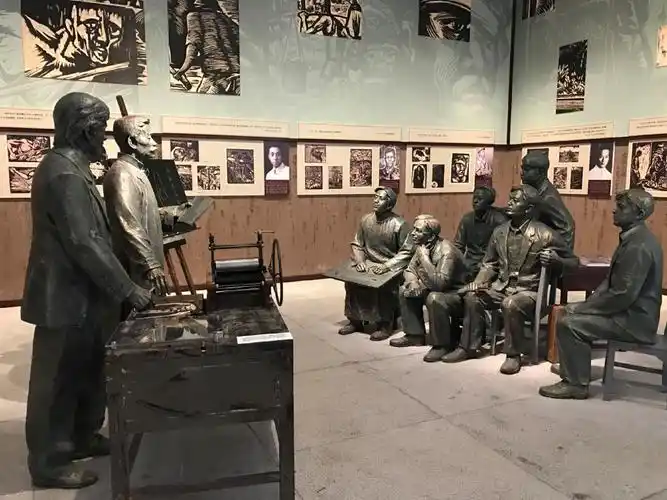 The memorial hall traces its origins to 1953, when local authorities first proposed preserving the writer's legacy, though the museum itself only opened in 1973 and moved to its purpose-built site in 2003. As the earliest biographical museum in Zhejiang and a nationally designated patriotic education site, it holds an honored place in Chinese cultural memory. Lu Xun (1881–1936), a contemporary of James Joyce and Franz Kafka, became the founding voice of modern Chinese literature, using fiction and essay to expose the contradictions of his era. Shaoxing itself has nurtured scholars since the Spring and Autumn period, more than 2,500 years ago.
Spanning roughly 6,000 square meters, the building follows an "old house plus new space" philosophy that marries traditional Jiangnan architecture to contemporary exhibition design. Visitors approach through flagstone courtyards flanked by classical Shaoxing gatehouses—upright wooden doorways unique to the region—while planted gardens showcase the camphor trees, orchids, and herbs that Lu Xun immortalized in his prose. Weathered brick, bamboo screens, and skylit galleries create a contemplative atmosphere akin to a literary cloister, where space itself echoes the writer's nostalgia for a vanished childhood.
Inside, more than 300 artifacts trace Lu Xun's journey from a late-Qing scholarly household to his final years as a Shanghai intellectual. Original manuscripts display visible editing marks, revealing the careful craft behind stories such as "The True Story of Ah Q" and "Diary of a Madman." A faithful reconstruction of his school desk and the legendary Hundred Plants Garden, complete with soapberry trees and mulberries, brings his beloved essay "From Hundred Plants Garden to Three-Flavor Study" vividly into view. For literary travelers, the experience recalls what Shakespeare's Birthplace in Stratford-upon-Avon offers in Britain: a rare chance to stand inside the formative landscape of a national storyteller.
Admission is free, but visitors must reserve timed entry through the WeChat accounts "Shaoxing Lu Xun Memorial Hall" or "Shaoxing Cultural Tourism Group," then present their passport at the gate. Hours run 8:30 a.m. to 5 p.m. on Mondays, and 8:30 a.m. to 9 p.m. (last entry 8:30 p.m.) Tuesday through Sunday. Allow two to three hours for a thorough visit. Complimentary audio guides are available, while live guided tours can be arranged for groups at 80–150 RMB per batch.
For the richest experience, follow the recommended clockwise route: Lu Xun Ancestral Residence → Three-Flavor Study → Lu Xun's Former Home with Hundred Plants Garden → Lu Xun Memorial Hall. Evening sessions after 5 p.m. attract smaller crowds and showcase the lantern-lit lanes at their most atmospheric. Afterward, wander into the surrounding Lu Xun Hometown district to sample Shaoxing stinky tofu, hua diao chicken, and aged rice wine, then drift along the canals in a black-canopied wooden boat beneath ancient stone bridges—an evocative taste of the water-town world Lu Xun knew and celebrated.
The memorial hall traces its origins to 1953, when local authorities first proposed preserving the writer's legacy, though the museum itself only opened in 1973 and moved to its purpose-built site in 2003. As the earliest biographical museum in Zhejiang and a nationally designated patriotic education site, it holds an honored place in Chinese cultural memory. Lu Xun (1881–1936), a contemporary of James Joyce and Franz Kafka, became the founding voice of modern Chinese literature, using fiction and essay to expose the contradictions of his era. Shaoxing itself has nurtured scholars since the Spring and Autumn period, more than 2,500 years ago.
Spanning roughly 6,000 square meters, the building follows an "old house plus new space" philosophy that marries traditional Jiangnan architecture to contemporary exhibition design. Visitors approach through flagstone courtyards flanked by classical Shaoxing gatehouses—upright wooden doorways unique to the region—while planted gardens showcase the camphor trees, orchids, and herbs that Lu Xun immortalized in his prose. Weathered brick, bamboo screens, and skylit galleries create a contemplative atmosphere akin to a literary cloister, where space itself echoes the writer's nostalgia for a vanished childhood.
Inside, more than 300 artifacts trace Lu Xun's journey from a late-Qing scholarly household to his final years as a Shanghai intellectual. Original manuscripts display visible editing marks, revealing the careful craft behind stories such as "The True Story of Ah Q" and "Diary of a Madman." A faithful reconstruction of his school desk and the legendary Hundred Plants Garden, complete with soapberry trees and mulberries, brings his beloved essay "From Hundred Plants Garden to Three-Flavor Study" vividly into view. For literary travelers, the experience recalls what Shakespeare's Birthplace in Stratford-upon-Avon offers in Britain: a rare chance to stand inside the formative landscape of a national storyteller.
Admission is free, but visitors must reserve timed entry through the WeChat accounts "Shaoxing Lu Xun Memorial Hall" or "Shaoxing Cultural Tourism Group," then present their passport at the gate. Hours run 8:30 a.m. to 5 p.m. on Mondays, and 8:30 a.m. to 9 p.m. (last entry 8:30 p.m.) Tuesday through Sunday. Allow two to three hours for a thorough visit. Complimentary audio guides are available, while live guided tours can be arranged for groups at 80–150 RMB per batch.
For the richest experience, follow the recommended clockwise route: Lu Xun Ancestral Residence → Three-Flavor Study → Lu Xun's Former Home with Hundred Plants Garden → Lu Xun Memorial Hall. Evening sessions after 5 p.m. attract smaller crowds and showcase the lantern-lit lanes at their most atmospheric. Afterward, wander into the surrounding Lu Xun Hometown district to sample Shaoxing stinky tofu, hua diao chicken, and aged rice wine, then drift along the canals in a black-canopied wooden boat beneath ancient stone bridges—an evocative taste of the water-town world Lu Xun knew and celebrated.