East Lake
⭐ 4.20
East Lake Scenic Area, Pinghu City, Jiaxing City, Zhejiang Province, China
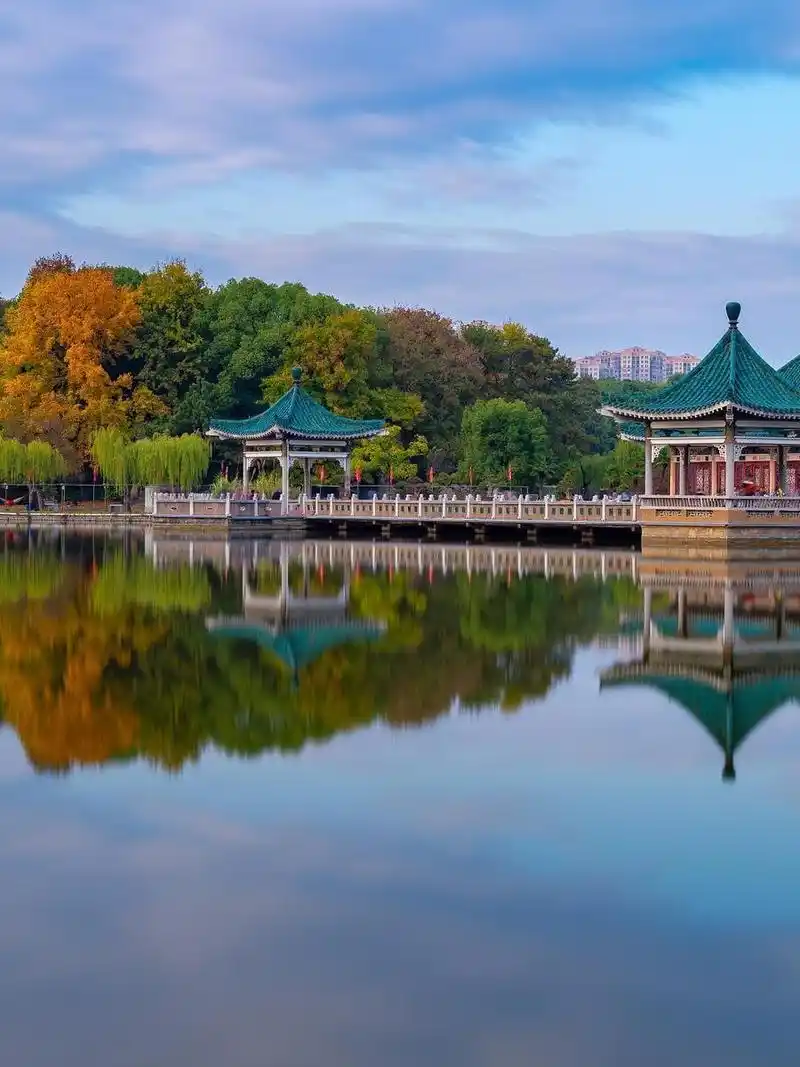 East Lake has a remarkably long pedigree, having formed in 127 AD during the Eastern Han dynasty when the earth subsided to create a natural basin. In world terms, this was the age of the Roman emperor Hadrian — the same period that saw the completion of Hadrian's Wall in northern Britain. Over the centuries the lake gathered waters from nine converging rivers into a layout fancifully called "Nine Dragons Playing with a Pearl," and was anciently known as Danghu or Parrot Lake. A galaxy of literati left verses here, and the legendary "Ten Scenes of East Lake" remain celebrated in regional poetry collections.
The landscaping follows the Jiangnan tradition of romantic, asymmetrical gardens — imagine a softer, more painterly cousin to Versailles, with pavilions, arched bridges, and zigzagging covered walkways deliberately framing borrowed scenery. Winding paths trace the shore, and the lake's four-season moods are vivid: willows trailing in spring, lotus blossoms in summer, layered maples in autumn, and glassy, mist-laden water in winter. Crowning the scene is the seven-story Baoben Pagoda, whose upper galleries reward visitors with panoramic views of both the lake and the surrounding cityscape.
The cultural heart of the park is the Li Shutong Memorial Hall, whose seven-petal lotus form — evoking the Buddhist symbol of purity — has drawn comparisons to modern icons like Sydney's Opera House for its sculptural clarity. Li Shutong (1880–1942), later ordained as the revered monk Master Hong Yi, was a pivotal cultural bridge figure: he studied Western oil painting and Western theatre in Tokyo before returning to China, where he became one of the country's first modern art teachers, composers, and editors, before renouncing worldly life in 1918 to become one of twentieth-century China's most influential Buddhist masters.
Beyond the memorial, the lakeside grounds showcase Pinghu's living heritage, including displays of local calligraphy traditions and the whimsical folk craft of watermelon-carving lanterns, an art unique to this part of Zhejiang. Together with the neighbouring South Hetou historic neighbourhood and the elegant late-Qing Mo Family Manor — sometimes compared to a modest Chinese answer to an English country house — the lake forms the centrepiece of an immersive cultural day trip that reveals the refined, less-touristed side of the Yangtze Delta.
The park is open free of charge from dawn to dusk, year-round. Lakeside cycling and walking are the most popular pastimes, while paddle boats and small tour boats can be hired from around 50 RMB per person. Climbing the Baoben Pagoda requires a small additional ticket of about 10 RMB. Spring (April–May) and autumn (October–November) offer the most comfortable weather for extended exploration, though the lotus blooms of midsummer are an unmissable seasonal spectacle for photographers.
Visit East Lake not for dramatic scale or ancient ruins, but for its quiet, layered charm — a place where an almost two-thousand-year-old body of water, a pagoda, and a modernist lotus memorial share the same reflective horizon, offering Western travellers an intimate window into the literary, artistic, and spiritual currents that shaped classical Jiangnan culture far from the bustle of Shanghai and Hangzhou.
East Lake has a remarkably long pedigree, having formed in 127 AD during the Eastern Han dynasty when the earth subsided to create a natural basin. In world terms, this was the age of the Roman emperor Hadrian — the same period that saw the completion of Hadrian's Wall in northern Britain. Over the centuries the lake gathered waters from nine converging rivers into a layout fancifully called "Nine Dragons Playing with a Pearl," and was anciently known as Danghu or Parrot Lake. A galaxy of literati left verses here, and the legendary "Ten Scenes of East Lake" remain celebrated in regional poetry collections.
The landscaping follows the Jiangnan tradition of romantic, asymmetrical gardens — imagine a softer, more painterly cousin to Versailles, with pavilions, arched bridges, and zigzagging covered walkways deliberately framing borrowed scenery. Winding paths trace the shore, and the lake's four-season moods are vivid: willows trailing in spring, lotus blossoms in summer, layered maples in autumn, and glassy, mist-laden water in winter. Crowning the scene is the seven-story Baoben Pagoda, whose upper galleries reward visitors with panoramic views of both the lake and the surrounding cityscape.
The cultural heart of the park is the Li Shutong Memorial Hall, whose seven-petal lotus form — evoking the Buddhist symbol of purity — has drawn comparisons to modern icons like Sydney's Opera House for its sculptural clarity. Li Shutong (1880–1942), later ordained as the revered monk Master Hong Yi, was a pivotal cultural bridge figure: he studied Western oil painting and Western theatre in Tokyo before returning to China, where he became one of the country's first modern art teachers, composers, and editors, before renouncing worldly life in 1918 to become one of twentieth-century China's most influential Buddhist masters.
Beyond the memorial, the lakeside grounds showcase Pinghu's living heritage, including displays of local calligraphy traditions and the whimsical folk craft of watermelon-carving lanterns, an art unique to this part of Zhejiang. Together with the neighbouring South Hetou historic neighbourhood and the elegant late-Qing Mo Family Manor — sometimes compared to a modest Chinese answer to an English country house — the lake forms the centrepiece of an immersive cultural day trip that reveals the refined, less-touristed side of the Yangtze Delta.
The park is open free of charge from dawn to dusk, year-round. Lakeside cycling and walking are the most popular pastimes, while paddle boats and small tour boats can be hired from around 50 RMB per person. Climbing the Baoben Pagoda requires a small additional ticket of about 10 RMB. Spring (April–May) and autumn (October–November) offer the most comfortable weather for extended exploration, though the lotus blooms of midsummer are an unmissable seasonal spectacle for photographers.
Visit East Lake not for dramatic scale or ancient ruins, but for its quiet, layered charm — a place where an almost two-thousand-year-old body of water, a pagoda, and a modernist lotus memorial share the same reflective horizon, offering Western travellers an intimate window into the literary, artistic, and spiritual currents that shaped classical Jiangnan culture far from the bustle of Shanghai and Hangzhou.