Orchid Pavilion
⭐ 4.70
Lanting Scenic Area, Lanting Town, Shengzhou City, Shaoxing City, Zhejiang Province, China
 **A Setting Steeped in History**
The Orchid Pavilion predates its most famous moment by nearly a millennium, having served as a royal orchid garden for the King of Yue in the Spring and Autumn period. Its modern fame, however, rests on a single spring afternoon in 353 CE, when Wang Xizhi gathered forty-two of the Jin dynasty's leading poets and scholars for the Purification Festival. As wine cups floated down a meandering stream, each guest composed verses before the cup stopped—a ritual akin to a classical Greek symposium, yet fused with the uniquely Chinese arts of poetry and calligraphy. The preface Wang wrote that evening became the "First Running Script Under Heaven," a work that has inspired the same reverence in East Asia that Raphael's Madonnas hold in the West.
**Architecture and Landscape**
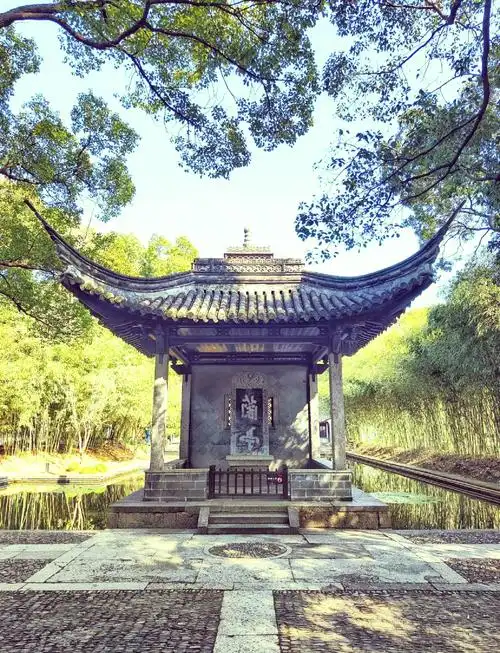
Spread across some 130,000 square meters at the foot of Lantu Mountain, the garden embodies the Jiangnan aesthetic of understated refinement, comparable in spirit to a pastoral English landscape garden or an Italian Renaissance villa, though rooted in distinctly Chinese principles of borrowed scenery and poetic mood. The Imperial Stele Pavilion soars with upturned eaves, while the restrained Song-style lines of Tianzhang Temple offer a meditation in white space and timber. Whitewashed walls and dark tiles dissolve into groves of bamboo and lotus-fringed ponds, creating a hushed atmosphere where every turn reveals another calligraphed stone.
**Cultural Treasures**
The park's monuments read like a who's who of Chinese literary and imperial history. The Imperial Stele Pavilion bears a remarkable palimpsest: Kangxi Emperor's bold "Orchid Pavilion" inscription on the front, paired with his grandson Qianlong's verse on the back—making it China's only "grandfather-grandson stele." Nearby stands the Goose Pool, named for Wang's toddler dabbing in the sand with his father's brush, while the Orchid Pavilion Calligraphy Museum, the country's largest dedicated to the art, displays exquisite replicas of *Lanting Xu* alongside masterworks spanning two millennia.
**Practical Visit Information**
The site is open daily from 8:00 a.m. to 5:20 p.m., with last entry at 4:50 p.m. Admission is 70 yuan for adults, with reduced 35-yuan tickets for students and seniors aged 60–69; those over 70 and local residents enter free. Allow 1.5 to 3 hours for a comfortable visit and wear flat shoes, as the garden involves considerable walking. Drivers should navigate to the East Gate surface parking lot; public-transit travelers can take Shaoxing Metro Line 1 to City Square Station, then transfer to Bus 3 for direct service to the entrance.
**Why Visit and Helpful Tips**
For travelers fascinated by the meeting point of art, history, and landscape, the Orchid Pavilion offers something rare: the chance to stand where one of the world's great artistic achievements was born. Hands-on experiences—stone-rubbing, tracing calligraphic templates, and a charming "floating cup" reenactment—delight families and curious beginners alike, while serious calligraphy devotees can study the museum's deep collection. Visit on the third day of the third lunar month to coincide with the Lanting Calligraphy Festival, though expect larger crowds. Mosquitoes can be brisk in summer, so bring repellent; overcast or rainy days lend poignant poetry to the visit, though they may dim the visibility of outdoor inscriptions.
**A Setting Steeped in History**
The Orchid Pavilion predates its most famous moment by nearly a millennium, having served as a royal orchid garden for the King of Yue in the Spring and Autumn period. Its modern fame, however, rests on a single spring afternoon in 353 CE, when Wang Xizhi gathered forty-two of the Jin dynasty's leading poets and scholars for the Purification Festival. As wine cups floated down a meandering stream, each guest composed verses before the cup stopped—a ritual akin to a classical Greek symposium, yet fused with the uniquely Chinese arts of poetry and calligraphy. The preface Wang wrote that evening became the "First Running Script Under Heaven," a work that has inspired the same reverence in East Asia that Raphael's Madonnas hold in the West.
**Architecture and Landscape**
Spread across some 130,000 square meters at the foot of Lantu Mountain, the garden embodies the Jiangnan aesthetic of understated refinement, comparable in spirit to a pastoral English landscape garden or an Italian Renaissance villa, though rooted in distinctly Chinese principles of borrowed scenery and poetic mood. The Imperial Stele Pavilion soars with upturned eaves, while the restrained Song-style lines of Tianzhang Temple offer a meditation in white space and timber. Whitewashed walls and dark tiles dissolve into groves of bamboo and lotus-fringed ponds, creating a hushed atmosphere where every turn reveals another calligraphed stone.
**Cultural Treasures**
The park's monuments read like a who's who of Chinese literary and imperial history. The Imperial Stele Pavilion bears a remarkable palimpsest: Kangxi Emperor's bold "Orchid Pavilion" inscription on the front, paired with his grandson Qianlong's verse on the back—making it China's only "grandfather-grandson stele." Nearby stands the Goose Pool, named for Wang's toddler dabbing in the sand with his father's brush, while the Orchid Pavilion Calligraphy Museum, the country's largest dedicated to the art, displays exquisite replicas of *Lanting Xu* alongside masterworks spanning two millennia.
**Practical Visit Information**
The site is open daily from 8:00 a.m. to 5:20 p.m., with last entry at 4:50 p.m. Admission is 70 yuan for adults, with reduced 35-yuan tickets for students and seniors aged 60–69; those over 70 and local residents enter free. Allow 1.5 to 3 hours for a comfortable visit and wear flat shoes, as the garden involves considerable walking. Drivers should navigate to the East Gate surface parking lot; public-transit travelers can take Shaoxing Metro Line 1 to City Square Station, then transfer to Bus 3 for direct service to the entrance.
**Why Visit and Helpful Tips**
For travelers fascinated by the meeting point of art, history, and landscape, the Orchid Pavilion offers something rare: the chance to stand where one of the world's great artistic achievements was born. Hands-on experiences—stone-rubbing, tracing calligraphic templates, and a charming "floating cup" reenactment—delight families and curious beginners alike, while serious calligraphy devotees can study the museum's deep collection. Visit on the third day of the third lunar month to coincide with the Lanting Calligraphy Festival, though expect larger crowds. Mosquitoes can be brisk in summer, so bring repellent; overcast or rainy days lend poignant poetry to the visit, though they may dim the visibility of outdoor inscriptions.