Qishan Scenic Area
⭐ 4.20
Qishan Scenic Area, Minhou County, Fuzhou City, Fujian Province, China
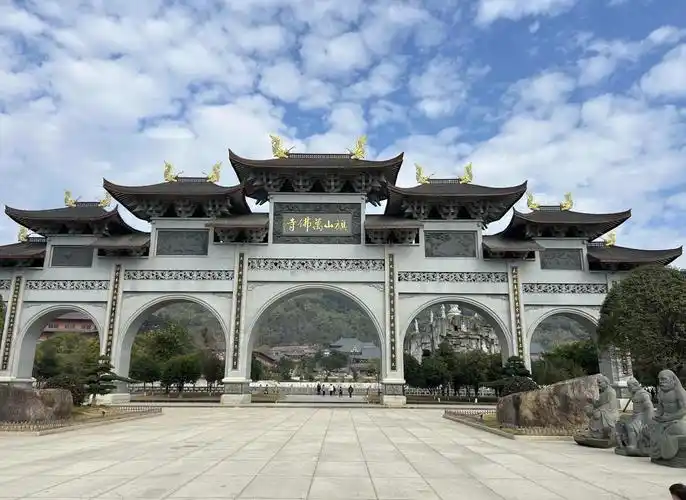 Rising in deliberate opposition to Fuzhou's better-known Drum Mountain (Gushan)—a site sacred since the Han dynasty where Confucian and Buddhist shrines have welcomed pilgrims for nearly two millennia—Flag Mountain completes a landscape pairing that locals have likened to the protective embrace of two guardians. Geographically analogous to the karst highlands of Slovenia's Karst Plateau, though softened by subtropical humidity, Qishan has echoed with Buddhist chants since at least the Song dynasty (960–1279), the same era that produced Europe's great Romanesque cathedrals. Today, its 775-metre summit anchors one of China's most ambitious modern reforestation efforts, a forested expanse larger than Brooklyn's Prospect Park multiplied by twenty.
The park's most arresting features are its karst peak forests—jagged limestone spires reminiscent of Guilin's celebrated scenery but far less frequented by international visitors. A 500-metre wooden boardwalk called "Heaven's Ladder" climbs precipitously through the canopy, while Longtan Canyon thunders with three-tiered waterfalls that rival the cascades of Switzerland's Lauterbrunnen Valley in drama, if not in scale. Spring unleashes rhododendron blooms across the slopes, while autumn paints the broadleaf forests in crimson and gold; after rain, seas of cloud surge between the peaks, an atmospheric phenomenon that draws comparison to the mist-wrapped landscapes of Hokusai's woodblock prints.
Dominating the mountain's cultural landscape, the colossal Wanfo Temple houses thousands of Buddha statues within halls reminiscent in scale and ambition of Thailand's Wat Pho or Myanmar's Shwedagon Pagoda, though conceived in a distinctly Chinese architectural idiom with sweeping tiled roofs and vermilion columns. Pilgrims circumambulate an island dedicated to Guanyin, the Bodhisattva of Compassion, while the mountain's older Song-dynastic Shisong Temple ruins and smaller hermitages such as Chaoshan and Longgu monasteries testify to a continuous thread of devotion winding back a thousand years—longer than many European abbeys have stood.
Practical access is refreshingly straightforward. Most of the forest park, including Wanfo Temple, charges no admission. Drivers should navigate to either the "Qishan National Forest Park South Gate" or the newer "Shuangfeng Village Entrance"; free parking awaits both, and the journey from central Fuzhou takes 40 to 50 minutes via the Xinyang Expressway. Public transport users can take the metro to Jinxiang or Juyuanzhou stations, transfer to Bus 168 toward Nanyu, and complete the trip on foot. Sturdy hiking shoes, bottled water, and insect repellent are essential; visitors should also avoid carrying plastic bags or eating visibly, as wild macaque troops inhabit the slopes and have learned to snatch food from unsuspecting tourists.
Dining options within the park remain limited and relatively expensive, so packing a light picnic is advisable. For those wishing to extend their stay, the adjacent AAAA-rated Qishan Forest Hot Spring Resort offers thermal pools fed by mineral-rich mountain springs—an indulgence comparable in character to Japan's renowned onsen retreats in Hakone. Visitors seeking a gentler itinerary can combine a half-day hike with an afternoon of temple exploration and conclude their journey with a soak, returning to Fuzhou refreshed and bearing memories that connect them to a tradition of mountain pilgrimage far older than most Western landscapes can claim.
Rising in deliberate opposition to Fuzhou's better-known Drum Mountain (Gushan)—a site sacred since the Han dynasty where Confucian and Buddhist shrines have welcomed pilgrims for nearly two millennia—Flag Mountain completes a landscape pairing that locals have likened to the protective embrace of two guardians. Geographically analogous to the karst highlands of Slovenia's Karst Plateau, though softened by subtropical humidity, Qishan has echoed with Buddhist chants since at least the Song dynasty (960–1279), the same era that produced Europe's great Romanesque cathedrals. Today, its 775-metre summit anchors one of China's most ambitious modern reforestation efforts, a forested expanse larger than Brooklyn's Prospect Park multiplied by twenty.
The park's most arresting features are its karst peak forests—jagged limestone spires reminiscent of Guilin's celebrated scenery but far less frequented by international visitors. A 500-metre wooden boardwalk called "Heaven's Ladder" climbs precipitously through the canopy, while Longtan Canyon thunders with three-tiered waterfalls that rival the cascades of Switzerland's Lauterbrunnen Valley in drama, if not in scale. Spring unleashes rhododendron blooms across the slopes, while autumn paints the broadleaf forests in crimson and gold; after rain, seas of cloud surge between the peaks, an atmospheric phenomenon that draws comparison to the mist-wrapped landscapes of Hokusai's woodblock prints.
Dominating the mountain's cultural landscape, the colossal Wanfo Temple houses thousands of Buddha statues within halls reminiscent in scale and ambition of Thailand's Wat Pho or Myanmar's Shwedagon Pagoda, though conceived in a distinctly Chinese architectural idiom with sweeping tiled roofs and vermilion columns. Pilgrims circumambulate an island dedicated to Guanyin, the Bodhisattva of Compassion, while the mountain's older Song-dynastic Shisong Temple ruins and smaller hermitages such as Chaoshan and Longgu monasteries testify to a continuous thread of devotion winding back a thousand years—longer than many European abbeys have stood.
Practical access is refreshingly straightforward. Most of the forest park, including Wanfo Temple, charges no admission. Drivers should navigate to either the "Qishan National Forest Park South Gate" or the newer "Shuangfeng Village Entrance"; free parking awaits both, and the journey from central Fuzhou takes 40 to 50 minutes via the Xinyang Expressway. Public transport users can take the metro to Jinxiang or Juyuanzhou stations, transfer to Bus 168 toward Nanyu, and complete the trip on foot. Sturdy hiking shoes, bottled water, and insect repellent are essential; visitors should also avoid carrying plastic bags or eating visibly, as wild macaque troops inhabit the slopes and have learned to snatch food from unsuspecting tourists.
Dining options within the park remain limited and relatively expensive, so packing a light picnic is advisable. For those wishing to extend their stay, the adjacent AAAA-rated Qishan Forest Hot Spring Resort offers thermal pools fed by mineral-rich mountain springs—an indulgence comparable in character to Japan's renowned onsen retreats in Hakone. Visitors seeking a gentler itinerary can combine a half-day hike with an afternoon of temple exploration and conclude their journey with a soak, returning to Fuzhou refreshed and bearing memories that connect them to a tradition of mountain pilgrimage far older than most Western landscapes can claim.