Three Lanes and Seven Alleys Historical and Cultural Block
⭐ 4.50
Three Lanes and Seven Alleys Historical and Cultural Block Scenic Area, Gulou District, Fuzhou, Fujian, China
 Par**
Fuzhou's Three Lanes and Seven Alleys trace their origins to the Jin dynasty, took shape during the Tang and Five Dynasties period, and reached their golden age in the Ming and Qing. Unlike the grid plans of, say, Renaissance Florence or Bath's Georgian crescents, this neighborhood preserves the much older Chinese "li-fang" ward system, where named lanes and alleys formed self-contained residential quarters behind city walls. Few cities in China retain this layout so completely, and Fuzhou's wooden-and-brick quarter survived the wars of the 20th century largely intact, offering visitors a rare window into how a southern Chinese merchant-scholar city actually looked and functioned over a thousand years.
**Ar**
The architecture here is unmistakably Minnan (Fujianese), distinguished by the sinuous "horse-saddle walls" that rise like frozen waves above rooflines, a regional flourish quite different from the imperial symmetry of Beijing's hutong or the stone severity of Shanxi merchant homes. Inside, expect soaring timber brackets, finely carved stone doorframes, and the cool calm of sky-lit courtyards with covered walkways. Standout sites include the Yan Fu Memorial Hall, the joint home of revolutionary Lin Juemin and beloved modern poet Bing Xin, the elegant Little Yellow Mansion (Xiaohuang Lou), and the enchanting Waterside Theater, a delicate pavilion once used for open-air opera performances.
**Cult**
The street's claim to fame rests on its extraordinary roll call of residents. Lin Zexu, the upright Qing official whose seizure of British opium triggered the 1839 Opium War, lived here, making the neighborhood roughly contemporaneous with figures like Britain's Queen Victoria. The translator Yan Fu introduced Darwin, John Stuart Mill, and Adam Smith to Chinese readers in the late 1800s, an intellectual feat on par with the great European Enlightenment translators. Lin Juemin, an idealistic revolutionary executed at 24, and Bing Xin, the "poet of the stars," round out a cast that justifies the locals' boast that this small quarter contains half the story of modern China.
**Practical**
The public lanes and alleys are free to wander at any hour. Yan Fu's former home and Bing Xin/Lin Juemin's residence are also free, while Yan Fu's home, Xiaohuang Lou, and several other mansions charge 20–48 yuan individually or about 90 yuan for a combined ticket. Most paid sites are closed on Mondays; opening hours are typically 08:30–17:00. Reach the area easily by Fuzhou Metro Lines 1 or 4 to Dongjiekou Station, exits B or D. Plan at least three to four hours, and save energy for the lantern-lit evenings when the atmosphere turns magical.
**F**
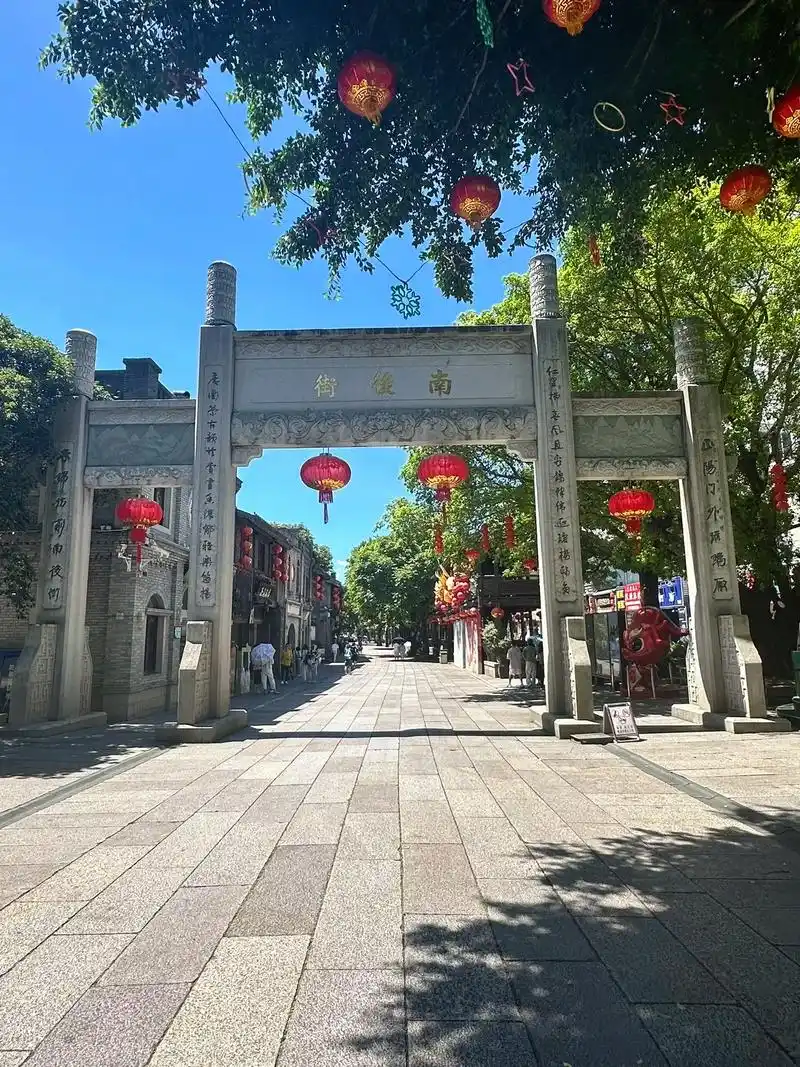
On Nanhou Street, the district's bustling spine, sample Fuzhou classics: the peppery pork-wonton soup at Tongli Rouyan, the bouncy fish balls at Yonghe, and the sweet peanut-and-tar pudding at Meiya Bo. Watch artisans craft Fuzhou's celebrated softwood paintings and lacquerware, two crafts unique to the city. For a fuller day, combine your visit with the lakeside serenity of West Lake Park and the riverside warehouses of Shangxiahang, another restored historical quarter that reveals Fuzhou's forgotten role as a maritime trading port.
**W**
What makes Three Lanes and Seven Alleys special for Western travelers is its refusal to feel like a museum. Children chase cats through flagstone alleys, grandmothers string laundry between curved walls, and tea shops spill onto the cobbles. It offers the depth of a European old town like Prague's Lesser Quarter or Seville's Santa Cruz, but with a distinctly southern Chinese soul, humid, fragrant, and steeped in jasmine, and the rare chance to walk the same stones as some of modern China's most consequential thinkers.
Par**
Fuzhou's Three Lanes and Seven Alleys trace their origins to the Jin dynasty, took shape during the Tang and Five Dynasties period, and reached their golden age in the Ming and Qing. Unlike the grid plans of, say, Renaissance Florence or Bath's Georgian crescents, this neighborhood preserves the much older Chinese "li-fang" ward system, where named lanes and alleys formed self-contained residential quarters behind city walls. Few cities in China retain this layout so completely, and Fuzhou's wooden-and-brick quarter survived the wars of the 20th century largely intact, offering visitors a rare window into how a southern Chinese merchant-scholar city actually looked and functioned over a thousand years.
**Ar**
The architecture here is unmistakably Minnan (Fujianese), distinguished by the sinuous "horse-saddle walls" that rise like frozen waves above rooflines, a regional flourish quite different from the imperial symmetry of Beijing's hutong or the stone severity of Shanxi merchant homes. Inside, expect soaring timber brackets, finely carved stone doorframes, and the cool calm of sky-lit courtyards with covered walkways. Standout sites include the Yan Fu Memorial Hall, the joint home of revolutionary Lin Juemin and beloved modern poet Bing Xin, the elegant Little Yellow Mansion (Xiaohuang Lou), and the enchanting Waterside Theater, a delicate pavilion once used for open-air opera performances.
**Cult**
The street's claim to fame rests on its extraordinary roll call of residents. Lin Zexu, the upright Qing official whose seizure of British opium triggered the 1839 Opium War, lived here, making the neighborhood roughly contemporaneous with figures like Britain's Queen Victoria. The translator Yan Fu introduced Darwin, John Stuart Mill, and Adam Smith to Chinese readers in the late 1800s, an intellectual feat on par with the great European Enlightenment translators. Lin Juemin, an idealistic revolutionary executed at 24, and Bing Xin, the "poet of the stars," round out a cast that justifies the locals' boast that this small quarter contains half the story of modern China.
**Practical**
The public lanes and alleys are free to wander at any hour. Yan Fu's former home and Bing Xin/Lin Juemin's residence are also free, while Yan Fu's home, Xiaohuang Lou, and several other mansions charge 20–48 yuan individually or about 90 yuan for a combined ticket. Most paid sites are closed on Mondays; opening hours are typically 08:30–17:00. Reach the area easily by Fuzhou Metro Lines 1 or 4 to Dongjiekou Station, exits B or D. Plan at least three to four hours, and save energy for the lantern-lit evenings when the atmosphere turns magical.
**F**
On Nanhou Street, the district's bustling spine, sample Fuzhou classics: the peppery pork-wonton soup at Tongli Rouyan, the bouncy fish balls at Yonghe, and the sweet peanut-and-tar pudding at Meiya Bo. Watch artisans craft Fuzhou's celebrated softwood paintings and lacquerware, two crafts unique to the city. For a fuller day, combine your visit with the lakeside serenity of West Lake Park and the riverside warehouses of Shangxiahang, another restored historical quarter that reveals Fuzhou's forgotten role as a maritime trading port.
**W**
What makes Three Lanes and Seven Alleys special for Western travelers is its refusal to feel like a museum. Children chase cats through flagstone alleys, grandmothers string laundry between curved walls, and tea shops spill onto the cobbles. It offers the depth of a European old town like Prague's Lesser Quarter or Seville's Santa Cruz, but with a distinctly southern Chinese soul, humid, fragrant, and steeped in jasmine, and the rare chance to walk the same stones as some of modern China's most consequential thinkers.