Foshan Lingnan Tiandi
⭐ 4.70
No. 21, Zumiao Road, Chancheng District, Foshan City, Guangdong Province, China
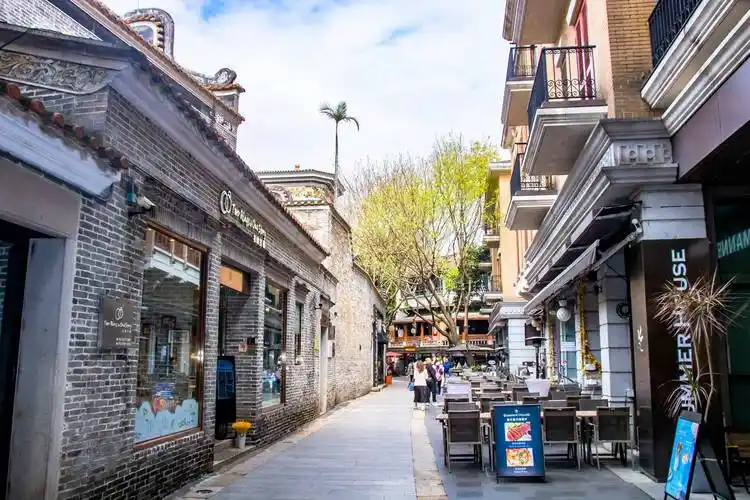 The district traces its origins to the Donghua Li neighborhood, established during the Song Dynasty—making the quarter nearly nine centuries old and contemporary with the Norman Conquest of England or the founding of Bruges. When city planners renovated the area in the 2000s, they followed a "repair as old" philosophy, preserving the Qing-dynasty street grid and traditional lane patterns rather than gentrifying them beyond recognition. Today the project stands as a national benchmark for adaptive heritage reuse in China and a key protected cultural site. For Western visitors, the experience compares to strolling through Seville's Santa Cruz quarter or Bologna's medieval heart.
The visual signature is unmistakable Lingnan architecture. Wok-ear walls—curved gables resembling traditional cooking vessels—rise in rhythmic undulations, casting shadows that recall the tiled rooflines of southern Portugal or the curved gables along Amsterdam's canals. Beneath them, blue-grey brickwork meets Western-influenced arched colonnades, while colorful Manchu windows filter sunlight into jewel-like patterns. Highlights include the Jian family mansion, an elegant early-20th-century residence blending Chinese and European styles much like Shanghai's former French Concession, and the Longtang Poetry Society, a Qing-era gathering place preserving the intimate scale of traditional literati culture.
Culture saturates every corner. Performers stage regular Cantonese opera and lion dance demonstrations—two intangible heritage traditions that define Guangdong identity. The Zhongshuge bookstore chain has opened a branch with a mirrored dome that reflects the surrounding wok-ear walls, creating one of the most photographed interiors in the Pearl River Delta. Weekend handicraft markets and pop-up design events keep the atmosphere fresh. In recognition of its cultural and economic vitality, the district was designated a national nighttime cultural tourism zone, with specially designed lighting that transforms the lanes after dark into an atmospheric wonderland.
The district is open free of charge around the clock, though individual shops typically operate from 10am to 10pm. Allow three to four hours to explore at a relaxed pace. The most convenient access is via the Guangfo Metro line to Zumiao Station, Exit C, followed by a five-minute walk. Bus routes serve the area extensively, and parking is available for drivers. Right next door, the historic Zumiao Museum—a Confucian temple complex dating to the Ming and Qing dynasties—charges around 20 yuan and pairs naturally with a visit. Weekday mornings or early evenings offer the most comfortable crowd levels.
Food alone justifies the trip. Long-established brands like Minxin, famed for silky double-skin milk pudding, sit alongside Huiji's rich black sesame soup and the celebrated Tai Gen Bao, known for a velvety congee made from strained rice water. Modern cafes and creative restaurants round out the dining options. As dusk falls, building facades glow and the clock-tower square fills with strollers and live music from the bar lanes—a scene that rivals an Italian evening passeggiata. Foshan's Lingnan Tiandi delivers heritage, cuisine, and nightlife in one walkable, photogenic package.
The district traces its origins to the Donghua Li neighborhood, established during the Song Dynasty—making the quarter nearly nine centuries old and contemporary with the Norman Conquest of England or the founding of Bruges. When city planners renovated the area in the 2000s, they followed a "repair as old" philosophy, preserving the Qing-dynasty street grid and traditional lane patterns rather than gentrifying them beyond recognition. Today the project stands as a national benchmark for adaptive heritage reuse in China and a key protected cultural site. For Western visitors, the experience compares to strolling through Seville's Santa Cruz quarter or Bologna's medieval heart.
The visual signature is unmistakable Lingnan architecture. Wok-ear walls—curved gables resembling traditional cooking vessels—rise in rhythmic undulations, casting shadows that recall the tiled rooflines of southern Portugal or the curved gables along Amsterdam's canals. Beneath them, blue-grey brickwork meets Western-influenced arched colonnades, while colorful Manchu windows filter sunlight into jewel-like patterns. Highlights include the Jian family mansion, an elegant early-20th-century residence blending Chinese and European styles much like Shanghai's former French Concession, and the Longtang Poetry Society, a Qing-era gathering place preserving the intimate scale of traditional literati culture.
Culture saturates every corner. Performers stage regular Cantonese opera and lion dance demonstrations—two intangible heritage traditions that define Guangdong identity. The Zhongshuge bookstore chain has opened a branch with a mirrored dome that reflects the surrounding wok-ear walls, creating one of the most photographed interiors in the Pearl River Delta. Weekend handicraft markets and pop-up design events keep the atmosphere fresh. In recognition of its cultural and economic vitality, the district was designated a national nighttime cultural tourism zone, with specially designed lighting that transforms the lanes after dark into an atmospheric wonderland.
The district is open free of charge around the clock, though individual shops typically operate from 10am to 10pm. Allow three to four hours to explore at a relaxed pace. The most convenient access is via the Guangfo Metro line to Zumiao Station, Exit C, followed by a five-minute walk. Bus routes serve the area extensively, and parking is available for drivers. Right next door, the historic Zumiao Museum—a Confucian temple complex dating to the Ming and Qing dynasties—charges around 20 yuan and pairs naturally with a visit. Weekday mornings or early evenings offer the most comfortable crowd levels.
Food alone justifies the trip. Long-established brands like Minxin, famed for silky double-skin milk pudding, sit alongside Huiji's rich black sesame soup and the celebrated Tai Gen Bao, known for a velvety congee made from strained rice water. Modern cafes and creative restaurants round out the dining options. As dusk falls, building facades glow and the clock-tower square fills with strollers and live music from the bar lanes—a scene that rivals an Italian evening passeggiata. Foshan's Lingnan Tiandi delivers heritage, cuisine, and nightlife in one walkable, photogenic package.