Shijiazhuang Liberation Memorial Hall
⭐ 4.60
No. 29, Jiefang Road, Qiaoxi District, Shijiazhuang City, Hebei Province, China
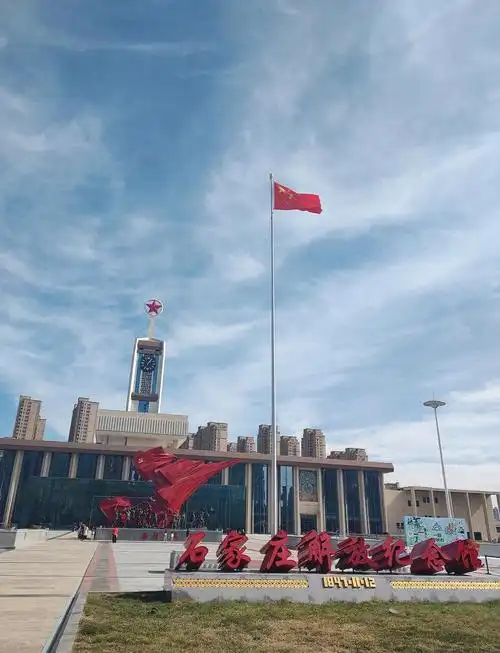 Shijiazhuang's capture in November 1947 marked a watershed of the Chinese Civil War: the first time Communist forces had stormed and held a major modern city, earning it the proud title "First City of Liberation." Military historians often draw a parallel to the fall of Berlin or Paris in 1944—though here the victory opened the route south across the Great Wall and precipitated the Yangtze campaigns of 1949. The museum traces this arc, but also contextualizes Shijiazhuang's earlier identity as an upstart railway town of the 1900s, when French and Belgian engineers built the Zhengding-Taiyuan line through what had been a quiet Hebei farming settlement.
The building itself is the second exhibit. The Zhengtai Hotel, opened in 1907 to serve travelers on that same railway, is one of Shijiazhuang's last surviving examples of the Sino-European railway-hotel tradition—loosely comparable to London's St Pancras or Lisbon's Rossio quarter. Curators have deliberately preserved the weathered brick facades and original spatial rhythm, while threading modern circulation, a soaring V-shaped entrance hall, a Taihang Mountain relief and a five-pointed star chandelier through the historic structure, much as Hamburg has done with its Speicherstadt or Berlin with the Hamburger Bahnhof.
Inside, the second gallery is the emotional centerpiece: a 1:1 sound-and-light reconstruction of the street-by-street combat of 1947, complete with a crawl-through mock underground trench. For visitors used to the audio-guide formality of European national museums, the mix of immersive theater and traditional cabinet displays comes as a surprisingly engaging blend—a style now also familiar to those who have toured Warsaw's Uprising Museum or London's Churchill War Rooms.
Admission is free, but advance reservation is mandatory via the WeChat account "石家庄解放纪念馆" (or a QR-code alternative at the door); bring the ID used to book. Opening hours are Tuesday–Sunday, 09:00–17:00, last entry at 16:30; closed Mondays. The site sits on Zhongshan West Road, Jiefang Square, in Qiaoxi District, directly outside Exit B of Jiefang Square Station on Metro Line 1—parking is severely limited, so public transit is strongly recommended.
Allow roughly 90 to 120 minutes and follow the suggested route: entrance hall, then galleries one through three in order, ending at the souvenir stamp station near the exit—a free commemorative seal is offered for visitors' own notebooks. Free Mandarin guided tours depart at set times, with audio guides available in some sections. Smart-casual attire is appropriate; personal photography is permitted, but flash and tripods are prohibited.
For travelers tracing modern China beyond Beijing's Great Wall and Shanghai's waterfront, this memorial offers something rare: an unsentimental, well-crafted museum in a second-tier capital, where a 78-year-old liberation story is told through the very walls that witnessed it—an accessible, half-day detour that rewards both history buffs and the casually curious.
Shijiazhuang's capture in November 1947 marked a watershed of the Chinese Civil War: the first time Communist forces had stormed and held a major modern city, earning it the proud title "First City of Liberation." Military historians often draw a parallel to the fall of Berlin or Paris in 1944—though here the victory opened the route south across the Great Wall and precipitated the Yangtze campaigns of 1949. The museum traces this arc, but also contextualizes Shijiazhuang's earlier identity as an upstart railway town of the 1900s, when French and Belgian engineers built the Zhengding-Taiyuan line through what had been a quiet Hebei farming settlement.
The building itself is the second exhibit. The Zhengtai Hotel, opened in 1907 to serve travelers on that same railway, is one of Shijiazhuang's last surviving examples of the Sino-European railway-hotel tradition—loosely comparable to London's St Pancras or Lisbon's Rossio quarter. Curators have deliberately preserved the weathered brick facades and original spatial rhythm, while threading modern circulation, a soaring V-shaped entrance hall, a Taihang Mountain relief and a five-pointed star chandelier through the historic structure, much as Hamburg has done with its Speicherstadt or Berlin with the Hamburger Bahnhof.
Inside, the second gallery is the emotional centerpiece: a 1:1 sound-and-light reconstruction of the street-by-street combat of 1947, complete with a crawl-through mock underground trench. For visitors used to the audio-guide formality of European national museums, the mix of immersive theater and traditional cabinet displays comes as a surprisingly engaging blend—a style now also familiar to those who have toured Warsaw's Uprising Museum or London's Churchill War Rooms.
Admission is free, but advance reservation is mandatory via the WeChat account "石家庄解放纪念馆" (or a QR-code alternative at the door); bring the ID used to book. Opening hours are Tuesday–Sunday, 09:00–17:00, last entry at 16:30; closed Mondays. The site sits on Zhongshan West Road, Jiefang Square, in Qiaoxi District, directly outside Exit B of Jiefang Square Station on Metro Line 1—parking is severely limited, so public transit is strongly recommended.
Allow roughly 90 to 120 minutes and follow the suggested route: entrance hall, then galleries one through three in order, ending at the souvenir stamp station near the exit—a free commemorative seal is offered for visitors' own notebooks. Free Mandarin guided tours depart at set times, with audio guides available in some sections. Smart-casual attire is appropriate; personal photography is permitted, but flash and tripods are prohibited.
For travelers tracing modern China beyond Beijing's Great Wall and Shanghai's waterfront, this memorial offers something rare: an unsentimental, well-crafted museum in a second-tier capital, where a 78-year-old liberation story is told through the very walls that witnessed it—an accessible, half-day detour that rewards both history buffs and the casually curious.