Zhaozhou Bridge
⭐ 3.80
Zhaozhou Bridge Scenic Area, Zhao County, Shijiazhuang City, Hebei Province, China
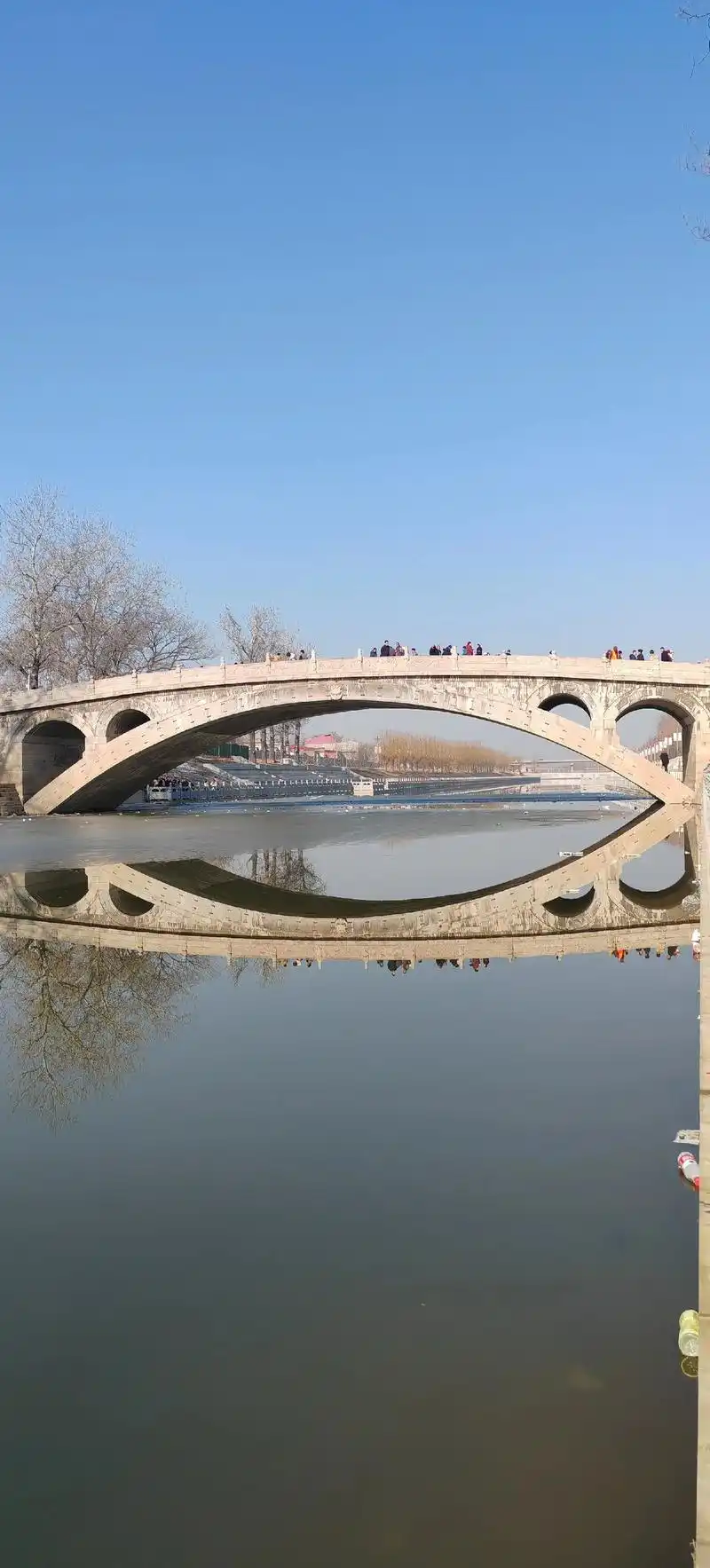 Built between 595 and 605 CE under the short-lived but remarkably progressive Sui Dynasty—the same era that saw the completion of the Grand Canal—the Zhaozhou Bridge was conceived by Li Chun, a craftsman whose name alone survives in the historical record, a testament to his achievement. At a time when most of Europe was constructing simple stone beam bridges, Li Chun was designing a segmental arch that reduced the rise-to-span ratio to roughly 1:5, a structurally efficient form not seen in Western engineering until the Renaissance. The American Society of Civil Engineers recognized this significance in 1991, designating it an International Historic Civil Engineering Landmark alongside such icons as the Eiffel Tower and the Panama Canal.
The bridge's true genius lies in its revolutionary "open spandrel" design. Rather than filling the spandrels (the spaces between the arch and the road deck) with solid masonry, Li Chun pierced each end of the main arch with four smaller arches, creating a lighter structure that reduced material by an estimated 15 percent and allowed floodwaters to pass through during the rainy season. This innovation would not appear in Europe until the 14th century, making the Zhaozhou Bridge a startling 1,200 years ahead of comparable Western designs. The single span of 37.02 meters held the world record for stone arch bridges for centuries.
A walk across the 64.4-meter-long bridge reveals 58 intricately carved dragons writhing along the railings and balustrades, executed in bold Sui-Dynasty style. These creatures, along with the asymmetrical profile of the arch (slightly shallower on one end to accommodate the riverbank), are precisely calibrated works of engineering disguised as art. Local legend holds that the legendary carpenter Lu Ban tested the bridge by riding across it with the immortal Zhang Guolao, a story that helped secure its place in Chinese primary-school literature and, more recently, on commemorative postage stamps.
The site is now a national AAAA-level scenic area with free admission, open daily from 8:30 to 17:30. Visitors must reserve in advance through the "China Zhaozhou Bridge" mini-program and present a valid ID. On-site amenities include the Ancient Bridge Exhibition Hall with AR demonstrations of the original construction, a stele forest, and a visitor center offering both human-guided tours (around 50 yuan) and intelligent audio guides—booking ahead is recommended. Allow roughly 2.5 hours for the full circuit, which begins at the Li Chun statue plaza and ends with a panoramic photo from the opposite riverbank.
Reaching the bridge requires some planning: it sits about 42 kilometers south of Shijiazhuang, best reached by car or ride-hailing service, with the journey taking around one hour. Summer visitors should prepare for heat and sudden thunderstorms, while the surrounding park is most photogenic in the soft morning light. Those with extra time can walk ten minutes south to the serene Bailin Chan Temple, a Buddhist sanctuary founded in the Han Dynasty, or combine the visit with the smaller but stylistically related Yongtong Bridge, often called the "Little Zhaozhou Bridge," and the elegant Tang-era Duoluoni Sutra Pillar in town.
What truly sets a visit apart is the sense of standing on ground where engineers, emperors, merchants, and monks have crossed for fourteen centuries. While European travelers will recognize the kinship with Roman aqueducts such as the Pont du Gard or medieval bridges in Florence and Avignon, the Zhaozhou Bridge offers something rarer: a chance to see structural engineering of the highest order executed in a living, breathing landscape. Pair the technical pilgrimage with a local lunch of donkey meat flatbread (lǚròu huǒshāo) and freshly pressed snow pear juice, and you have a half-day that lingers long in memory.
Built between 595 and 605 CE under the short-lived but remarkably progressive Sui Dynasty—the same era that saw the completion of the Grand Canal—the Zhaozhou Bridge was conceived by Li Chun, a craftsman whose name alone survives in the historical record, a testament to his achievement. At a time when most of Europe was constructing simple stone beam bridges, Li Chun was designing a segmental arch that reduced the rise-to-span ratio to roughly 1:5, a structurally efficient form not seen in Western engineering until the Renaissance. The American Society of Civil Engineers recognized this significance in 1991, designating it an International Historic Civil Engineering Landmark alongside such icons as the Eiffel Tower and the Panama Canal.
The bridge's true genius lies in its revolutionary "open spandrel" design. Rather than filling the spandrels (the spaces between the arch and the road deck) with solid masonry, Li Chun pierced each end of the main arch with four smaller arches, creating a lighter structure that reduced material by an estimated 15 percent and allowed floodwaters to pass through during the rainy season. This innovation would not appear in Europe until the 14th century, making the Zhaozhou Bridge a startling 1,200 years ahead of comparable Western designs. The single span of 37.02 meters held the world record for stone arch bridges for centuries.
A walk across the 64.4-meter-long bridge reveals 58 intricately carved dragons writhing along the railings and balustrades, executed in bold Sui-Dynasty style. These creatures, along with the asymmetrical profile of the arch (slightly shallower on one end to accommodate the riverbank), are precisely calibrated works of engineering disguised as art. Local legend holds that the legendary carpenter Lu Ban tested the bridge by riding across it with the immortal Zhang Guolao, a story that helped secure its place in Chinese primary-school literature and, more recently, on commemorative postage stamps.
The site is now a national AAAA-level scenic area with free admission, open daily from 8:30 to 17:30. Visitors must reserve in advance through the "China Zhaozhou Bridge" mini-program and present a valid ID. On-site amenities include the Ancient Bridge Exhibition Hall with AR demonstrations of the original construction, a stele forest, and a visitor center offering both human-guided tours (around 50 yuan) and intelligent audio guides—booking ahead is recommended. Allow roughly 2.5 hours for the full circuit, which begins at the Li Chun statue plaza and ends with a panoramic photo from the opposite riverbank.
Reaching the bridge requires some planning: it sits about 42 kilometers south of Shijiazhuang, best reached by car or ride-hailing service, with the journey taking around one hour. Summer visitors should prepare for heat and sudden thunderstorms, while the surrounding park is most photogenic in the soft morning light. Those with extra time can walk ten minutes south to the serene Bailin Chan Temple, a Buddhist sanctuary founded in the Han Dynasty, or combine the visit with the smaller but stylistically related Yongtong Bridge, often called the "Little Zhaozhou Bridge," and the elegant Tang-era Duoluoni Sutra Pillar in town.
What truly sets a visit apart is the sense of standing on ground where engineers, emperors, merchants, and monks have crossed for fourteen centuries. While European travelers will recognize the kinship with Roman aqueducts such as the Pont du Gard or medieval bridges in Florence and Avignon, the Zhaozhou Bridge offers something rarer: a chance to see structural engineering of the highest order executed in a living, breathing landscape. Pair the technical pilgrimage with a local lunch of donkey meat flatbread (lǚròu huǒshāo) and freshly pressed snow pear juice, and you have a half-day that lingers long in memory.