Huang Feihong Memorial Hall
⭐ 4.00
No. 15, Zumiao Road, Chancheng District, Foshan City, Guangdong Province, China
 Huang Feihong (1857-1925) lived through China's turbulent late Qing era—an age of Opium Wars, Taiping Rebellion, and the dynasty's final collapse in 1912. Like Robin Hood in English legend or Zorro in Spanish California lore, he became a folk hero whose reputation for fighting injustice and healing the sick grew to near-mythic status. A genuine historical figure, he mastered Hung Ga kung fu and ran Bao Zhilin (Treasure Herb Garden), a charitable clinic treating the poor. Over 100 films starring Jet Li, Jackie Chan, and others have immortalized his legend; the memorial carefully separates fact from cinematic fantasy.
The memorial showcases classical Lingnan wok-ear architecture, whose distinctive curved gable walls resemble cooking pots—a style unique to Guangdong and rarely seen outside southern China. Comparable in sweeping silhouette to Kyoto temple rooflines or Bavarian baroque gables, the two-story structure spans roughly 5,000 square meters of grey brick and dark tile. Its central courtyard follows the traditional "four waters returning to the hall" principle, channeling rainwater inward as both practical drainage and symbolic prosperity. Integrated into the larger Zumiao complex, it harmonizes beautifully with the neighboring 900-year-old Ancestral Temple.
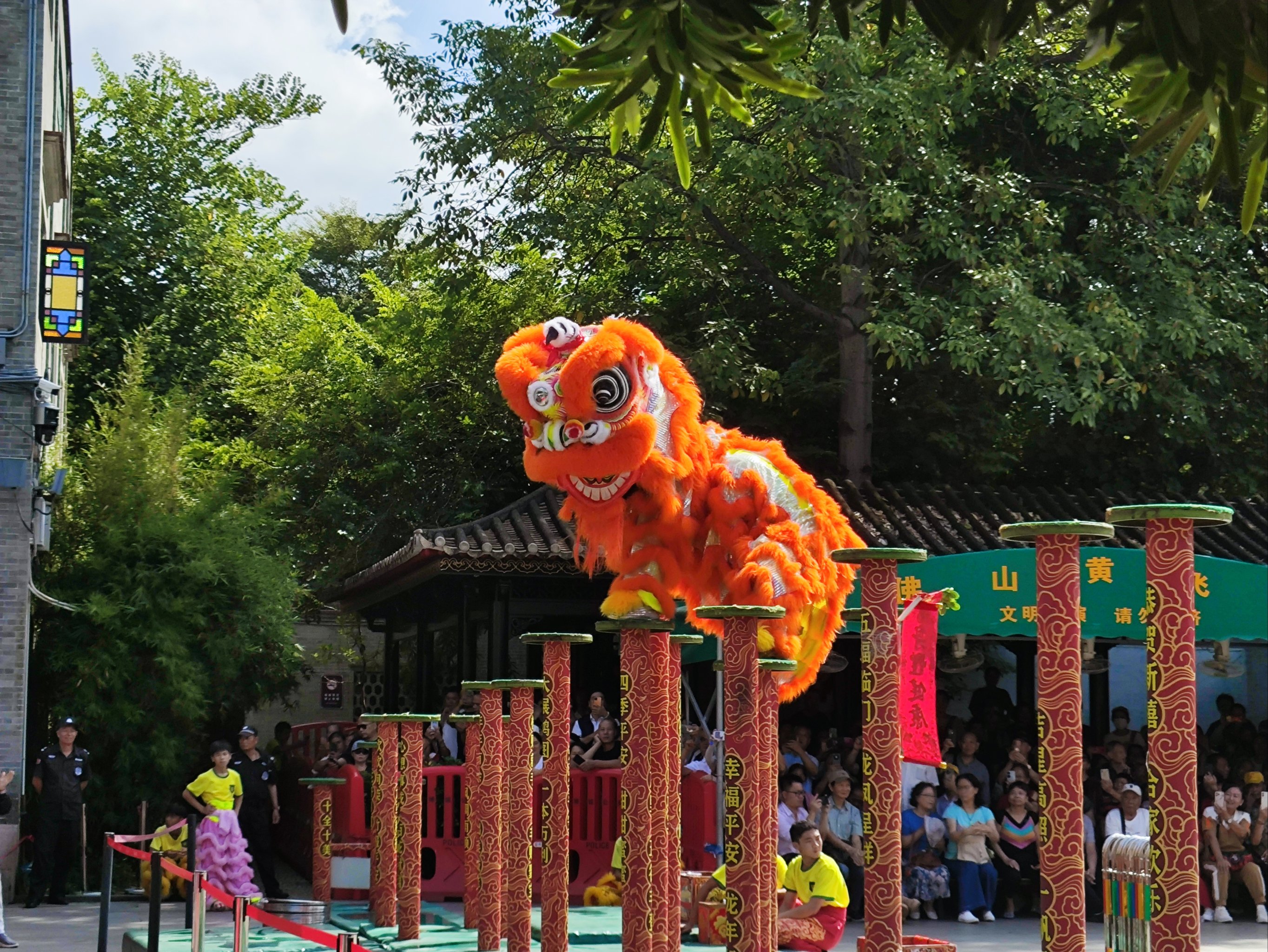
The memorial celebrates three intertwined Lingnan intangible heritages: martial arts, traditional Chinese bone-setting medicine, and southern lion dance. Recreated scenes from Huang's clinic allow visitors to visualize how he treated impoverished patients, while a film corridor showcases how Hong Kong cinema transformed his image. The thunderous southern lion dances—where acrobatic costumed lions leap for "lettuce" suspended high above—blend folk ritual with athletic spectacle, rivaling Spanish bull-leaping or Scottish Highland games in dramatic intensity. Together they reveal how combat prowess, healing arts, and folk performance remain woven into Lingnan identity.
Located at 21 Zumiao Road in central Foshan, the memorial lies inside the larger Zumiao Museum, easily reached via the Guangzhou-Foshan Metro's Zumiao Station (Exit A, two-minute walk). No separate ticket is needed—entry comes with the Ancestral Temple ticket (about 20 RMB for adults, half-price for students). The site opens daily from 8:30 AM to 6:00 PM, though outdoor performances may cancel during heavy rain or extreme heat. Parking is limited in the old town, so public transit is strongly recommended.
To catch the daily lion dance and Hung Ga demonstrations—typically at 10:00-10:40 AM, 2:15-2:55 PM, and 3:30-4:10 PM—arrive 20 minutes early to secure a good viewing spot near the courtyard. The static exhibits require only 30-45 minutes, but with performances, budget 1.5-2 hours total. Don't confuse this site with the free martial arts hall at nearby Xiqiao Mountain, which focuses on tracing Huang Feihong's hometown roots; the Foshan memorial offers the richer biographical and cinematic experience. For kung fu enthusiasts, it is the definitive pilgrimage destination.
Huang Feihong (1857-1925) lived through China's turbulent late Qing era—an age of Opium Wars, Taiping Rebellion, and the dynasty's final collapse in 1912. Like Robin Hood in English legend or Zorro in Spanish California lore, he became a folk hero whose reputation for fighting injustice and healing the sick grew to near-mythic status. A genuine historical figure, he mastered Hung Ga kung fu and ran Bao Zhilin (Treasure Herb Garden), a charitable clinic treating the poor. Over 100 films starring Jet Li, Jackie Chan, and others have immortalized his legend; the memorial carefully separates fact from cinematic fantasy.
The memorial showcases classical Lingnan wok-ear architecture, whose distinctive curved gable walls resemble cooking pots—a style unique to Guangdong and rarely seen outside southern China. Comparable in sweeping silhouette to Kyoto temple rooflines or Bavarian baroque gables, the two-story structure spans roughly 5,000 square meters of grey brick and dark tile. Its central courtyard follows the traditional "four waters returning to the hall" principle, channeling rainwater inward as both practical drainage and symbolic prosperity. Integrated into the larger Zumiao complex, it harmonizes beautifully with the neighboring 900-year-old Ancestral Temple.
The memorial celebrates three intertwined Lingnan intangible heritages: martial arts, traditional Chinese bone-setting medicine, and southern lion dance. Recreated scenes from Huang's clinic allow visitors to visualize how he treated impoverished patients, while a film corridor showcases how Hong Kong cinema transformed his image. The thunderous southern lion dances—where acrobatic costumed lions leap for "lettuce" suspended high above—blend folk ritual with athletic spectacle, rivaling Spanish bull-leaping or Scottish Highland games in dramatic intensity. Together they reveal how combat prowess, healing arts, and folk performance remain woven into Lingnan identity.
Located at 21 Zumiao Road in central Foshan, the memorial lies inside the larger Zumiao Museum, easily reached via the Guangzhou-Foshan Metro's Zumiao Station (Exit A, two-minute walk). No separate ticket is needed—entry comes with the Ancestral Temple ticket (about 20 RMB for adults, half-price for students). The site opens daily from 8:30 AM to 6:00 PM, though outdoor performances may cancel during heavy rain or extreme heat. Parking is limited in the old town, so public transit is strongly recommended.
To catch the daily lion dance and Hung Ga demonstrations—typically at 10:00-10:40 AM, 2:15-2:55 PM, and 3:30-4:10 PM—arrive 20 minutes early to secure a good viewing spot near the courtyard. The static exhibits require only 30-45 minutes, but with performances, budget 1.5-2 hours total. Don't confuse this site with the free martial arts hall at nearby Xiqiao Mountain, which focuses on tracing Huang Feihong's hometown roots; the Foshan memorial offers the richer biographical and cinematic experience. For kung fu enthusiasts, it is the definitive pilgrimage destination.