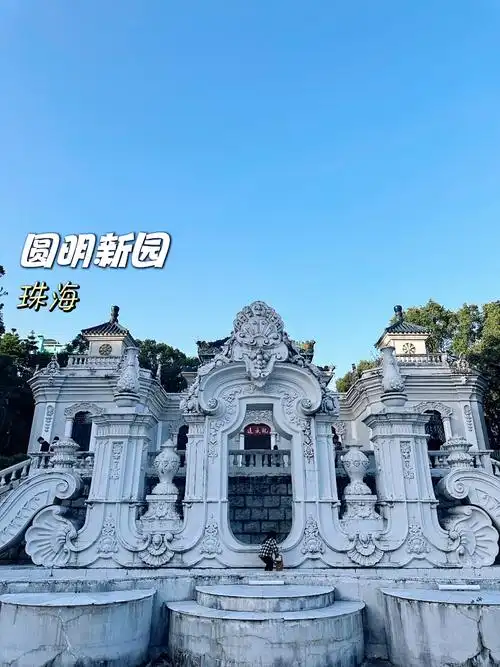
Completed in 1997, Yuanming Xinyuan was conceived as a faithful homage to the original Yuanmingyuan in Beijing, the "Garden of Gardens" once hailed by eighteenth-century European visitors as China's Versailles. The original palace was sacked and burned by Anglo-French forces in 1860 during the Second Opium War, an act that remains a defining wound in modern Chinese memory. While this Zhuhai version is a recreation rather than a historical ruin, its ambitious scale and craftsmanship offer visitors a vivid window into the splendor of the Qing imperial world at its zenith.
The park unfolds along a grand north-south axis, beginning with the imposing Dagongmen gate and progressing through the ceremonial halls of Zhengda Guangming and Jiuzhou Qingyan. These throne rooms echo the solemn grandeur of Beijing's Forbidden City, while their ornate rooflines and vermilion columns reflect the architectural refinement of the Kangxi and Qianlong eras. Around Fuhai Lake, delicate Jiangnan-style pavilions, zigzag bridges, and lotus-lined shores evoke the poetic landscapes of Suzhou's classical gardens, earning comparisons to the water vistas of Tivoli or Schönbrunn.
The Western-style Palaces section provides the park's most photographed highlights. Dazzling baroque fountains, carved stone columns, and geometric façades reproduce the European structures originally designed by Jesuit architects Giuseppe Castiglione and Michel Benoist in the mid-1700s. The famous Dashuifa (Great Water Clock Fountain) and Haiyantang (Hall of Calm Seas) recall the chinoiserie fantasies of European royal gardens, blending French rococo ambition with Qing imperial taste in a uniquely cross-cultural masterpiece.
Beyond its architectural appeal, the park serves as a poignant cultural memorial. The Twelve Zodiac Animal Fountain, each bronze head representing a different hour of the day, is a powerful symbol of China's ongoing campaign to recover artworks looted in 1860. Visiting here invites reflection not only on imperial aesthetics but also on the turbulent history of East-West encounters, colonialism, and cultural heritage, themes that resonate strongly with travelers interested in world history.
Practical information makes a visit straightforward. The main entrance at 164 Lanpu Road is free and requires no reservation, with daily opening from 9:00 AM to 5:30 PM, extended to 9:00 PM on Fridays and Saturdays. Boats, electric carts, and some performances are ticketed separately. The site is easily reached by public bus routes 1, 13, and 20, and on-site parking is available. Visitors should wear comfortable shoes, bring sun protection and water in summer, and note that on-site dining options are limited. A counter-clockwise loop from Fuhai Lake through Haiyantang to Dashuifa takes roughly two to three hours, ideally ending with the illuminated evening fountain show.
Beyond its visual splendor, Yuanming Xinyuan offers something rare: the chance to experience a vanished imperial world without the crowds of Beijing. For Western travelers curious about China's last great dynasty, the meeting of East and West in eighteenth-century court culture, or simply seeking an unhurried afternoon amid lakes, palaces, and gardens, this Zhuhai treasure delivers an experience that feels both grand and surprisingly intimate.