Zhuhai Grand Theatre
⭐ 4.60
No. 2, Lovers' Middle Road, Xiangzhou District, Zhuhai City, Guangdong Province, China
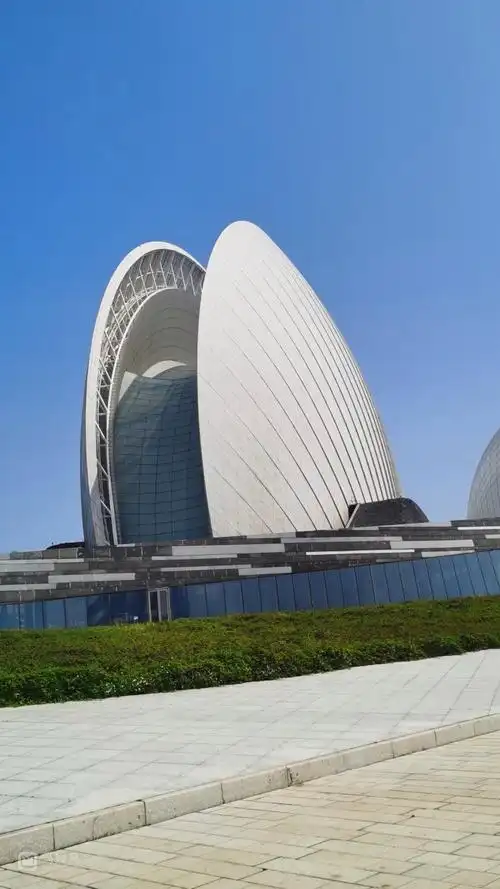 The Zhuhai Grand Theatre began as a flagship cultural project for the western flank of the Pearl River Delta, breaking ground in 2010 and opening its doors in 2018. The complex was designed under the direction of Yu Kongjian, dean of Peking University's School of Architecture and Landscape Design, who set out to create a landmark worthy of Zhuhai's growing status within the Greater Bay Area. Much as the Sydney Opera House transformed Sydney Harbour from a working port into a global cultural icon, this theater signals Zhuhai's ambition to be recognized not merely as a coastal resort town but as a serious cultural destination linking Hong Kong, Macau, and the mainland.
Two interlocking shell-shaped domes form the building's signature silhouette: the larger "Sun Shell" rises 90 meters while the smaller "Moon Shell" stands at 60. Clad in white perforated aluminum panels and glass curtain walls, the structures appear almost translucent during the day and shimmer with programmable LED lighting after dark. The design pays homage to Botticelli's "Birth of Venus," with the curved forms echoing seashells washed ashore. Spanning roughly 59,000 square meters, the complex is one of the few major theaters worldwide to fuse marine imagery with cutting-edge engineering—a marriage of organic form and industrial precision rarely seen outside Oslo's Opera House or Bilbao's Guggenheim.
Since opening, the theater has staged more than 120 performances annually, including opera, musical theater, symphony concerts, and ballet, attracting leading international touring companies alongside Chinese national troupes. Beyond ticketed events, the surrounding public plazas and walkways function as a civic living room where locals practice tai chi, jog along the seaside promenade, and gather at sunset. This dual role—prestigious performance venue and everyday public space—mirrors the function of ancient Greek amphitheaters, where art and community life were inseparable. For a relatively young city, the venue has rapidly become a symbol of urban sophistication and a key stop on the cultural map of southern China.
The outdoor spaces—including Yeli Island plaza and the 3-kilometer ring walkway circling the island—are open to the public free of charge around the clock. To attend a performance inside, tickets must be purchased with a real-name ID and average around 220 RMB, with frequent discount tickets available for students and residents. The venue is reached by city buses L1, L3, 9, and 99, which all stop nearby; drivers can park at the Mingting Park entrance lot. The official WeChat account and website are the most reliable sources for current programming. On-site food options are limited, so eating beforehand is recommended.
For first-time visitors, the prime window is between 4 and 9 PM, when daylight, sunset, and the theater's after-dark illumination can all be experienced in a single visit. The viewing terrace at the adjacent Haoyun City shopping mall offers the most dramatic upward angle of the twin shells. Walking the island's perimeter path rewards travelers with a distant silhouette of the Hong Kong-Zhuhai-Macau Bridge, one of the world's longest sea crossings, linking three of China's most dynamic regions. Whether attending an opera, photographing the futuristic domes, or simply enjoying a seaside stroll, the Sun-Moon Shells deliver the kind of memorable skyline moment that defines a journey through coastal Guangdong.
The Zhuhai Grand Theatre began as a flagship cultural project for the western flank of the Pearl River Delta, breaking ground in 2010 and opening its doors in 2018. The complex was designed under the direction of Yu Kongjian, dean of Peking University's School of Architecture and Landscape Design, who set out to create a landmark worthy of Zhuhai's growing status within the Greater Bay Area. Much as the Sydney Opera House transformed Sydney Harbour from a working port into a global cultural icon, this theater signals Zhuhai's ambition to be recognized not merely as a coastal resort town but as a serious cultural destination linking Hong Kong, Macau, and the mainland.
Two interlocking shell-shaped domes form the building's signature silhouette: the larger "Sun Shell" rises 90 meters while the smaller "Moon Shell" stands at 60. Clad in white perforated aluminum panels and glass curtain walls, the structures appear almost translucent during the day and shimmer with programmable LED lighting after dark. The design pays homage to Botticelli's "Birth of Venus," with the curved forms echoing seashells washed ashore. Spanning roughly 59,000 square meters, the complex is one of the few major theaters worldwide to fuse marine imagery with cutting-edge engineering—a marriage of organic form and industrial precision rarely seen outside Oslo's Opera House or Bilbao's Guggenheim.
Since opening, the theater has staged more than 120 performances annually, including opera, musical theater, symphony concerts, and ballet, attracting leading international touring companies alongside Chinese national troupes. Beyond ticketed events, the surrounding public plazas and walkways function as a civic living room where locals practice tai chi, jog along the seaside promenade, and gather at sunset. This dual role—prestigious performance venue and everyday public space—mirrors the function of ancient Greek amphitheaters, where art and community life were inseparable. For a relatively young city, the venue has rapidly become a symbol of urban sophistication and a key stop on the cultural map of southern China.
The outdoor spaces—including Yeli Island plaza and the 3-kilometer ring walkway circling the island—are open to the public free of charge around the clock. To attend a performance inside, tickets must be purchased with a real-name ID and average around 220 RMB, with frequent discount tickets available for students and residents. The venue is reached by city buses L1, L3, 9, and 99, which all stop nearby; drivers can park at the Mingting Park entrance lot. The official WeChat account and website are the most reliable sources for current programming. On-site food options are limited, so eating beforehand is recommended.
For first-time visitors, the prime window is between 4 and 9 PM, when daylight, sunset, and the theater's after-dark illumination can all be experienced in a single visit. The viewing terrace at the adjacent Haoyun City shopping mall offers the most dramatic upward angle of the twin shells. Walking the island's perimeter path rewards travelers with a distant silhouette of the Hong Kong-Zhuhai-Macau Bridge, one of the world's longest sea crossings, linking three of China's most dynamic regions. Whether attending an opera, photographing the futuristic domes, or simply enjoying a seaside stroll, the Sun-Moon Shells deliver the kind of memorable skyline moment that defines a journey through coastal Guangdong.