**Ancient Volcano and Geological Wonder**
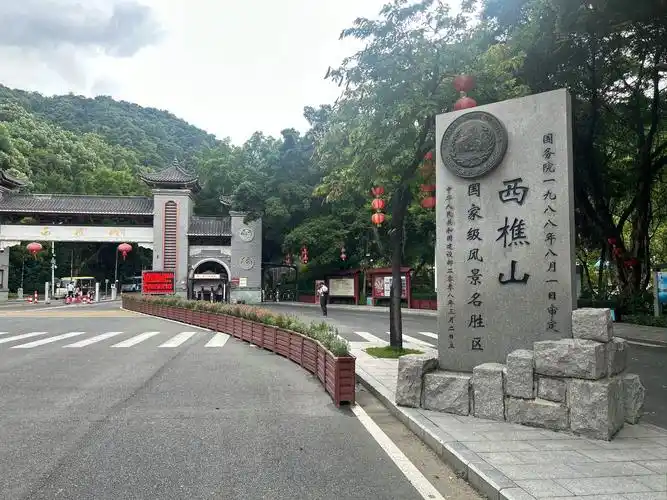
Xiqiao Mountain is the best-preserved extinct volcano in the entire Pearl River Delta, formed 45 million years ago when lava flows sculpted its dramatic terrain. Comparable in geological interest to Italy's Monte Somma or Scotland's Arthur's Seat, the mountain still cradles Tianhu, a pristine crater lake, alongside striking basalt formations at Jiulong Rock and B Jade Cave. Stone Swallow Cave contains a nationally protected underwater quarrying site where ancient miners extracted stone for centuries—visitors can boat into the cool, climate-controlled caverns for an atmospheric journey into industrial archaeology.
**Six Millennia of Human Settlement**
Excavations on the mountain have unearthed distinctive shouldered stone tools dating back 6,000 years, placing Xiqiao among the earliest centers of civilization in southern China. This makes the site contemporaneous with ancient Egypt's Old Kingdom and the early European megalithic cultures. The mountain earned the poetic title "Beacon of Pearl River Civilization" for its continuous occupation through the Neolithic era and into historical times, offering rare insight into prehistoric life along China's southern coast.
**Neo-Confucian Heritage and the Scholar's Mountain**
During the Ming Dynasty, Xiqiao became a thriving center of Neo-Confucian philosophy, hosting great academies such as the Da-ke and San-hu Institutes. Scholars compare its intellectual legacy to the great monastic schools of medieval Europe. Most famously, the young reformer Kang Youwei studied here before going on to shape China's path toward modernization in the 1890s. Walking among the restored academy buildings, visitors can sense the contemplative spirit that once drew China's leading thinkers to these forested slopes.
**Wong Fei-hung and the Living Art of Lion Dance**
The mountain's most colorful cultural legacy belongs to Wong Fei-hung, the legendary martial arts master whose life inspired over 100 films. At the Wong Fei-hung Lion Art and Martial Arts Hall, daily performances showcase Southern Lion Dance—unlike the Northern style performed during Lunar New Year across China's Chinatowns, this acrobatic southern variant emphasizes speed, mimicry, and martial agility. Demonstrations of Hung Ga kung fu offer a fascinating window into the martial traditions that shaped modern global perceptions of Chinese combat arts.
**The Guanyin Statue and Sacred Sites**
Dominating the skyline is the 61.9-meter seated Guanyin (Goddess of Mercy) statue, one of the tallest outdoor representations of this beloved bodhisattva in the world, surpassing many similar monuments across Buddhist Asia. Adjacent Baofeng Temple, founded during the Southern Han dynasty over a millennium ago, ranks among Guangdong's four great monasteries. Nearby Tianhu Park occupies the ancient caldera, ringed by peach orchards and oxygen-rich forest trails—making it a refreshing summer escape where visitors can breathe air measured at therapeutic ion levels.
**Practical Information for Visitors**
Since October 2024, main gate admission has been free; only shuttle buses and cable cars require payment, making Xiqiao outstanding value. Enter through the South Gate, take the sightseeing bus upward, and explore Tianhu, the Guanyin statue, Baofeng Temple, and Stone Swallow Cave in sequence before descending from the North Gate—one full day covers the highlights. Reserve via the WeChat accounts "Xiqiao Mountain" or "Nanhai Xiqiao." The park operates 7:30 a.m. to 5:30 p.m.; wear sturdy non-slip shoes, bring sunscreen and mosquito repellent, observe temple etiquette, and stick to marked trails for a safe, rewarding visit.