Yangma Island
⭐ 4.20
Mouping District, Yantai, Shandong, China
 **Legend and Setting**
Yangma Island sits in the Yellow Sea, linked to the mainland by a single bridge nine kilometers north of Yantai's Mouping District. Its name harks back to 215 BC, when Qin Shi Huang—the first emperor who unified China and ordered the construction of the Great Wall and the Terracotta Army—reportedly passed through during his eastern inspection tour and found pastures rich enough for his prized imperial horses. The island's outline, resembling a reclining elephant, also earns it the nickname "Elephant Island." Covering roughly 13 square kilometers, it remains one of the few genuinely free, unspoiled coastal destinations on the Jiaodong coast.
**A Rare Northern "Jelly Sea"**
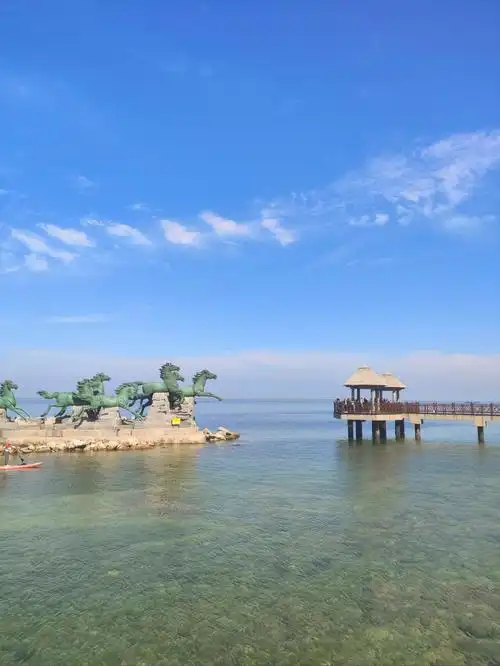
The island's defining feature is its unusual geography of "one island, three beaches": a black mudflat facing the mainland, a soft golden-sand swimming beach on the eastern tip, and a rugged rocky coastline along the rear. On clear days the water turns a startling blue-green, earning the nickname "jelly sea"—a phenomenon more commonly associated with the Aegean or the Caribbean than with northern China's often grey shores. The rear coastline is the island's visual heart, where sea-eroded caves, dramatic rock formations, and a sculptural group of Qin Shi Huang's horses create a scene reminiscent of a smaller, freer version of Croatia's Kornati Islands.
**Scenic Loop and Sunset**
A 17-to-18-kilometer coastal road circles the island, easily tackled by bicycle or car. Key stops include Tianma Square, the towering Qin Fengya Cliff, the red wooden boardwalk stretching out to tiny Zhangdao Islet, and the Lotus Sunset viewing platform—widely considered the finest place on the Shandong coast to watch the sun sink into the sea. At low tide, the rocky back-beach becomes a natural playground for beachcombing, where visitors wade through tidal pools collecting clams, small crabs, and seashells, much like families gathering shellfish along Portugal's Algarve or Ireland's Atlantic coast.
**Food and Stays**
Yangma's fishing villages serve some of the freshest seafood in Shandong at remarkably modest prices. Local specialties include mackerel dumplings (a Jiaodong heritage dish), wok-fried mantis shrimp, steamed swimming crab, and sea urchin over rice—expect a generous meal for around ¥50–80 per person. Overnight options center on family-run fishing homestays from roughly ¥100 per night, considerably cheaper than Yantai city hotels, and offer a slice of genuine coastal village life.
**Practical Tips**
The best windows are May–June and September–October, when temperatures are mild and crowds thin. July and August bring swimmers but also heavy traffic, with one-way restrictions on the loop road. Plan half a day to a full day; arrive for sunset at Lotus Sunset, and return early the next morning to have the coastline entirely to yourself. Check tide tables before beachcombing, wear non-slip shoes on the rocks, and—crucially for foreign visitors—set up mobile payment (Alipay or WeChat Pay) and download offline maps before you arrive, as English signage is limited and card acceptance rare outside major hotels.
**Why Visit**
For travelers tracing China's coastal heritage beyond the obvious stops of Beijing and Shanghai, Yangma Island offers something increasingly hard to find: an unhurried, uncommercialized seaside experience where imperial legend, geological curiosity, and seafood tradition combine into a single leisurely loop. It is, quite simply, one of the most rewarding day trips from Yantai.
**Legend and Setting**
Yangma Island sits in the Yellow Sea, linked to the mainland by a single bridge nine kilometers north of Yantai's Mouping District. Its name harks back to 215 BC, when Qin Shi Huang—the first emperor who unified China and ordered the construction of the Great Wall and the Terracotta Army—reportedly passed through during his eastern inspection tour and found pastures rich enough for his prized imperial horses. The island's outline, resembling a reclining elephant, also earns it the nickname "Elephant Island." Covering roughly 13 square kilometers, it remains one of the few genuinely free, unspoiled coastal destinations on the Jiaodong coast.
**A Rare Northern "Jelly Sea"**
The island's defining feature is its unusual geography of "one island, three beaches": a black mudflat facing the mainland, a soft golden-sand swimming beach on the eastern tip, and a rugged rocky coastline along the rear. On clear days the water turns a startling blue-green, earning the nickname "jelly sea"—a phenomenon more commonly associated with the Aegean or the Caribbean than with northern China's often grey shores. The rear coastline is the island's visual heart, where sea-eroded caves, dramatic rock formations, and a sculptural group of Qin Shi Huang's horses create a scene reminiscent of a smaller, freer version of Croatia's Kornati Islands.
**Scenic Loop and Sunset**
A 17-to-18-kilometer coastal road circles the island, easily tackled by bicycle or car. Key stops include Tianma Square, the towering Qin Fengya Cliff, the red wooden boardwalk stretching out to tiny Zhangdao Islet, and the Lotus Sunset viewing platform—widely considered the finest place on the Shandong coast to watch the sun sink into the sea. At low tide, the rocky back-beach becomes a natural playground for beachcombing, where visitors wade through tidal pools collecting clams, small crabs, and seashells, much like families gathering shellfish along Portugal's Algarve or Ireland's Atlantic coast.
**Food and Stays**
Yangma's fishing villages serve some of the freshest seafood in Shandong at remarkably modest prices. Local specialties include mackerel dumplings (a Jiaodong heritage dish), wok-fried mantis shrimp, steamed swimming crab, and sea urchin over rice—expect a generous meal for around ¥50–80 per person. Overnight options center on family-run fishing homestays from roughly ¥100 per night, considerably cheaper than Yantai city hotels, and offer a slice of genuine coastal village life.
**Practical Tips**
The best windows are May–June and September–October, when temperatures are mild and crowds thin. July and August bring swimmers but also heavy traffic, with one-way restrictions on the loop road. Plan half a day to a full day; arrive for sunset at Lotus Sunset, and return early the next morning to have the coastline entirely to yourself. Check tide tables before beachcombing, wear non-slip shoes on the rocks, and—crucially for foreign visitors—set up mobile payment (Alipay or WeChat Pay) and download offline maps before you arrive, as English signage is limited and card acceptance rare outside major hotels.
**Why Visit**
For travelers tracing China's coastal heritage beyond the obvious stops of Beijing and Shanghai, Yangma Island offers something increasingly hard to find: an unhurried, uncommercialized seaside experience where imperial legend, geological curiosity, and seafood tradition combine into a single leisurely loop. It is, quite simply, one of the most rewarding day trips from Yantai.