Chaoren Wharf
⭐ 3.80
Chaoren Wharf, Xiangqiao District, Chaozhou, Guangdong, China
 Shantou opened to foreign trade in 1860 under the Treaty of Tianjin, joining treaty ports like Shanghai and Hong Kong that reshaped China's nineteenth-century coastline. The Haibin Road waterfront quickly became the city's commercial heart, anchoring customs offices, shipping terminals, and the qiaopi remittance trade that linked Teochew emigrants with their homeland. Surviving landmarks—the red-brick Customs Clock Tower and Xiti Park's "Departure Pillars" sculptures—stand as physical testaments to generations who crossed the South China Sea seeking opportunity. Travelers familiar with Liverpool's Albert Dock or Hamburg's Speicherstadt will find a less-polished but equally evocative window into maritime globalization.
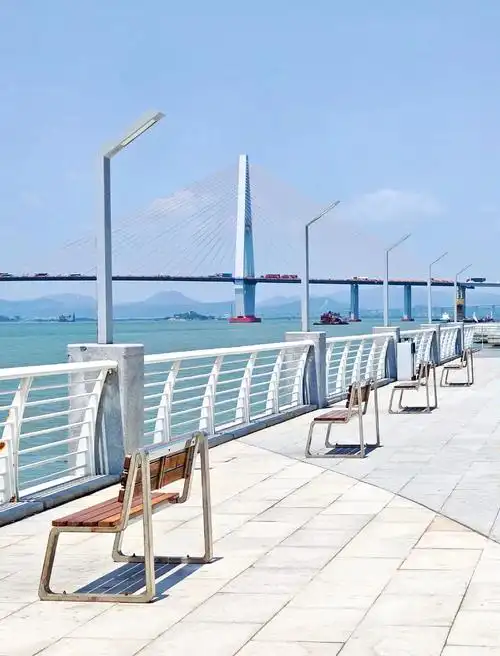
The pier's open promenade unfurls along the shoreline like Shanghai's Bund in miniature, linking central plazas, viewing platforms, and heritage zones in one continuous walkway. Dominating the skyline is the Shantou Customs Clock Tower, a striking example of Sino-Western hybrid architecture: weathered red walls, grey-tiled eaves, and a European clock tower recalling Macau's colonial towers or Guangzhou's Shamian Island. The neighbouring "Departure Pillars" ensemble features sculptural columns commemorating emigrants who ventured abroad—a memorial tradition echoing Ellis Island's immigrant sculptures or Lisbon's Padrão dos Descobrimentos.
Beyond its scenic appeal, the pier functions as a cultural showcase for overseas Teochew identity, maritime heritage, and Shantou's evolution from treaty port to modern harbor city. At dusk, the sun sinks between Queshi Bridge and the horizon, creating the viral "Xiti Suspended Sunset" that draws photographers nightly. As darkness falls, the historic Laoma Temple open-air stage frequently hosts free Teochew opera performances—centuries-old melodies drifting across the bay. Connected to the Xiaogongyuan historic district and its arcaded qilou streets, the pier threads together Shantou's commercial past with its contemporary waterfront revival.
Admission is free, and the park remains open around the clock as a public space. The prime visiting window runs from 5:30 to 8:30 PM, when sunset, harbor lights, and evening performances align. From central Shantou, taxis reach the pier in about fifteen minutes; travelers from Chaozhou can take a high-speed train to Shantou Station and transfer by bus or taxi—roughly twenty minutes. Signage is primarily in Chinese, so Amap or Baidu Maps is essential. The area is moving toward cashless payment, so setting up Alipay or WeChat Pay in advance is advisable.
The ideal half-day itinerary begins in the Xiaogongyuan arcade district to soak up overseas Chinese atmosphere, then walks or cycles southward along the coastal promenade to the pier for sea breezes and bridge views, ending at Xiti Park beside the Departure Pillars. Adventurous travelers can hop the square ferry to Queshi Island for just 1 RMB—the cheapest harbor cruise in town. Pack sunscreen, mosquito repellent, and a foldable umbrella in summer, plus basic stomach remedies. Few places along China's south coast condense so much migration history, architectural variety, and natural drama into one free, walkable stretch.
Shantou opened to foreign trade in 1860 under the Treaty of Tianjin, joining treaty ports like Shanghai and Hong Kong that reshaped China's nineteenth-century coastline. The Haibin Road waterfront quickly became the city's commercial heart, anchoring customs offices, shipping terminals, and the qiaopi remittance trade that linked Teochew emigrants with their homeland. Surviving landmarks—the red-brick Customs Clock Tower and Xiti Park's "Departure Pillars" sculptures—stand as physical testaments to generations who crossed the South China Sea seeking opportunity. Travelers familiar with Liverpool's Albert Dock or Hamburg's Speicherstadt will find a less-polished but equally evocative window into maritime globalization.
The pier's open promenade unfurls along the shoreline like Shanghai's Bund in miniature, linking central plazas, viewing platforms, and heritage zones in one continuous walkway. Dominating the skyline is the Shantou Customs Clock Tower, a striking example of Sino-Western hybrid architecture: weathered red walls, grey-tiled eaves, and a European clock tower recalling Macau's colonial towers or Guangzhou's Shamian Island. The neighbouring "Departure Pillars" ensemble features sculptural columns commemorating emigrants who ventured abroad—a memorial tradition echoing Ellis Island's immigrant sculptures or Lisbon's Padrão dos Descobrimentos.
Beyond its scenic appeal, the pier functions as a cultural showcase for overseas Teochew identity, maritime heritage, and Shantou's evolution from treaty port to modern harbor city. At dusk, the sun sinks between Queshi Bridge and the horizon, creating the viral "Xiti Suspended Sunset" that draws photographers nightly. As darkness falls, the historic Laoma Temple open-air stage frequently hosts free Teochew opera performances—centuries-old melodies drifting across the bay. Connected to the Xiaogongyuan historic district and its arcaded qilou streets, the pier threads together Shantou's commercial past with its contemporary waterfront revival.
Admission is free, and the park remains open around the clock as a public space. The prime visiting window runs from 5:30 to 8:30 PM, when sunset, harbor lights, and evening performances align. From central Shantou, taxis reach the pier in about fifteen minutes; travelers from Chaozhou can take a high-speed train to Shantou Station and transfer by bus or taxi—roughly twenty minutes. Signage is primarily in Chinese, so Amap or Baidu Maps is essential. The area is moving toward cashless payment, so setting up Alipay or WeChat Pay in advance is advisable.
The ideal half-day itinerary begins in the Xiaogongyuan arcade district to soak up overseas Chinese atmosphere, then walks or cycles southward along the coastal promenade to the pier for sea breezes and bridge views, ending at Xiti Park beside the Departure Pillars. Adventurous travelers can hop the square ferry to Queshi Island for just 1 RMB—the cheapest harbor cruise in town. Pack sunscreen, mosquito repellent, and a foldable umbrella in summer, plus basic stomach remedies. Few places along China's south coast condense so much migration history, architectural variety, and natural drama into one free, walkable stretch.