Zhongshan Road Pedestrian Street
⭐ 3.80
Zhongshan Road Pedestrian Street, Xiangqiao District, Chaozhou City, Guangdong Province, China
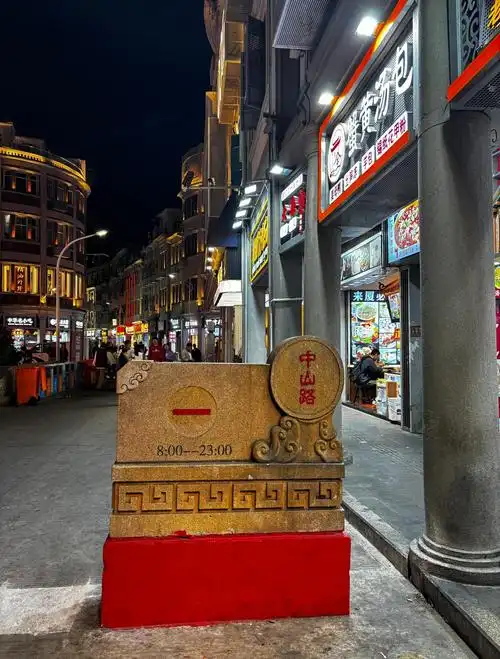 Zhongshan Road's story begins in the Song dynasty, when it served as Chaozhou's principal north-south axis—making it contemporary with Europe's great medieval trading towns like Bruges and Lübeck. By the late Qing and early Republican eras, the street had evolved into the commercial arcade thoroughfare seen today, with merchants building sheltered walkways to protect shoppers from Guangdong's intense subtropical sun and monsoon rains. A thoughtful 2022 restoration relaid the original stone paving and converted the street to one-way eastward traffic, balancing heritage preservation with modern visitor comfort. Walking here feels like stepping into a living chapter of the Maritime Silk Road, when Chaozhou was a major port linking southern China to Southeast Asia and beyond.
The street's defining feature is its remarkable row of qilou—arcade buildings whose colonnaded ground floors blend Lingnan tradition with subtle European influences introduced via returning overseas Chinese. With terracotta-tiled roofs, carved wooden brackets, and stucco facades, these structures recall Italian Renaissance loggias or the wrought-iron balconies of New Orleans' French Quarter. Notable landmarks include the Xu Fu Ma Mansion, the oldest official-style residence surviving in eastern Guangdong and a striking counterpart to the courtyard mansions of Beijing's hutong districts. The Li Cuo Ancestral Hall once housed the Chaozhou branch of the famed Whampoa Military Academy, while the elegant Zhuo Mansion adds further architectural variety to this remarkably intact streetscape.
Zhongshan Road has earned its nickname as "Chaozhou's Craft Street," hosting the city's densest concentration of workshops dedicated to intangible cultural heritage. Visitors can observe artisans practicing Chaoshan woodcarving—a tradition recognized alongside Italian marquetry for its extraordinary precision—and elaborate embroidery techniques that parallel French haute couture in their meticulous handwork. Small cultural spaces such as the Wenyuan Woodcarving Art Museum and the literary-themed Chaoshu Bookstore punctuate the route, reflecting Chaozhou's long reputation as a city that valued scholarship and the arts. The atmosphere is contemplative rather than commercial; here the emphasis is on watching craftsmanship unfold rather than transactional sightseeing.
The street sits within Xiangqiao District's walled old city, easily reached on foot from Paifang Street or by taxi to West Lake Park's main gate. Allow two to three hours for a relaxed visit; early morning and late afternoon offer the softest light for photography and the most tranquil ambiance. Note that Zhongshan Road is not a fully pedestrianized zone—cars, scooters, and delivery vehicles still use it—so visitors should stay alert, particularly when stepping out from the arcades to cross the roadway. Comfortable walking shoes are essential, as the newly relaid stone surface, while atmospheric, can be uneven.
Zhongshan Road is best experienced as part of a half-day circuit that also includes Paifang Street, the thousand-year-old Kaiyuan Temple, and West Lake itself. Where Paifang Street buzzes with food stalls and souvenir shopping, Zhongshan Road offers a quieter counterpoint—a place for history lovers, photographers, and anyone curious about living traditions. Travelers seeking nightlife, bustling markets, and street-food marathons will find Paifang Street more rewarding; those drawn to architecture, intangible heritage, and the contemplative beauty of an old Chinese town will discover Zhongshan Road unforgettable.
Zhongshan Road's story begins in the Song dynasty, when it served as Chaozhou's principal north-south axis—making it contemporary with Europe's great medieval trading towns like Bruges and Lübeck. By the late Qing and early Republican eras, the street had evolved into the commercial arcade thoroughfare seen today, with merchants building sheltered walkways to protect shoppers from Guangdong's intense subtropical sun and monsoon rains. A thoughtful 2022 restoration relaid the original stone paving and converted the street to one-way eastward traffic, balancing heritage preservation with modern visitor comfort. Walking here feels like stepping into a living chapter of the Maritime Silk Road, when Chaozhou was a major port linking southern China to Southeast Asia and beyond.
The street's defining feature is its remarkable row of qilou—arcade buildings whose colonnaded ground floors blend Lingnan tradition with subtle European influences introduced via returning overseas Chinese. With terracotta-tiled roofs, carved wooden brackets, and stucco facades, these structures recall Italian Renaissance loggias or the wrought-iron balconies of New Orleans' French Quarter. Notable landmarks include the Xu Fu Ma Mansion, the oldest official-style residence surviving in eastern Guangdong and a striking counterpart to the courtyard mansions of Beijing's hutong districts. The Li Cuo Ancestral Hall once housed the Chaozhou branch of the famed Whampoa Military Academy, while the elegant Zhuo Mansion adds further architectural variety to this remarkably intact streetscape.
Zhongshan Road has earned its nickname as "Chaozhou's Craft Street," hosting the city's densest concentration of workshops dedicated to intangible cultural heritage. Visitors can observe artisans practicing Chaoshan woodcarving—a tradition recognized alongside Italian marquetry for its extraordinary precision—and elaborate embroidery techniques that parallel French haute couture in their meticulous handwork. Small cultural spaces such as the Wenyuan Woodcarving Art Museum and the literary-themed Chaoshu Bookstore punctuate the route, reflecting Chaozhou's long reputation as a city that valued scholarship and the arts. The atmosphere is contemplative rather than commercial; here the emphasis is on watching craftsmanship unfold rather than transactional sightseeing.
The street sits within Xiangqiao District's walled old city, easily reached on foot from Paifang Street or by taxi to West Lake Park's main gate. Allow two to three hours for a relaxed visit; early morning and late afternoon offer the softest light for photography and the most tranquil ambiance. Note that Zhongshan Road is not a fully pedestrianized zone—cars, scooters, and delivery vehicles still use it—so visitors should stay alert, particularly when stepping out from the arcades to cross the roadway. Comfortable walking shoes are essential, as the newly relaid stone surface, while atmospheric, can be uneven.
Zhongshan Road is best experienced as part of a half-day circuit that also includes Paifang Street, the thousand-year-old Kaiyuan Temple, and West Lake itself. Where Paifang Street buzzes with food stalls and souvenir shopping, Zhongshan Road offers a quieter counterpoint—a place for history lovers, photographers, and anyone curious about living traditions. Travelers seeking nightlife, bustling markets, and street-food marathons will find Paifang Street more rewarding; those drawn to architecture, intangible heritage, and the contemplative beauty of an old Chinese town will discover Zhongshan Road unforgettable.