Chaozhou Ancient City Wall
⭐ 4.40
Chaozhou Ancient City Wall, Xiangqiao District, Chaozhou City, Guangdong Province, China
 The wall's origins reach back to the Northern Song Dynasty around 1070 AD, making it a near-contemporary of Europe's great Norman castles and the early Romanesque churches rising across Tuscany. Originally built of rammed earth, it was rebuilt in stone during the Southern Song and then massively reconstructed in 1370 under Ming Emperor Hongwu—around the same time Florence was crowning its cathedral dome. Of seven original gates, only four survived the urban expansion of the 19th and 20th centuries. Restorations in 2001 and 2022 have stabilized the structure, much as modern efforts have preserved Carcassonne or Ávila for today's visitors.
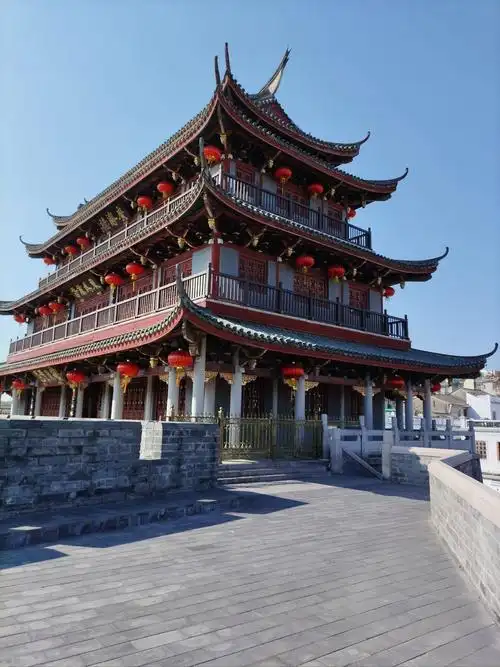
Stretching 2,132 meters, the wall combines a fortified base of cut granite blocks with an upper body of neatly laid grey brick, creating a hybrid that doubles as flood defense—often compared to Dutch sea-dikes or the riverside curtain walls still encircling parts of the Tower of London. A flat walkway runs the entire length, welcoming pedestrians and cyclists alike. The crown jewel is Guangji Gate Tower, an original Ming-era three-story pavilion in palatial style, its upturned eaves recalling the silhouettes of Kyoto's temple roofs or Prague's Gothic spires across the rooftops of the old town.
Beyond its military past, the wall functions as a living cultural artery. Inside Guangji Tower, rotating exhibitions showcase Chaozhou's intangible heritage—embroidery, ceramics, and the beloved "Fulou Monkey" folk mascot—blending the artifact-and-experience approach now standard at heritage sites like Stockholm's Vasa Museum. Scholars prize the wall as a rare surviving example of integrated urban water management in subtropical China, demonstrating how ancient engineers adapted defensive architecture to the rhythms of the East Asian monsoon, a feat of hydraulic engineering on par with Bruges' canal systems.
The site is free and open year-round, no reservation required. Allow one to two hours to walk the full circuit from Shangshui Gate through Zhumu and Guangji to Xiashui. The Guangji Tower interior exhibits generally operate during daytime hours—check on-site notices for current schedules. From Chaoshan High-Speed Rail Station, dedicated K1 and K2 bus lines deliver you directly to the old town. Comfortable walking shoes are essential, as much of the path is uneven cobble and brick.
For the most evocative experience, time your visit for dawn, when the Han River drifts beneath a veil of mist, or linger into evening when the towers ignite with golden illumination rivaling the lit ramparts of Dubrovnik. Travelers with extra time should pair the wall with neighboring Guangji Bridge—China's oldest surviving stone-and-floating pontoon bridge—the photogenic Paifang Street of stone memorial arches, and the Tang-dynasty Kaiyuan Temple. Together they form a "cross the bridge, climb the tower, wander the old street" loop that distills 1,300 years of Chaozhou's living history into a single unforgettable day.
The wall's origins reach back to the Northern Song Dynasty around 1070 AD, making it a near-contemporary of Europe's great Norman castles and the early Romanesque churches rising across Tuscany. Originally built of rammed earth, it was rebuilt in stone during the Southern Song and then massively reconstructed in 1370 under Ming Emperor Hongwu—around the same time Florence was crowning its cathedral dome. Of seven original gates, only four survived the urban expansion of the 19th and 20th centuries. Restorations in 2001 and 2022 have stabilized the structure, much as modern efforts have preserved Carcassonne or Ávila for today's visitors.
Stretching 2,132 meters, the wall combines a fortified base of cut granite blocks with an upper body of neatly laid grey brick, creating a hybrid that doubles as flood defense—often compared to Dutch sea-dikes or the riverside curtain walls still encircling parts of the Tower of London. A flat walkway runs the entire length, welcoming pedestrians and cyclists alike. The crown jewel is Guangji Gate Tower, an original Ming-era three-story pavilion in palatial style, its upturned eaves recalling the silhouettes of Kyoto's temple roofs or Prague's Gothic spires across the rooftops of the old town.
Beyond its military past, the wall functions as a living cultural artery. Inside Guangji Tower, rotating exhibitions showcase Chaozhou's intangible heritage—embroidery, ceramics, and the beloved "Fulou Monkey" folk mascot—blending the artifact-and-experience approach now standard at heritage sites like Stockholm's Vasa Museum. Scholars prize the wall as a rare surviving example of integrated urban water management in subtropical China, demonstrating how ancient engineers adapted defensive architecture to the rhythms of the East Asian monsoon, a feat of hydraulic engineering on par with Bruges' canal systems.
The site is free and open year-round, no reservation required. Allow one to two hours to walk the full circuit from Shangshui Gate through Zhumu and Guangji to Xiashui. The Guangji Tower interior exhibits generally operate during daytime hours—check on-site notices for current schedules. From Chaoshan High-Speed Rail Station, dedicated K1 and K2 bus lines deliver you directly to the old town. Comfortable walking shoes are essential, as much of the path is uneven cobble and brick.
For the most evocative experience, time your visit for dawn, when the Han River drifts beneath a veil of mist, or linger into evening when the towers ignite with golden illumination rivaling the lit ramparts of Dubrovnik. Travelers with extra time should pair the wall with neighboring Guangji Bridge—China's oldest surviving stone-and-floating pontoon bridge—the photogenic Paifang Street of stone memorial arches, and the Tang-dynasty Kaiyuan Temple. Together they form a "cross the bridge, climb the tower, wander the old street" loop that distills 1,300 years of Chaozhou's living history into a single unforgettable day.