Han Wengong Memorial Temple
⭐ 4.20
Chaozhou, Guangdong, China
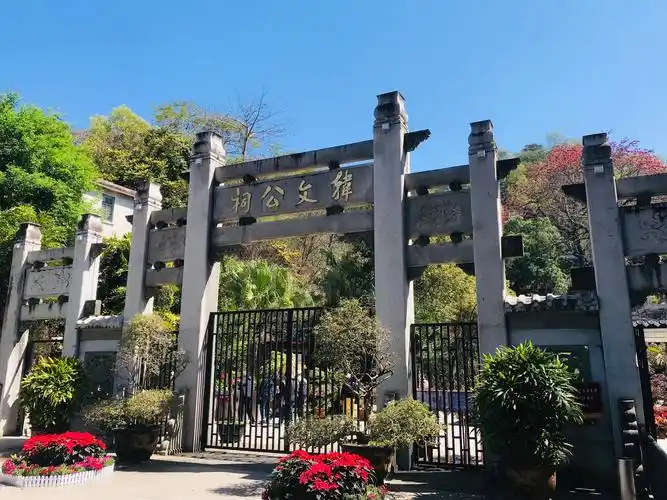 Few figures in Chinese literary history command the reverence accorded Han Yu (768–824), the Tang dynasty essayist whose bold classical revival prefigured the later Neo-Confucian movement much as Petrarch's rediscovery of Cicero shaped the European Renaissance. Exiled to the remote southern outpost of Chaozhou as its governor in 819 AD, he spent only eight months there, yet his deeds—banishing crocodiles, founding schools, freeing enslaved girls, and planting a scholar-oak that still shades the courtyard—earned him sainthood among locals. Within a century of his death, grateful citizens raised this temple in 999 AD, making it the first shrine anywhere dedicated solely to Han Yu.
The compound climbs the western flank of Bijia Mountain in a strictly axial layout typical of Song dynasty sacred architecture, comparable in its disciplined symmetry to early Romanesque abbey plans. Visitors pass through the main gate into a covered corridor gallery, then ascend to the principal hall before reaching the crowning Shirong Pavilion. The aesthetic is strikingly austere: grey-tiled roofs above weathered crimson walls, framed by lush subtropical foliage, evoke the timeless monastic compounds of Mount Lu or the contemplative cloisters of Assisi far more than the ornate temples of northern China.
The 89-metre stele corridor is the scholarly heart of the site, housing more than 30 carved stone tablets spanning the Song, Yuan, Ming, and Qing dynasties. Among the most prized inscriptions are commentaries by Su Shi, the Song polymath often ranked with Leonardo da Vinci for the breadth of his genius. Together these tablets form an open-air archive of Han Yu's enduring cultural influence and Chaozhou's evolution as a regional literary capital—making the temple a pilgrimage destination for sinologists as much as for casual sightseers.
Reaching the top floor of the Shirong Pavilion rewards the climb with one of southern China's finest panoramas: the Han River glides past in silver ribbons, the 800-year-old Guangji Bridge—a floating pontoon-and-pavilion marvel sometimes called the "Chinese version of Venice's Rialto"—stretches across its waters, and the tiled rooftops of Chaozhou's old town cascade toward distant mountains. Photographers find this vantage especially magical in the golden hour, when the setting sun ignites the river and the ancient bridge's stone piers.
Practical planning is straightforward but requires preparation. Admission is free, but visitors must book in advance through the official channel and present an ID card or passport at the gate. Opening hours run from 8:30 AM to 5:30 PM, with last entry at 5:00 PM. The 51 steps can be slippery, so sturdy non-slip footwear is essential; the climb is manageable for most fitness levels but not wheelchair-accessible. August brings Chaozhou's hottest, rainiest weather—aim for early morning or late afternoon, and pair your visit with the Guangji Bridge and the Paifang Street arcade for a satisfying half-day immersion in the soul of this underrated Guangdong gem.
Few figures in Chinese literary history command the reverence accorded Han Yu (768–824), the Tang dynasty essayist whose bold classical revival prefigured the later Neo-Confucian movement much as Petrarch's rediscovery of Cicero shaped the European Renaissance. Exiled to the remote southern outpost of Chaozhou as its governor in 819 AD, he spent only eight months there, yet his deeds—banishing crocodiles, founding schools, freeing enslaved girls, and planting a scholar-oak that still shades the courtyard—earned him sainthood among locals. Within a century of his death, grateful citizens raised this temple in 999 AD, making it the first shrine anywhere dedicated solely to Han Yu.
The compound climbs the western flank of Bijia Mountain in a strictly axial layout typical of Song dynasty sacred architecture, comparable in its disciplined symmetry to early Romanesque abbey plans. Visitors pass through the main gate into a covered corridor gallery, then ascend to the principal hall before reaching the crowning Shirong Pavilion. The aesthetic is strikingly austere: grey-tiled roofs above weathered crimson walls, framed by lush subtropical foliage, evoke the timeless monastic compounds of Mount Lu or the contemplative cloisters of Assisi far more than the ornate temples of northern China.
The 89-metre stele corridor is the scholarly heart of the site, housing more than 30 carved stone tablets spanning the Song, Yuan, Ming, and Qing dynasties. Among the most prized inscriptions are commentaries by Su Shi, the Song polymath often ranked with Leonardo da Vinci for the breadth of his genius. Together these tablets form an open-air archive of Han Yu's enduring cultural influence and Chaozhou's evolution as a regional literary capital—making the temple a pilgrimage destination for sinologists as much as for casual sightseers.
Reaching the top floor of the Shirong Pavilion rewards the climb with one of southern China's finest panoramas: the Han River glides past in silver ribbons, the 800-year-old Guangji Bridge—a floating pontoon-and-pavilion marvel sometimes called the "Chinese version of Venice's Rialto"—stretches across its waters, and the tiled rooftops of Chaozhou's old town cascade toward distant mountains. Photographers find this vantage especially magical in the golden hour, when the setting sun ignites the river and the ancient bridge's stone piers.
Practical planning is straightforward but requires preparation. Admission is free, but visitors must book in advance through the official channel and present an ID card or passport at the gate. Opening hours run from 8:30 AM to 5:30 PM, with last entry at 5:00 PM. The 51 steps can be slippery, so sturdy non-slip footwear is essential; the climb is manageable for most fitness levels but not wheelchair-accessible. August brings Chaozhou's hottest, rainiest weather—aim for early morning or late afternoon, and pair your visit with the Guangji Bridge and the Paifang Street arcade for a satisfying half-day immersion in the soul of this underrated Guangdong gem.