Kaiyuan Temple
⭐ 4.60
Kaiyuan Temple, Xiangqiao District, Chaozhou City, Guangdong Province, China
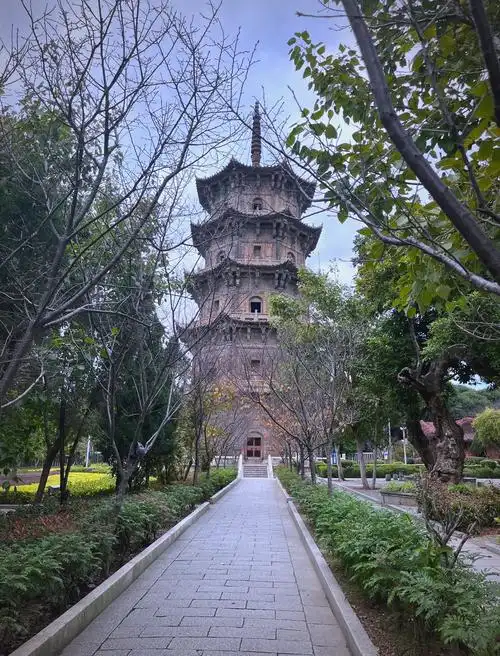 **A Living Survivor of the Tang Dynasty**
Founded in 738 CE during Emperor Xuanzong's celebrated Kaiyuan era—a period when Chang'an was the world's most cosmopolitan city and Buddhism flourished across Asia—Kaiyuan Temple predates many of Europe's Romanesque cathedrals. Originally called Lifeng Temple, it endured nearly 1,300 years of dynastic change, war, and reform. Today it ranks among only four surviving Kaiyuan-era temples in China and serves as the seat of the Lingdong Buddhist Academy. Its uninterrupted lineage offers visitors a rare window into southeastern China's spiritual evolution.
**Architecture Without a Single Nail**
The temple's crown jewel, the Hall of Heavenly Kings, is a jaw-dropping feat of Song Dynasty engineering (12th century). Built entirely with interlocking wooden joints—no iron nails whatsoever—its bracket sets (dougong) cascade in a dozen intricate layers, a technique akin to the precision found in Japan's ancient Kinkaku-ji, yet predating it. Scholars recognize this hall as a solitary surviving example of the "Great Buddha Style" (Dafo Yang) in Chinese timber construction, putting it on par with the better-known wooden halls of Shanxi province for architectural historians.
**Treasures from a Thousand Years**
The temple houses an extraordinary museum-without-walls collection: an original Tang stone sutra pillar from 738 CE, a Song Dynasty bronze bell weighing over 1,100 pounds, a Yuan-era incense burner carved from a meteorite, and a dazzling Ming Dynasty gilded-wood Thousand-Buddha Pagoda. Emperor Qianlong's personal gift of the Dragon Treasury Tripitaka completes the collection—each artifact offering a tactile connection to imperial Buddhist patronage that once rivaled the Vatican's manuscript tradition in scale.
**The Art of the Rooftop**
Look up to see Chaozhou's signature "porcelain镶嵌" (porcelain-inlay) craftwork adorning the roof ridges—colorful, weatherproof mosaics of broken glazed tiles depicting dragons, phoenixes, and Buddhist motifs. This national intangible cultural heritage technique shares artistic DNA with Portugal's azulejo tiles and Italy's maiolica tradition, yet evolved independently in this coastal region. The vibrant ceramics shimmer against subtropical skies, transforming functional rooflines into soaring folk-art canvases.
**Planning Your Visit**
The temple welcomes visitors daily from 8:00 AM to 5:00 PM (last entry 4:30 PM) at 32 Kaiyuan Road, Xiangqiao District. Admission is free; bring your passport for registration—no advance booking required. Allow 1–2 hours for a meaningful visit, ideally following the central axis from the mountain gate through the main halls to the scripture library. Dress modestly and respectfully; photography of Buddha statues inside the halls is prohibited. Rent an audio guide or hire a local interpreter for roughly 100 yuan to unlock the symbolism embedded in every beam and bracket.
**Why It's Worth Detouring For**
While most travelers associate Chinese Buddhist heritage with Beijing or Dunhuang, Kaiyuan Temple offers something rarer: an unscripted, ungentrified encounter where elderly devotees still burn incense beside 12th-century wooden columns. Pair your visit with nearby attractions—just a short walk leads to the intricately carved Huang Gong Ancestral Hall (a Qing-era woodcarving masterpiece), the historic Guangji Bridge (one of China's four great ancient bridges, predating Ponte Vecchio by centuries), and Paifang Street's tea houses where you can sample Chaozhou gongfu cha, one of China's most refined tea ceremonies. Together, they form a compact half-day immersion into a culture rarely encountered by Western tourists.
**A Living Survivor of the Tang Dynasty**
Founded in 738 CE during Emperor Xuanzong's celebrated Kaiyuan era—a period when Chang'an was the world's most cosmopolitan city and Buddhism flourished across Asia—Kaiyuan Temple predates many of Europe's Romanesque cathedrals. Originally called Lifeng Temple, it endured nearly 1,300 years of dynastic change, war, and reform. Today it ranks among only four surviving Kaiyuan-era temples in China and serves as the seat of the Lingdong Buddhist Academy. Its uninterrupted lineage offers visitors a rare window into southeastern China's spiritual evolution.
**Architecture Without a Single Nail**
The temple's crown jewel, the Hall of Heavenly Kings, is a jaw-dropping feat of Song Dynasty engineering (12th century). Built entirely with interlocking wooden joints—no iron nails whatsoever—its bracket sets (dougong) cascade in a dozen intricate layers, a technique akin to the precision found in Japan's ancient Kinkaku-ji, yet predating it. Scholars recognize this hall as a solitary surviving example of the "Great Buddha Style" (Dafo Yang) in Chinese timber construction, putting it on par with the better-known wooden halls of Shanxi province for architectural historians.
**Treasures from a Thousand Years**
The temple houses an extraordinary museum-without-walls collection: an original Tang stone sutra pillar from 738 CE, a Song Dynasty bronze bell weighing over 1,100 pounds, a Yuan-era incense burner carved from a meteorite, and a dazzling Ming Dynasty gilded-wood Thousand-Buddha Pagoda. Emperor Qianlong's personal gift of the Dragon Treasury Tripitaka completes the collection—each artifact offering a tactile connection to imperial Buddhist patronage that once rivaled the Vatican's manuscript tradition in scale.
**The Art of the Rooftop**
Look up to see Chaozhou's signature "porcelain镶嵌" (porcelain-inlay) craftwork adorning the roof ridges—colorful, weatherproof mosaics of broken glazed tiles depicting dragons, phoenixes, and Buddhist motifs. This national intangible cultural heritage technique shares artistic DNA with Portugal's azulejo tiles and Italy's maiolica tradition, yet evolved independently in this coastal region. The vibrant ceramics shimmer against subtropical skies, transforming functional rooflines into soaring folk-art canvases.
**Planning Your Visit**
The temple welcomes visitors daily from 8:00 AM to 5:00 PM (last entry 4:30 PM) at 32 Kaiyuan Road, Xiangqiao District. Admission is free; bring your passport for registration—no advance booking required. Allow 1–2 hours for a meaningful visit, ideally following the central axis from the mountain gate through the main halls to the scripture library. Dress modestly and respectfully; photography of Buddha statues inside the halls is prohibited. Rent an audio guide or hire a local interpreter for roughly 100 yuan to unlock the symbolism embedded in every beam and bracket.
**Why It's Worth Detouring For**
While most travelers associate Chinese Buddhist heritage with Beijing or Dunhuang, Kaiyuan Temple offers something rarer: an unscripted, ungentrified encounter where elderly devotees still burn incense beside 12th-century wooden columns. Pair your visit with nearby attractions—just a short walk leads to the intricately carved Huang Gong Ancestral Hall (a Qing-era woodcarving masterpiece), the historic Guangji Bridge (one of China's four great ancient bridges, predating Ponte Vecchio by centuries), and Paifang Street's tea houses where you can sample Chaozhou gongfu cha, one of China's most refined tea ceremonies. Together, they form a compact half-day immersion into a culture rarely encountered by Western tourists.