Xiangzi Bridge
⭐ 4.50
Xiangzi Bridge, Xiangqiao District, Chaozhou, Guangdong Province, China
 Built in 1171 during the Southern Song Dynasty, Xiangzi Bridge predates Europe's famous medieval spans—Prague's Charles Bridge, for instance, was begun in 1357. The structure reflects a sophisticated era when Chinese engineering was producing innovations unmatched elsewhere, contemporary with the rise of Europe's great Gothic cathedrals. Recognized as a National Key Cultural Relic in 1988 and an AAAA-rated scenic site in 2006, it remains a working monument—one of the rare places where ancient infrastructure still performs its original function every single day.
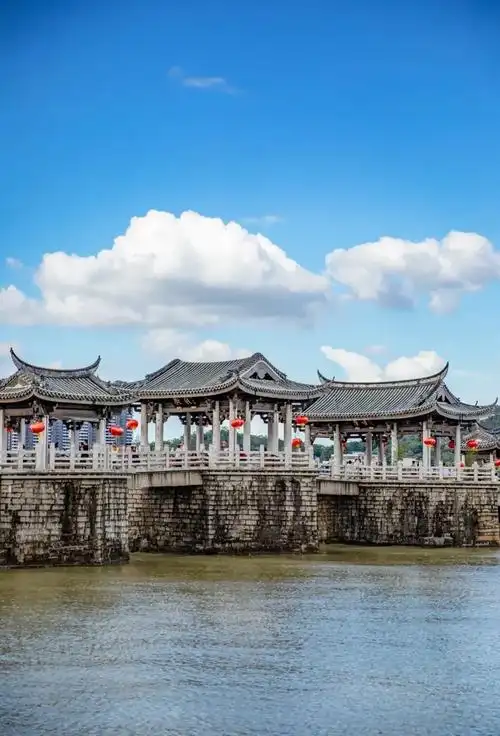
The 518-meter bridge merges three structural types in one elegant crossing: stone-beam sections supported by 12 eastern and 8 western piers, joined by a central pontoon of 18 wooden boats that detaches and floats aside each afternoon around 5 PM to let vessels pass. Twenty-four pavilions in distinct architectural styles punctuate the span, embodying the local saying: "eighteen boats and twenty-four islets, twenty-four pavilions in twenty-four forms." This combination of beam, floating, and arch construction was so ingenious that bridge expert Mao Yisheng hailed it as the world's first opening bridge—a concept that wouldn't appear in Europe until drawbridges on medieval castles.
A folk legend explains the bridge's unusual design as the result of a magical contest between the Daoist immortal Han Xiangzi and the monk Guangji, whose competing supernatural efforts could only be reconciled by linking their half-built piers with boats. Beyond mythology, the bridge functioned as a lively marketplace for centuries—shops and tea houses tucked into its pavilions made it a precursor to commercial crossings like Florence's Ponte Vecchio. Today it anchors "Xiangqiao Spring Floods," one of Chaozhou's eight celebrated scenic views, and remains the cultural heart of the old city.
Located outside Chaozhou's East Gate on Huancheng East Road, the bridge welcomes visitors with tickets from 20 yuan (free for seniors over 60 and children under 1.2 m). Weekend and holiday hours run 9:00–17:30; weekdays 10:00–17:30, with last entry at 17:00. The pontoon section only connects during limited daily windows—miss it and you'll have to admire the structure from the riverbanks. Late afternoon is the prime slot for catching the boats parting, when the sun glows off the Han River and the bridge seems to float between two worlds.
Plan at least half a day: climb the bridge in daylight to study its pavilions and boat mechanisms up close, then walk to nearby Hanwengong Temple or Guangji Gate Tower for sunset views framing the river. After dark, the riverside promenade hosts a free "One River, Two Banks" light show at around 8 or 9 PM, when the bridge glows in color. Within easy walking distance of Paifang Street and the 700-year-old Kaiyuan Temple, the bridge is the perfect gateway to Chaozhou's old town—sampling beef balls, oyster omelets, and the slow ritual of Gongfu tea along the way.
Built in 1171 during the Southern Song Dynasty, Xiangzi Bridge predates Europe's famous medieval spans—Prague's Charles Bridge, for instance, was begun in 1357. The structure reflects a sophisticated era when Chinese engineering was producing innovations unmatched elsewhere, contemporary with the rise of Europe's great Gothic cathedrals. Recognized as a National Key Cultural Relic in 1988 and an AAAA-rated scenic site in 2006, it remains a working monument—one of the rare places where ancient infrastructure still performs its original function every single day.
The 518-meter bridge merges three structural types in one elegant crossing: stone-beam sections supported by 12 eastern and 8 western piers, joined by a central pontoon of 18 wooden boats that detaches and floats aside each afternoon around 5 PM to let vessels pass. Twenty-four pavilions in distinct architectural styles punctuate the span, embodying the local saying: "eighteen boats and twenty-four islets, twenty-four pavilions in twenty-four forms." This combination of beam, floating, and arch construction was so ingenious that bridge expert Mao Yisheng hailed it as the world's first opening bridge—a concept that wouldn't appear in Europe until drawbridges on medieval castles.
A folk legend explains the bridge's unusual design as the result of a magical contest between the Daoist immortal Han Xiangzi and the monk Guangji, whose competing supernatural efforts could only be reconciled by linking their half-built piers with boats. Beyond mythology, the bridge functioned as a lively marketplace for centuries—shops and tea houses tucked into its pavilions made it a precursor to commercial crossings like Florence's Ponte Vecchio. Today it anchors "Xiangqiao Spring Floods," one of Chaozhou's eight celebrated scenic views, and remains the cultural heart of the old city.
Located outside Chaozhou's East Gate on Huancheng East Road, the bridge welcomes visitors with tickets from 20 yuan (free for seniors over 60 and children under 1.2 m). Weekend and holiday hours run 9:00–17:30; weekdays 10:00–17:30, with last entry at 17:00. The pontoon section only connects during limited daily windows—miss it and you'll have to admire the structure from the riverbanks. Late afternoon is the prime slot for catching the boats parting, when the sun glows off the Han River and the bridge seems to float between two worlds.
Plan at least half a day: climb the bridge in daylight to study its pavilions and boat mechanisms up close, then walk to nearby Hanwengong Temple or Guangji Gate Tower for sunset views framing the river. After dark, the riverside promenade hosts a free "One River, Two Banks" light show at around 8 or 9 PM, when the bridge glows in color. Within easy walking distance of Paifang Street and the 700-year-old Kaiyuan Temple, the bridge is the perfect gateway to Chaozhou's old town—sampling beef balls, oyster omelets, and the slow ritual of Gongfu tea along the way.