Guangji Bridge
⭐ 4.60
Guangji Bridge, Xiangqiao District, Chaozhou, Guangdong, China
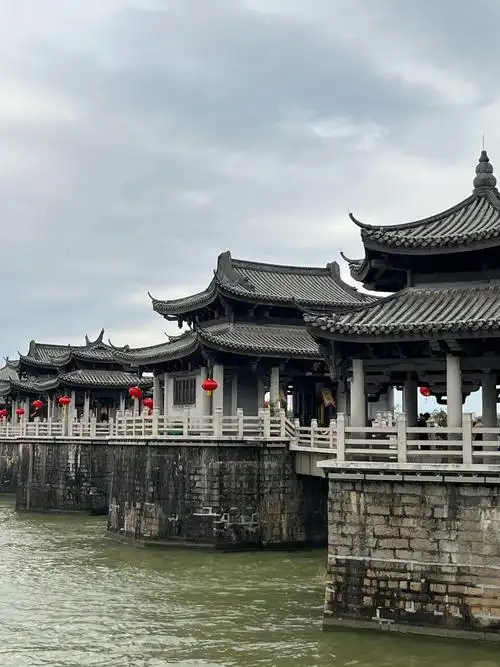 Guangji Bridge has stood across the Han River since 1171, when it was first commissioned by Prefect Zeng Wang during the Southern Song dynasty. To put that timeline in perspective, construction began only a few decades after Thomas Becket was murdered in Canterbury and roughly a century before Marco Polo set foot in Asia. Over the following centuries the bridge was repeatedly rebuilt and refined, achieving its celebrated present form by 1530. Local legend credits the Taoist immortal Han Xiangzi — nephew of the great Tang-dynasty poet Han Yu — and the Eight Immortals with magically constructing the span, lending a layer of myth to what was already a monumental engineering achievement.
What sets Guangji Bridge apart from Europe's surviving medieval bridges — London's Tower Bridge, Prague's Charles Bridge, Florence's Ponte Vecchio — is its hybrid design. The eastern and western sections rest on twenty massive stone piers supporting fixed beam spans, while the central gap is bridged by eighteen wooden barges lashed together as a pontoon. Every evening these barges are untied and swung apart to allow river traffic to pass, then reconnected at dawn. Imagine a working bascule bridge, but powered by hand and tradition for over 900 years — a sight without parallel anywhere in the world.
Beyond its engineering brilliance, the bridge serves as a living cultural artery. Its twenty-four pavilions once hosted bustling markets, giving rise to the saying "a one-li bridge, a one-li marketplace." Today these pavilions showcase Chaozhou's celebrated intangible heritage: intricate embroidery, woodcarving, and the revered Gongfu tea ceremony. The bridge is one of Chaozhou's eight classical scenic spots and a protected national monument, embodying the soul of this riverside city in Guangdong's eastern Chaozhou-Shantou region.
Plan to arrive from the western side via the atmospheric Paifang Street, lined with elaborately carved memorial archways reminiscent of a Ming-dynasty arcade. Be on the bridge approach before 5 p.m. to witness the daily opening ceremony, when the pontoon section parts and the barges glide to either bank — a spectacle unique in modern bridge engineering. After dark, from around 7:30 p.m., the entire structure transforms under colored lights and laser projections, accompanied by the thunderous rhythms of traditional Chaozhou drum music, evoking a Song-dynasty night festival.
Admission runs roughly 20–50 yuan; seniors over 60 and children under 1.2 meters enter free. Mobile payment and foreign-card scanning are accepted at the ticket gate, though a little cash is wise as backup. Wear sturdy non-slip footwear — the deck is largely uneven stone steps with some narrow stretches — and check typhoon and rain forecasts in summer. Most visitors spend about one hour for the bridge alone, or two hours if combining the light show and cultural demonstrations. For a rewarding half- or full-day itinerary, pair Guangji Bridge with Paifang Street on the west bank and the Han Wengong Ancestral Temple on the east, forming a compact "bridge, street, and shrine" cultural circuit.
Guangji Bridge has stood across the Han River since 1171, when it was first commissioned by Prefect Zeng Wang during the Southern Song dynasty. To put that timeline in perspective, construction began only a few decades after Thomas Becket was murdered in Canterbury and roughly a century before Marco Polo set foot in Asia. Over the following centuries the bridge was repeatedly rebuilt and refined, achieving its celebrated present form by 1530. Local legend credits the Taoist immortal Han Xiangzi — nephew of the great Tang-dynasty poet Han Yu — and the Eight Immortals with magically constructing the span, lending a layer of myth to what was already a monumental engineering achievement.
What sets Guangji Bridge apart from Europe's surviving medieval bridges — London's Tower Bridge, Prague's Charles Bridge, Florence's Ponte Vecchio — is its hybrid design. The eastern and western sections rest on twenty massive stone piers supporting fixed beam spans, while the central gap is bridged by eighteen wooden barges lashed together as a pontoon. Every evening these barges are untied and swung apart to allow river traffic to pass, then reconnected at dawn. Imagine a working bascule bridge, but powered by hand and tradition for over 900 years — a sight without parallel anywhere in the world.
Beyond its engineering brilliance, the bridge serves as a living cultural artery. Its twenty-four pavilions once hosted bustling markets, giving rise to the saying "a one-li bridge, a one-li marketplace." Today these pavilions showcase Chaozhou's celebrated intangible heritage: intricate embroidery, woodcarving, and the revered Gongfu tea ceremony. The bridge is one of Chaozhou's eight classical scenic spots and a protected national monument, embodying the soul of this riverside city in Guangdong's eastern Chaozhou-Shantou region.
Plan to arrive from the western side via the atmospheric Paifang Street, lined with elaborately carved memorial archways reminiscent of a Ming-dynasty arcade. Be on the bridge approach before 5 p.m. to witness the daily opening ceremony, when the pontoon section parts and the barges glide to either bank — a spectacle unique in modern bridge engineering. After dark, from around 7:30 p.m., the entire structure transforms under colored lights and laser projections, accompanied by the thunderous rhythms of traditional Chaozhou drum music, evoking a Song-dynasty night festival.
Admission runs roughly 20–50 yuan; seniors over 60 and children under 1.2 meters enter free. Mobile payment and foreign-card scanning are accepted at the ticket gate, though a little cash is wise as backup. Wear sturdy non-slip footwear — the deck is largely uneven stone steps with some narrow stretches — and check typhoon and rain forecasts in summer. Most visitors spend about one hour for the bridge alone, or two hours if combining the light show and cultural demonstrations. For a rewarding half- or full-day itinerary, pair Guangji Bridge with Paifang Street on the west bank and the Han Wengong Ancestral Temple on the east, forming a compact "bridge, street, and shrine" cultural circuit.