Mount Fuyan
⭐ 3.50
Fuyan Mountain Scenic Area, Linqu County, Weifang City, Shandong Province, China
 Rising at the southern tail of the Tai-Yi mountain range, Fuyan Mountain covers roughly 11.4 square kilometres of gentle, wooded slopes. Its summit is modest—about 161 metres above sea level, comparable to a tall English Down—but the microclimate feels distinctly cooler than downtown Weifang in summer, often two to three degrees lower. Locals flock here to walk among seven natural springs and dense stands of mixed forest, much as visitors to the Bois de Boulogne escape Paris for fresh air. The mountain's nickname, "Weifang's Green Lung," reflects this essential role as the city's breathing space.
The human history layered into these slopes stretches back to the Han dynasty (206 BCE–220 CE), when the statesman Gongsun Hong, a chief minister to Emperor Wu—often called China's Augustus—chose this site for his tomb. Stone stelae from the Yuan dynasty (13th–14th century), including the celebrated "Autumn Moon over Lutai" inscription, sit alongside later Ming carvings, much as medieval memorial tablets enrich cathedrals across Europe. These relics anchor Fuyan as a tangible chapter in the cultural story of Shandong, the ancient heartland of Qi-Lu civilisation.
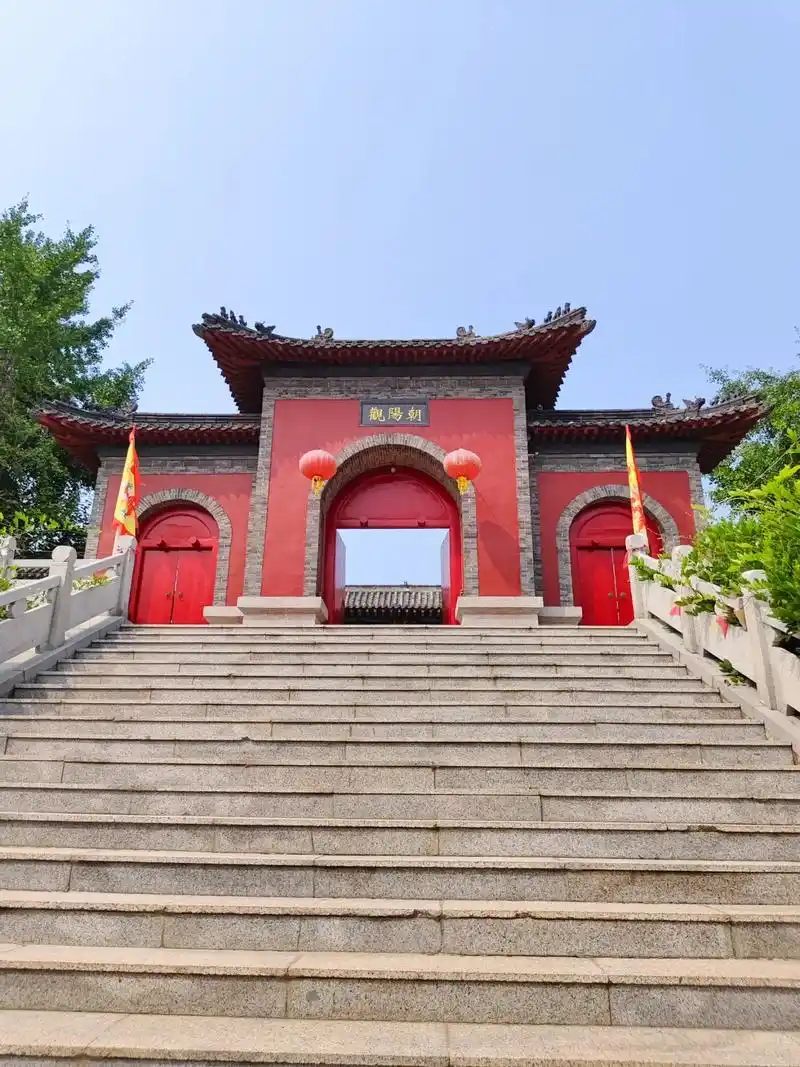
Religious architecture follows the ridgeline from Tang times onward. The Xiuzhen Temple, later renamed Chaoyang Temple, was founded in the 7th–8th centuries—a period contemporary with the early rise of Europe's great Romanesque abbeys. Nearby stand the Fuyan Pagoda, a multi-tiered brick tower recalling the slim silhouettes of Tuscan campaniles, and Hongfu Temple, a working Buddhist sanctuary tucked into the trees. Together they form a quiet, contemplative circuit that rivals the spiritual atmosphere of pilgrimage sites like Monte Cassino or Montserrat.
The mountain's modern fame springs from the sky. Every April, when the Weifang International Kite Festival takes over its purpose-built flying field, Fuyan becomes a global capital of aeronautical folklore—a tradition Chinese artisans have refined since the philosopher Mozi studied lift here over two millennia ago. Out of festival season, visitors can still hire kites and watch locals fly everything from dragon-shaped giants to delicate butterfly designs, continuing an unbroken link to the dawn of human flight.
Getting here is straightforward: city buses 9 and 19 run from central Weifang, and ample free parking welcomes drivers. The park itself opens free from roughly 08:30 to 18:00; only small entry fees apply to individual sites such as Hongfu Temple. Trails can be mossy after rain, so sturdy non-slip shoes are essential, and with limited on-site dining, carrying water and snacks is wise. A recommended half-day route enters through the grand memorial archway, climbs to Hongfu Temple and the pagoda for views, then descends through forest paths to the kite field—best savoured in the mild spring or autumn weather.
Rising at the southern tail of the Tai-Yi mountain range, Fuyan Mountain covers roughly 11.4 square kilometres of gentle, wooded slopes. Its summit is modest—about 161 metres above sea level, comparable to a tall English Down—but the microclimate feels distinctly cooler than downtown Weifang in summer, often two to three degrees lower. Locals flock here to walk among seven natural springs and dense stands of mixed forest, much as visitors to the Bois de Boulogne escape Paris for fresh air. The mountain's nickname, "Weifang's Green Lung," reflects this essential role as the city's breathing space.
The human history layered into these slopes stretches back to the Han dynasty (206 BCE–220 CE), when the statesman Gongsun Hong, a chief minister to Emperor Wu—often called China's Augustus—chose this site for his tomb. Stone stelae from the Yuan dynasty (13th–14th century), including the celebrated "Autumn Moon over Lutai" inscription, sit alongside later Ming carvings, much as medieval memorial tablets enrich cathedrals across Europe. These relics anchor Fuyan as a tangible chapter in the cultural story of Shandong, the ancient heartland of Qi-Lu civilisation.
Religious architecture follows the ridgeline from Tang times onward. The Xiuzhen Temple, later renamed Chaoyang Temple, was founded in the 7th–8th centuries—a period contemporary with the early rise of Europe's great Romanesque abbeys. Nearby stand the Fuyan Pagoda, a multi-tiered brick tower recalling the slim silhouettes of Tuscan campaniles, and Hongfu Temple, a working Buddhist sanctuary tucked into the trees. Together they form a quiet, contemplative circuit that rivals the spiritual atmosphere of pilgrimage sites like Monte Cassino or Montserrat.
The mountain's modern fame springs from the sky. Every April, when the Weifang International Kite Festival takes over its purpose-built flying field, Fuyan becomes a global capital of aeronautical folklore—a tradition Chinese artisans have refined since the philosopher Mozi studied lift here over two millennia ago. Out of festival season, visitors can still hire kites and watch locals fly everything from dragon-shaped giants to delicate butterfly designs, continuing an unbroken link to the dawn of human flight.
Getting here is straightforward: city buses 9 and 19 run from central Weifang, and ample free parking welcomes drivers. The park itself opens free from roughly 08:30 to 18:00; only small entry fees apply to individual sites such as Hongfu Temple. Trails can be mossy after rain, so sturdy non-slip shoes are essential, and with limited on-site dining, carrying water and snacks is wise. A recommended half-day route enters through the grand memorial archway, climbs to Hongfu Temple and the pagoda for views, then descends through forest paths to the kite field—best savoured in the mild spring or autumn weather.