Weifang Kite Museum
⭐ 4.70
Weifang Kite Museum, Kuiwen District, Weifang City, Shandong Province, China
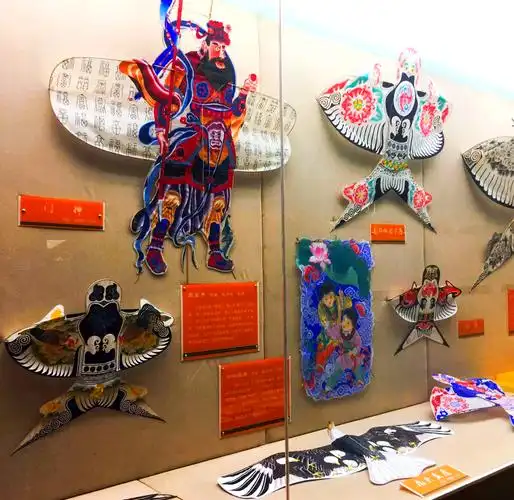 Kite-making has flourished in China for over 2,400 years, with origins traditionally traced to the Spring and Autumn period master Lu Ban and his wooden "wooden hawk." Weifang, a city in Shandong province, has been the beating heart of this craft for centuries, earning its reputation as the global capital of kite-making. The Weifang World Kite Museum, opened in 1989, serves much like London's Victoria and Albert Museum does for decorative arts, preserving and interpreting this remarkably rich tradition for visitors from around the globe.
The building itself is a striking piece of architectural storytelling. Its rooftop features a remarkable ceramic dragon frieze that reimagines the traditional dragon-centipede kite motif in permanent form, making the museum recognizable from a distance. Inside, twelve bright, airy galleries flow logically through history and craftsmanship, while the soaring central atrium rises dramatically upward, the perfect stage for the colossal kite suspended beneath its glass ceiling.
The museum holds over 1,300 treasures spanning the major kite traditions of the world, including Chinese classics in tube, board, hard-wing, soft-wing, and string configurations, alongside whimsical cartoon designs and even space-themed creations. The undisputed showpiece is the "Great Dragon of China," a magnificent dragon-centipede kite stretching 280 meters in length with a dragon head standing 4.2 meters tall—a work of art on a scale rivaling the great hanging installations of European cathedrals. Exhibits also include historical documents from the annual Weifang International Kite Festival, a major event since 1984 that draws competitors from dozens of countries.
Located at 66 Xingzheng Street in the Quwen District of Weifang, the museum is easily reached by public bus. Opening hours are Tuesday through Sunday, 9:00 a.m. to 5:00 p.m., with last entry at 4:30 p.m.; the museum closes all day Monday. Admission is completely free, though visitors should scan a QR code on-site or follow the museum's official WeChat account to reserve an entry slot. On-site parking is available but limited during holidays, so public transportation is strongly recommended.
Beyond the galleries, the museum offers hands-on kite-making and painting workshops, with some requiring on-site registration and a small materials fee, plus a second-floor VR experience zone at a modest extra cost of roughly 20 to 30 yuan. Allow between 1.5 and 2.5 hours for a satisfying visit, ideally following the suggested route: ascend to see the great dragon first, then trace the historical timeline, explore the international collections, study the traditional "binding, pasting, painting, and flying" craft techniques, and end at the interactive zone. The museum is especially rewarding for families and craft enthusiasts, though foreign visitors may want to bring a translation app to fully appreciate the detailed craftsmanship explanations.
Whether you arrive as a serious student of folk art or simply a curious traveler, the Weifang World Kite Museum offers something genuinely rare: a place where an everyday object of childhood imagination is treated with the reverence and depth typically reserved for paintings in the Louvre or antiquities in the British Museum, yet remains entirely welcoming and accessible to all who pass through its doors.
Kite-making has flourished in China for over 2,400 years, with origins traditionally traced to the Spring and Autumn period master Lu Ban and his wooden "wooden hawk." Weifang, a city in Shandong province, has been the beating heart of this craft for centuries, earning its reputation as the global capital of kite-making. The Weifang World Kite Museum, opened in 1989, serves much like London's Victoria and Albert Museum does for decorative arts, preserving and interpreting this remarkably rich tradition for visitors from around the globe.
The building itself is a striking piece of architectural storytelling. Its rooftop features a remarkable ceramic dragon frieze that reimagines the traditional dragon-centipede kite motif in permanent form, making the museum recognizable from a distance. Inside, twelve bright, airy galleries flow logically through history and craftsmanship, while the soaring central atrium rises dramatically upward, the perfect stage for the colossal kite suspended beneath its glass ceiling.
The museum holds over 1,300 treasures spanning the major kite traditions of the world, including Chinese classics in tube, board, hard-wing, soft-wing, and string configurations, alongside whimsical cartoon designs and even space-themed creations. The undisputed showpiece is the "Great Dragon of China," a magnificent dragon-centipede kite stretching 280 meters in length with a dragon head standing 4.2 meters tall—a work of art on a scale rivaling the great hanging installations of European cathedrals. Exhibits also include historical documents from the annual Weifang International Kite Festival, a major event since 1984 that draws competitors from dozens of countries.
Located at 66 Xingzheng Street in the Quwen District of Weifang, the museum is easily reached by public bus. Opening hours are Tuesday through Sunday, 9:00 a.m. to 5:00 p.m., with last entry at 4:30 p.m.; the museum closes all day Monday. Admission is completely free, though visitors should scan a QR code on-site or follow the museum's official WeChat account to reserve an entry slot. On-site parking is available but limited during holidays, so public transportation is strongly recommended.
Beyond the galleries, the museum offers hands-on kite-making and painting workshops, with some requiring on-site registration and a small materials fee, plus a second-floor VR experience zone at a modest extra cost of roughly 20 to 30 yuan. Allow between 1.5 and 2.5 hours for a satisfying visit, ideally following the suggested route: ascend to see the great dragon first, then trace the historical timeline, explore the international collections, study the traditional "binding, pasting, painting, and flying" craft techniques, and end at the interactive zone. The museum is especially rewarding for families and craft enthusiasts, though foreign visitors may want to bring a translation app to fully appreciate the detailed craftsmanship explanations.
Whether you arrive as a serious student of folk art or simply a curious traveler, the Weifang World Kite Museum offers something genuinely rare: a place where an everyday object of childhood imagination is treated with the reverence and depth typically reserved for paintings in the Louvre or antiquities in the British Museum, yet remains entirely welcoming and accessible to all who pass through its doors.