Zhishan Park
⭐ 3.80
Zhishan Park, Xiangcheng District, Zhangzhou City, Fujian Province, China
 Originally known as Denggao Hill, Zhishan received its imperial name "Purple Zhi Mountain" in 1380 after rare purple lingzhi mushrooms were discovered growing on its slopes—a discovery considered an auspicious omen by the Ming court. The mountain forms a continuation of the Tianbao range and has watched over Zhangzhou for over six centuries. Rebuilt and reopened in 2010, this 28-hectare park now serves as the only comprehensive hillside ecological park within the urban core, functioning much like Rome's Villa Borghese or Paris's Parc des Buttes-Chaumont—a green refuge rising gracefully above the surrounding cityscape.
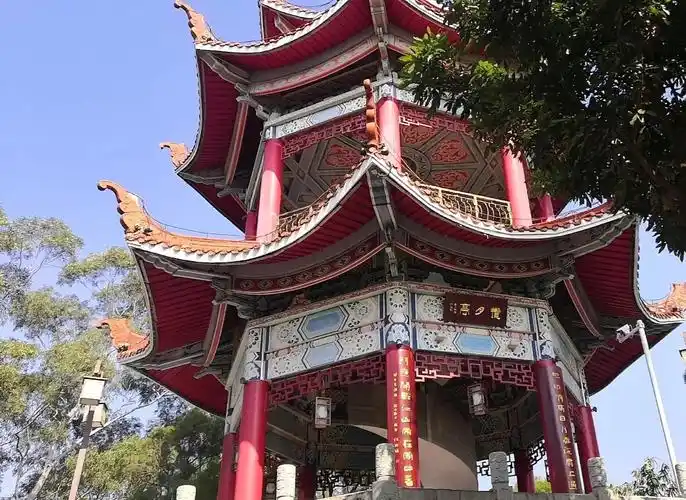
The park's architectural treasures are three Ming Dynasty pavilions—Weizhen, Ganlu, and Yangzhi—built between 1488 and 1566 and recognized as municipal protected relics. Their weathered wooden and stone elements have endured over 450 years of coastal Fujian weather, comparable in age to many of England's Tudor-era garden follies. Crowning the summit stands the modern Lanyue ("Moon-Gazing") Pavilion, a striking double-tiered octagonal structure in classical style. From its upper deck, visitors enjoy sweeping 360-degree views across the Zhangzhou plain, with the city's modern skyline unfolding below like a living map.
At the north entrance, a sculpted relief wall honors ten historical luminaries including Tang Dynasty pioneer Chen Yuanguang and Song Dynasty philosopher Zhu Xi—whose Neo-Confucian teachings shaped East Asian thought much as Thomas Aquinas influenced medieval European philosophy. A dedicated Zhangzhou-Taiwan cultural zone documents the deep historical bonds between the two regions, while a small Sun Yat-sen memorial reflects the revolutionary currents of the early twentieth century. Together these installations weave a narrative connecting local heritage to broader Chinese and cross-strait history.
The park sits at Datong North Road in Xiangcheng District, just behind the municipal government building, with free parking available near the north gate. Bus routes V2, B6, 27, and 902 all stop at "Zhishan Park" station. The grounds are open 24 hours year-round at no cost, though the shared reading room and tea stalls operate only on weekends from 9:00–11:00 AM and 3:00–5:00 PM. Signage is primarily in Chinese, so downloading an offline translation map beforehand is advisable for non-Mandarin speakers.
Plan your visit for early morning or late afternoon to escape summer heat and capture the softest light over the city—much like visiting Florence's Piazzale Michelangelo at sunset. The recommended route enters through the north gate, passes the relief wall, explores the three Ming pavilions, then ascends to Lanyue Pavilion for the climactic panorama, totaling 1.5 to 2 hours. From the west gate, it's a short ten-minute walk into Zhangzhou's ancient old town, where travelers can sample local Minnan specialties like braised noodles (lumiàn) and refreshing four-fruit dessert (sìguǒtāng).
Originally known as Denggao Hill, Zhishan received its imperial name "Purple Zhi Mountain" in 1380 after rare purple lingzhi mushrooms were discovered growing on its slopes—a discovery considered an auspicious omen by the Ming court. The mountain forms a continuation of the Tianbao range and has watched over Zhangzhou for over six centuries. Rebuilt and reopened in 2010, this 28-hectare park now serves as the only comprehensive hillside ecological park within the urban core, functioning much like Rome's Villa Borghese or Paris's Parc des Buttes-Chaumont—a green refuge rising gracefully above the surrounding cityscape.
The park's architectural treasures are three Ming Dynasty pavilions—Weizhen, Ganlu, and Yangzhi—built between 1488 and 1566 and recognized as municipal protected relics. Their weathered wooden and stone elements have endured over 450 years of coastal Fujian weather, comparable in age to many of England's Tudor-era garden follies. Crowning the summit stands the modern Lanyue ("Moon-Gazing") Pavilion, a striking double-tiered octagonal structure in classical style. From its upper deck, visitors enjoy sweeping 360-degree views across the Zhangzhou plain, with the city's modern skyline unfolding below like a living map.
At the north entrance, a sculpted relief wall honors ten historical luminaries including Tang Dynasty pioneer Chen Yuanguang and Song Dynasty philosopher Zhu Xi—whose Neo-Confucian teachings shaped East Asian thought much as Thomas Aquinas influenced medieval European philosophy. A dedicated Zhangzhou-Taiwan cultural zone documents the deep historical bonds between the two regions, while a small Sun Yat-sen memorial reflects the revolutionary currents of the early twentieth century. Together these installations weave a narrative connecting local heritage to broader Chinese and cross-strait history.
The park sits at Datong North Road in Xiangcheng District, just behind the municipal government building, with free parking available near the north gate. Bus routes V2, B6, 27, and 902 all stop at "Zhishan Park" station. The grounds are open 24 hours year-round at no cost, though the shared reading room and tea stalls operate only on weekends from 9:00–11:00 AM and 3:00–5:00 PM. Signage is primarily in Chinese, so downloading an offline translation map beforehand is advisable for non-Mandarin speakers.
Plan your visit for early morning or late afternoon to escape summer heat and capture the softest light over the city—much like visiting Florence's Piazzale Michelangelo at sunset. The recommended route enters through the north gate, passes the relief wall, explores the three Ming pavilions, then ascends to Lanyue Pavilion for the climactic panorama, totaling 1.5 to 2 hours. From the west gate, it's a short ten-minute walk into Zhangzhou's ancient old town, where travelers can sample local Minnan specialties like braised noodles (lumiàn) and refreshing four-fruit dessert (sìguǒtāng).