Nanshan Cultural Tourism Zone
⭐ 4.60
Nanshan Cultural Tourism Zone, Tianya District, Sanya City, Hainan Province, China
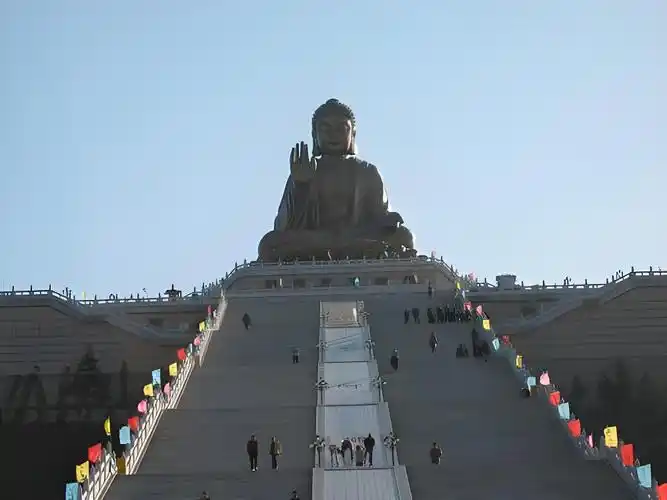 Set where Hainan's mountainous spine tumbles into the South China Sea, Nanshan ranks among Asia's great coastal Buddhist sites — a Pacific counterpart to India's Bodh Gaya or Portugal's hilltop monastery of Sintra. Developed under the auspices of the Buddhist Association of China and opened in 1998, it has grown into a flagship showcase of Han Chinese Buddhism, drawing on the same Silk Road transmission of Buddhist thought that once linked Chang'an to distant Nalanda. Its location, at China's southernmost latitude, lends it a sacred edge-of-the-world atmosphere reminiscent of Europe's ancient coastal monasteries perched above crashing Atlantic waves.
The undisputed icon is the 108-meter Three-Faced Guanyin of the South Sea — taller than Rio's Christ the Redeemer by nearly seventy meters and exceeding Manhattan's Statue of Liberty by fifteen. Cast as a single integrated sculpture and finished in gleaming white, the deity stands serenely holding a lotus (peace), a scripture (wisdom), and prayer beads (compassion). Within its lotus-shaped base sits the Yuantong Treasure Hall, where visitors can climb to "embrace the Buddha's feet" while gazing out across turquoise water — a moment of awe comparable to ascending the dome of Florence's Duomo over the Tuscan hills.
Nanshan Temple itself is the largest Han Buddhist complex built in China in the past half-century, an ambitious recreation of Tang Dynasty palace architecture echoing the grandeur of Chang'an's Dayan Palace or the soaring halls of Kyoto's Todai-ji. Sweeping glazed-tile roofs, vermilion pillars, and gilded Buddha statues unfold across terraced courtyards, flanked by the atmospheric Thirty-Three Guanyin Hall — holder of a Guinness record for its assemblage of Guanyin imagery — and the Golden Jade Guanyin Pavilion, which houses national-treasure-grade statuary that would feel at home beside the reliquaries of Venice's San Marco.
Culturally, the site functions as a living Buddhist hub rather than a static museum. Daily chanting, blessing ceremonies, and incense rituals engage visitors in centuries-old practices, while the surrounding meditation gardens and ocean-view walkways invite quiet contemplation. Vegetarian pilgrims have long traveled here, much as medieval devotees once journeyed to Santiago de Compostela, and today's travelers find similar spiritual resonance paired with stunning photo opportunities at every turn.
Practical planning is straightforward. Peak-season admission runs 129 RMB (about $18), dropping to 108 RMB in the off-season; the 30 RMB sightseeing shuttle is essential given the vast grounds, and three to four hours are needed for a comfortable visit. Arrive between 8 and 10 AM for soft light and thin crowds — ideal both for photography and for slipping into the temples' hushed interior. Modest dress is required (no hats or sunglasses in halls), and flash photography near statues should be avoided; refreshments are pricey, so bring water, though the famous vegetarian buffet is well worth sampling.
For Western visitors, Nanshan offers something genuinely rare: a chance to experience authentic Buddhist devotion in a tropical seaside setting that feels both exotic and welcoming, where two-thousand-year-old tradition meets the warm hospitality of China's tropical south. It is, quite simply, an unmissable stop on any Hainan itinerary.
Set where Hainan's mountainous spine tumbles into the South China Sea, Nanshan ranks among Asia's great coastal Buddhist sites — a Pacific counterpart to India's Bodh Gaya or Portugal's hilltop monastery of Sintra. Developed under the auspices of the Buddhist Association of China and opened in 1998, it has grown into a flagship showcase of Han Chinese Buddhism, drawing on the same Silk Road transmission of Buddhist thought that once linked Chang'an to distant Nalanda. Its location, at China's southernmost latitude, lends it a sacred edge-of-the-world atmosphere reminiscent of Europe's ancient coastal monasteries perched above crashing Atlantic waves.
The undisputed icon is the 108-meter Three-Faced Guanyin of the South Sea — taller than Rio's Christ the Redeemer by nearly seventy meters and exceeding Manhattan's Statue of Liberty by fifteen. Cast as a single integrated sculpture and finished in gleaming white, the deity stands serenely holding a lotus (peace), a scripture (wisdom), and prayer beads (compassion). Within its lotus-shaped base sits the Yuantong Treasure Hall, where visitors can climb to "embrace the Buddha's feet" while gazing out across turquoise water — a moment of awe comparable to ascending the dome of Florence's Duomo over the Tuscan hills.
Nanshan Temple itself is the largest Han Buddhist complex built in China in the past half-century, an ambitious recreation of Tang Dynasty palace architecture echoing the grandeur of Chang'an's Dayan Palace or the soaring halls of Kyoto's Todai-ji. Sweeping glazed-tile roofs, vermilion pillars, and gilded Buddha statues unfold across terraced courtyards, flanked by the atmospheric Thirty-Three Guanyin Hall — holder of a Guinness record for its assemblage of Guanyin imagery — and the Golden Jade Guanyin Pavilion, which houses national-treasure-grade statuary that would feel at home beside the reliquaries of Venice's San Marco.
Culturally, the site functions as a living Buddhist hub rather than a static museum. Daily chanting, blessing ceremonies, and incense rituals engage visitors in centuries-old practices, while the surrounding meditation gardens and ocean-view walkways invite quiet contemplation. Vegetarian pilgrims have long traveled here, much as medieval devotees once journeyed to Santiago de Compostela, and today's travelers find similar spiritual resonance paired with stunning photo opportunities at every turn.
Practical planning is straightforward. Peak-season admission runs 129 RMB (about $18), dropping to 108 RMB in the off-season; the 30 RMB sightseeing shuttle is essential given the vast grounds, and three to four hours are needed for a comfortable visit. Arrive between 8 and 10 AM for soft light and thin crowds — ideal both for photography and for slipping into the temples' hushed interior. Modest dress is required (no hats or sunglasses in halls), and flash photography near statues should be avoided; refreshments are pricey, so bring water, though the famous vegetarian buffet is well worth sampling.
For Western visitors, Nanshan offers something genuinely rare: a chance to experience authentic Buddhist devotion in a tropical seaside setting that feels both exotic and welcoming, where two-thousand-year-old tradition meets the warm hospitality of China's tropical south. It is, quite simply, an unmissable stop on any Hainan itinerary.