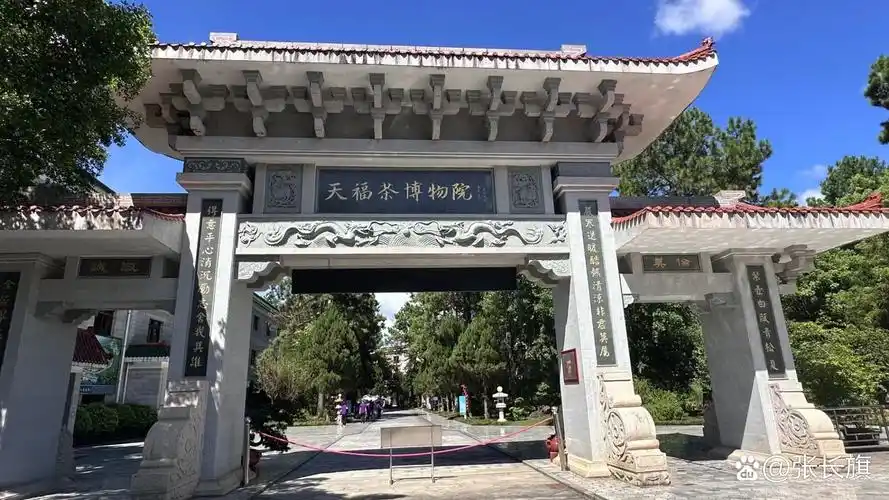
The Tianfu Tea Museum was founded in 2002 by the Tianfu Group and has since earned recognition as a National Agricultural Tourism Demonstration Site. Its galleries trace the arc of tea culture from the legendary Emperor Shennong, who is said to have discovered the leaf's properties some 5,000 years ago, through the refined tea rituals of the Tang and Song dynasties when Fujian itself became one of China's great tea-producing regions. Exhibits extend beyond China's borders, offering a concise primer on tea traditions in Japan, Korea, India, and Britain—allowing visitors to grasp, much as one might at the British Museum's Enlightenment galleries, how a single plant reshaped commerce, ceremony, and daily life across continents.
Architecturally, the museum balances scholarly gravitas with garden romance. The main exhibition halls evoke the calm symmetry of a Confucian academy, while the Japanese tea pavilion "Fuhui An" replicates the cypress-and-rice-paper aesthetic of a Kyoto machiya, and the Korean Tea Etiquette Hall faithfully reconstructs a Joseon-era ceremonial chamber. Winding through the grounds, visitors encounter a Han Dynasty-style pavilion, a Song-era stone bridge, a Ming-dynasty lake, and a striking nine-meter purple clay teapot sculpture that recalls the whimsy of the Hedgehog in Kew Gardens or the oversized monuments of European Baroque folly architecture.
The cultural centerpiece is its living program of tea performances. Throughout the day, attendants in period costume demonstrate Tang-style whisking, Japanese matcha preparation, and Korean ancestral tea rituals, each performance free with admission. Limited hands-on sessions allow visitors to brew their own cup, an experience that resonates with the participatory philosophy of tea master Sen no Rikyū's sixteenth-century "wabi-cha" aesthetic, simplified here for international travelers.
Practical planning is straightforward. The site generally opens 08:00–18:00 in high season, though visitors should call 0596-3822198 to confirm before traveling. Admission runs roughly 24–30 yuan, with discounts for children, seniors, and military personnel. English interpretation is limited, so a translation app or a Chinese-speaking companion is strongly recommended. Plan on 1.5 to 2.5 hours for a thorough visit, syncing your schedule with the posted performance times at the entrance.
The museum sits about 60 kilometers from central Zhangzhou, making a taxi or rented car the most convenient option. Pairing a visit with the adjacent Tianfu Tea Plantation—where guests can pick leaves and sample tea-infused cuisine—turns a half-day stop into a complete immersion in the Camellia sinensis experience, comparable in spirit to a wine-tour day in Tuscany, but centered on the Orient's most celebrated beverage.