Zhangzhou Ancient City
⭐ 4.20
Lantian Town, Longwen District, Zhangzhou City, Fujian Province, China
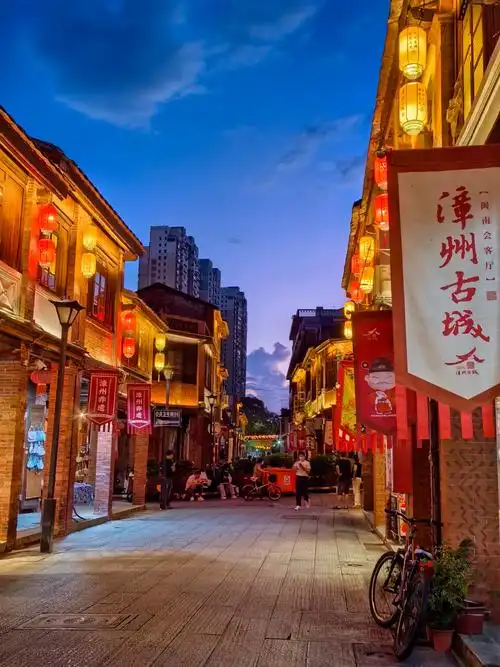 Zhangzhou's history stretches back to the Tang dynasty (618–907 CE), with successive expansions during the Song, Yuan, Ming, and Qing eras shaping its "pillow of three terraces, lapped by two rivers" configuration. Recognized as a core zone of a National Historical and Cultural City in 1994, it predates many European Renaissance towns yet retains a more authentic, lived-in atmosphere than today's heavily touristed old quarters in cities like Florence or Prague. The ancient "Nine Streets and Thirteen Alleys" grid—comparable in density to Venice's medieval calle but far less crowded—still guides visitors through the same commercial arteries merchants walked a millennium ago.
The architectural highlights cluster along Taiwan Road and Hong Kong Road, where colonnaded arcades reminiscent of Singapore's shophouses or Hanoi's Old Quarter line the streets. Southeast Asian-style pillars mingle with classic Minnan red-brick residences crowned by elegant swallow-tail roof ridges—a style unique to the Fujian-Taiwan region. Two exquisite Ming dynasty stone memorial archways, "Shangshu Tanhua" and "Sanshi Zai'er," showcase intricate carvings that rival European Baroque stonework in craftsmanship. The Confucius Temple, founded in the Northern Song period (around 1044 CE), ranks among the oldest surviving coastal temple complexes dedicated to China's most revered sage.
Culture here isn't preserved behind glass—it's actively practiced. The city hosts seven national-level intangible heritage traditions, including glove puppetry, woodblock printing of Buddhist scriptures, and the famed Babao seal paste (a red cinnabar ink once used on imperial documents). On Xiuwen Road's "Intangible Heritage Street," master craftspeople demonstrate puppet carving and ink-pad making live, while returnee侨 descendants on Guilai Street tell the story of the Minnan diaspora who sailed south to Southeast Asia—much like the Italian, Irish, or Greek emigrant traditions that shaped entire neighborhoods in New York or Buenos Aires.
Food is the true soul of any Zhangzhou visit. For roughly $7–11 USD per person, travelers can feast on lu mian (rich braised noodles), siguo tang (a cooling four-fruit dessert), mochi-like ma ci, and crispy炸五香 pork rolls. Hidden alleys serve Vietnamese grilled beef short ribs and Malaysian-inspired desserts, reflecting the Hokkien diaspora's Southeast Asian connections—a culinary bridge between China and the Malay world. Plan your visit for late afternoon: the golden hour illuminates the arcades beautifully, and lanterns transform the lanes after dark.
Practical tips: the old town is open 24/7 and entirely free, with no ticket needed for any attraction. From Zhangzhou High-Speed Rail Station, a taxi takes about 20 minutes (¥30–50). No cars enter the historic core, so wear comfortable walking shoes or rent a shared e-bike. Spring and autumn offer the most pleasant weather; summer brings humidity and typhoon risks worth monitoring. Photography enthusiasts should target the Taiwan Road arcade's vanishing-point perspective, the archways shot from below, the temple's symmetrical red walls, and the rooftop panorama from the historic Baihuo Building at sunset. Always ask residents before photographing private homes.
Zhangzhou's history stretches back to the Tang dynasty (618–907 CE), with successive expansions during the Song, Yuan, Ming, and Qing eras shaping its "pillow of three terraces, lapped by two rivers" configuration. Recognized as a core zone of a National Historical and Cultural City in 1994, it predates many European Renaissance towns yet retains a more authentic, lived-in atmosphere than today's heavily touristed old quarters in cities like Florence or Prague. The ancient "Nine Streets and Thirteen Alleys" grid—comparable in density to Venice's medieval calle but far less crowded—still guides visitors through the same commercial arteries merchants walked a millennium ago.
The architectural highlights cluster along Taiwan Road and Hong Kong Road, where colonnaded arcades reminiscent of Singapore's shophouses or Hanoi's Old Quarter line the streets. Southeast Asian-style pillars mingle with classic Minnan red-brick residences crowned by elegant swallow-tail roof ridges—a style unique to the Fujian-Taiwan region. Two exquisite Ming dynasty stone memorial archways, "Shangshu Tanhua" and "Sanshi Zai'er," showcase intricate carvings that rival European Baroque stonework in craftsmanship. The Confucius Temple, founded in the Northern Song period (around 1044 CE), ranks among the oldest surviving coastal temple complexes dedicated to China's most revered sage.
Culture here isn't preserved behind glass—it's actively practiced. The city hosts seven national-level intangible heritage traditions, including glove puppetry, woodblock printing of Buddhist scriptures, and the famed Babao seal paste (a red cinnabar ink once used on imperial documents). On Xiuwen Road's "Intangible Heritage Street," master craftspeople demonstrate puppet carving and ink-pad making live, while returnee侨 descendants on Guilai Street tell the story of the Minnan diaspora who sailed south to Southeast Asia—much like the Italian, Irish, or Greek emigrant traditions that shaped entire neighborhoods in New York or Buenos Aires.
Food is the true soul of any Zhangzhou visit. For roughly $7–11 USD per person, travelers can feast on lu mian (rich braised noodles), siguo tang (a cooling four-fruit dessert), mochi-like ma ci, and crispy炸五香 pork rolls. Hidden alleys serve Vietnamese grilled beef short ribs and Malaysian-inspired desserts, reflecting the Hokkien diaspora's Southeast Asian connections—a culinary bridge between China and the Malay world. Plan your visit for late afternoon: the golden hour illuminates the arcades beautifully, and lanterns transform the lanes after dark.
Practical tips: the old town is open 24/7 and entirely free, with no ticket needed for any attraction. From Zhangzhou High-Speed Rail Station, a taxi takes about 20 minutes (¥30–50). No cars enter the historic core, so wear comfortable walking shoes or rent a shared e-bike. Spring and autumn offer the most pleasant weather; summer brings humidity and typhoon risks worth monitoring. Photography enthusiasts should target the Taiwan Road arcade's vanishing-point perspective, the archways shot from below, the temple's symmetrical red walls, and the rooftop panorama from the historic Baihuo Building at sunset. Always ask residents before photographing private homes.