Yundongyan Scenic Area
⭐ 4.30
Yundongyan Scenic Area, Longwen District, Zhangzhou City, Fujian Province, China
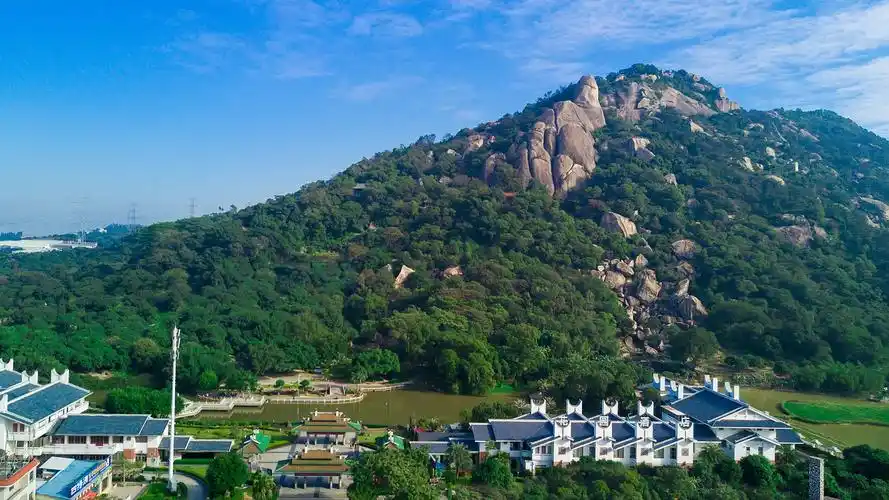 Yundongyan's story begins in the Tang dynasty, when scholars first climbed its misty slopes seeking inspiration among its granite hollows. By the Five Dynasties period, travelers like the legendary hermit Xu Que were leaving verses in the stone, but it was the 12th-century visit of Zhu Xi—the towering neo-Confucian philosopher whose ideas shaped East Asian governance as profoundly as Aquinas shaped medieval Europe—that transformed the mountain into a pilgrimage site for literati. His inscriptions, alongside works by officials and poets across ten centuries, make this collection comparable in ambition to the famous cliff carvings at China's Mount Tai, though far more intimate and uncrowded.
Unlike the limestone karst caves that honeycomb Guilin or Vietnam's Ha Long Bay, Yundongyan's 40-odd caverns were hollowed from weathered granite, producing the distinctive red-hued Danxia formations that geologists compare to Arizona's Paria Canyon or parts of Spain's Bardenas Reales. The Thousand Person Cave is the crown jewel—a vast natural chamber where a thousand visitors can stand comfortably while summer temperatures outside climb past 35°C. The mountain's most heart-stopping feature is the One-Line Sky, a near-vertical fissure that forces climbers to turn sideways and edge upward through dripping stone walls, an experience that rivals Romania's celebrated Bicaz Gorges in sheer visceral thrill.
What truly distinguishes Yundongyan is its open-air calligraphy gallery, where more than 200 inscriptions in seal, clerical, regular, running, and cursive scripts are carved directly into living rock. Imagine the Bayeux Tapestry translated into stone: each inscription marks a moment when a scholar paused on a precarious ledge to leave his mark for posterity. Some pieces date to the late Tang dynasty, others to the Southern Song, Ming, and Qing periods, creating a remarkable timeline of Chinese literary culture you can trace with your fingertips. For travelers interested in East Asian history, this is the equivalent of stumbling upon a hidden annex of the British Museum carved into a mountainside.
Reaching the mountain is refreshingly simple. From Zhangzhou city center, buses 1, 23, B6, or the dedicated L8 cultural tourism line (just 2 yuan) deliver visitors directly to the entrance. Drivers coming from Xiamen will find the journey takes roughly an hour along well-maintained highways. The site opens daily from 8:00 AM to 6:00 PM, with extended hours until 7:30 PM during summer; calling 0596-2102223 beforehand is wise, particularly during typhoon season. Admission remains free, though donations to support the inscriptions' preservation are welcome.
Plan a half-day visit, allowing two to three hours for the classic circuit: pass through the welcoming Crane Gate, admire the Scholar Zhu Xi's celebrated inscriptions, venture into the Thousand Person Cave, brave the One-Line Sky, and summit at Tianzhu Peak to witness the famous wind-rocking boulder that defies gravity. Sturdy hiking shoes are essential—the stone steps grow slick with moss, particularly after rain. Bring water, insect repellent, and a light jacket in summer. Time your ascent for early morning or just after a rainfall to witness the cloud-mist phenomenon that gave the mountain its name. After descending, treat yourself to the local specialty: salt-baked chicken prepared in traditional Zhangzhou style, a regional delicacy dating back centuries.
Yundongyan's story begins in the Tang dynasty, when scholars first climbed its misty slopes seeking inspiration among its granite hollows. By the Five Dynasties period, travelers like the legendary hermit Xu Que were leaving verses in the stone, but it was the 12th-century visit of Zhu Xi—the towering neo-Confucian philosopher whose ideas shaped East Asian governance as profoundly as Aquinas shaped medieval Europe—that transformed the mountain into a pilgrimage site for literati. His inscriptions, alongside works by officials and poets across ten centuries, make this collection comparable in ambition to the famous cliff carvings at China's Mount Tai, though far more intimate and uncrowded.
Unlike the limestone karst caves that honeycomb Guilin or Vietnam's Ha Long Bay, Yundongyan's 40-odd caverns were hollowed from weathered granite, producing the distinctive red-hued Danxia formations that geologists compare to Arizona's Paria Canyon or parts of Spain's Bardenas Reales. The Thousand Person Cave is the crown jewel—a vast natural chamber where a thousand visitors can stand comfortably while summer temperatures outside climb past 35°C. The mountain's most heart-stopping feature is the One-Line Sky, a near-vertical fissure that forces climbers to turn sideways and edge upward through dripping stone walls, an experience that rivals Romania's celebrated Bicaz Gorges in sheer visceral thrill.
What truly distinguishes Yundongyan is its open-air calligraphy gallery, where more than 200 inscriptions in seal, clerical, regular, running, and cursive scripts are carved directly into living rock. Imagine the Bayeux Tapestry translated into stone: each inscription marks a moment when a scholar paused on a precarious ledge to leave his mark for posterity. Some pieces date to the late Tang dynasty, others to the Southern Song, Ming, and Qing periods, creating a remarkable timeline of Chinese literary culture you can trace with your fingertips. For travelers interested in East Asian history, this is the equivalent of stumbling upon a hidden annex of the British Museum carved into a mountainside.
Reaching the mountain is refreshingly simple. From Zhangzhou city center, buses 1, 23, B6, or the dedicated L8 cultural tourism line (just 2 yuan) deliver visitors directly to the entrance. Drivers coming from Xiamen will find the journey takes roughly an hour along well-maintained highways. The site opens daily from 8:00 AM to 6:00 PM, with extended hours until 7:30 PM during summer; calling 0596-2102223 beforehand is wise, particularly during typhoon season. Admission remains free, though donations to support the inscriptions' preservation are welcome.
Plan a half-day visit, allowing two to three hours for the classic circuit: pass through the welcoming Crane Gate, admire the Scholar Zhu Xi's celebrated inscriptions, venture into the Thousand Person Cave, brave the One-Line Sky, and summit at Tianzhu Peak to witness the famous wind-rocking boulder that defies gravity. Sturdy hiking shoes are essential—the stone steps grow slick with moss, particularly after rain. Bring water, insect repellent, and a light jacket in summer. Time your ascent for early morning or just after a rainfall to witness the cloud-mist phenomenon that gave the mountain its name. After descending, treat yourself to the local specialty: salt-baked chicken prepared in traditional Zhangzhou style, a regional delicacy dating back centuries.