Langya Mountain Cliff Inscriptions
⭐ 4.20
Within Langya Mountain Scenic Area, Langya District, Chuzhou City, Anhui Province, China
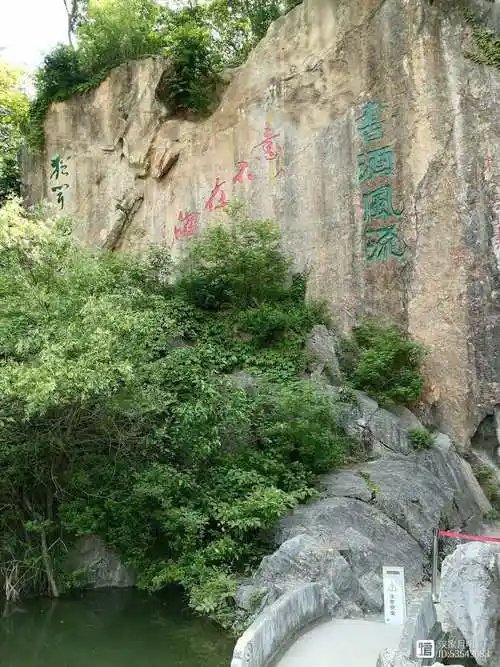 Mount Langya's inscription tradition began in 771 CE, roughly the same era Charlemagne was consolidating his Frankish empire and the Tang court was reaching its cultural zenith. Over twelve centuries, officials, monks, and poets left verses, prose, and images on the mountain's rock faces and cave walls, creating a continuous literary record unmatched in central China. The Tang-dynasty carvings alone—seven of them—represent the largest grouping of pre-tenth-century cliff inscriptions in Anhui, comparable in density to the runestone fields of Scandinavia, though far richer in literary content.
The site's three most celebrated treasures each represent a different art form. Inside the Baosong Studio, the calligrapher Su Shi—who lived contemporaneously with the Norman conquerors of England—rendered Ouyang Xiu's immortal essay "The Old Drunkard's Pavilion" in austere regular script, a "dream team" pairing of prose and brushwork still regarded as a Song-dynasty peak. In the Guiyun and Xuehong Caves near Langya Temple, Tang-dynasty inscriptions include a Guanyin relief said to echo the brush of Wu Daozi, the era's supreme painter. A third treasure bears a snow-set verse by Xin Qiji, the southern Song's greatest lyric poet, whose martial spirit echoes the warrior-poets of medieval Europe.
The inscriptions cluster across three scenic zones: Zuiweng Pavilion, Fengle Pavilion, and Langya Temple, each offering a distinct flavor. The Zuiweng area has the densest concentration of literary relics, while the temple zone guards the oldest Tang carvings. The Fengle area preserves a recarved version of Su Shi's calligraphy for an essay celebrating shared public joy—a remarkably civic sentiment for an eleventh-century official. Together, the three zones allow visitors to trace Chinese stone-carving aesthetics across five dynasties in a single morning.
A visit rewards patience and curiosity more than speed. The carvings are tucked into cliffs, caves, and old paths, so renting an audio guide or booking an official docent is strongly recommended; some tablets are weathered enough that even Chinese readers need help deciphering them. Allow three to four hours along the recommended route: north gate → Zuiweng Pavilion → Tongle Garden → Langya Temple → South Heaven Gate. Comfortable non-slip shoes and mosquito repellent are essential, and visitors should never touch, trace, or photograph the stones with flash.
A delightful practical bonus: weekdays, thirty visitors, and weekends roughly sixty to one hundred, can gain free admission by reciting Ouyang Xiu's 400-character essay from memory at the gate within five minutes. Even without the literary feat, the entrance fee is modest. With around 4.2 out of 5 on visitor satisfaction, ratings rise for authenticity and atmosphere and dip for the physical effort and the difficulty of reading weathered text—making this a destination best suited to travelers who treat walking as part of the experience and who want to engage with one of China's most layered cultural landscapes.
Mount Langya's inscription tradition began in 771 CE, roughly the same era Charlemagne was consolidating his Frankish empire and the Tang court was reaching its cultural zenith. Over twelve centuries, officials, monks, and poets left verses, prose, and images on the mountain's rock faces and cave walls, creating a continuous literary record unmatched in central China. The Tang-dynasty carvings alone—seven of them—represent the largest grouping of pre-tenth-century cliff inscriptions in Anhui, comparable in density to the runestone fields of Scandinavia, though far richer in literary content.
The site's three most celebrated treasures each represent a different art form. Inside the Baosong Studio, the calligrapher Su Shi—who lived contemporaneously with the Norman conquerors of England—rendered Ouyang Xiu's immortal essay "The Old Drunkard's Pavilion" in austere regular script, a "dream team" pairing of prose and brushwork still regarded as a Song-dynasty peak. In the Guiyun and Xuehong Caves near Langya Temple, Tang-dynasty inscriptions include a Guanyin relief said to echo the brush of Wu Daozi, the era's supreme painter. A third treasure bears a snow-set verse by Xin Qiji, the southern Song's greatest lyric poet, whose martial spirit echoes the warrior-poets of medieval Europe.
The inscriptions cluster across three scenic zones: Zuiweng Pavilion, Fengle Pavilion, and Langya Temple, each offering a distinct flavor. The Zuiweng area has the densest concentration of literary relics, while the temple zone guards the oldest Tang carvings. The Fengle area preserves a recarved version of Su Shi's calligraphy for an essay celebrating shared public joy—a remarkably civic sentiment for an eleventh-century official. Together, the three zones allow visitors to trace Chinese stone-carving aesthetics across five dynasties in a single morning.
A visit rewards patience and curiosity more than speed. The carvings are tucked into cliffs, caves, and old paths, so renting an audio guide or booking an official docent is strongly recommended; some tablets are weathered enough that even Chinese readers need help deciphering them. Allow three to four hours along the recommended route: north gate → Zuiweng Pavilion → Tongle Garden → Langya Temple → South Heaven Gate. Comfortable non-slip shoes and mosquito repellent are essential, and visitors should never touch, trace, or photograph the stones with flash.
A delightful practical bonus: weekdays, thirty visitors, and weekends roughly sixty to one hundred, can gain free admission by reciting Ouyang Xiu's 400-character essay from memory at the gate within five minutes. Even without the literary feat, the entrance fee is modest. With around 4.2 out of 5 on visitor satisfaction, ratings rise for authenticity and atmosphere and dip for the physical effort and the difficulty of reading weathered text—making this a destination best suited to travelers who treat walking as part of the experience and who want to engage with one of China's most layered cultural landscapes.