Qinghui Garden
⭐ 4.60
No. 1, Qinghui Road, Daliang Subdistrict, Shunde District, Foshan City, Guangdong Province, China
 Step into Qinghui Garden and you walk through nearly five centuries of history, for its origins trace back to the late Ming era under Emperor Wanli, around 1600 CE—a period when Shakespeare's London was still rebuilding from the Great Plague and Galileo was refining his telescope. The estate originally belonged to Huang Shijun, a zhuangyuan (the empire's top-ranked scholar in the imperial examinations), before being expanded in the early 1800s by the Long family, scholarly gentry comparable to the cultivated landowning classes of contemporary European estates. The poetic name "Qinghui," drawn from Tang poet Meng Jiao's touching verse about a child's devotion to his mother, endows the garden with a soul reminiscent of the romantic, contemplative spirit found in English landscape gardens like Stourhead.
The garden's 2.2-hectare footprint reveals a remarkable architectural density, where every turn frames a new vista. The Ship Hall, a dry-land pleasure boat once serving as a young lady's embroidery chamber, is an architectural fantasy akin to Sanssouci's whimsical follies in Potsdam. Afternoon sunlight streaming through the precious Qing-dynasty Manchu stained-glass windows—depicting the Eight Scenes of Guangzhou in layered colored glass—paints the floor in kaleidoscopic patterns; such Sino-Western craftsmanship remains exceptionally rare in Chinese garden design. The Bixi Caotang (Green Stream Thatched Hall), the garden's oldest surviving building, features breathtaking "Hundred Longevity" wood carvings that showcase the patient artistry of master Ming-Qing craftsmen.
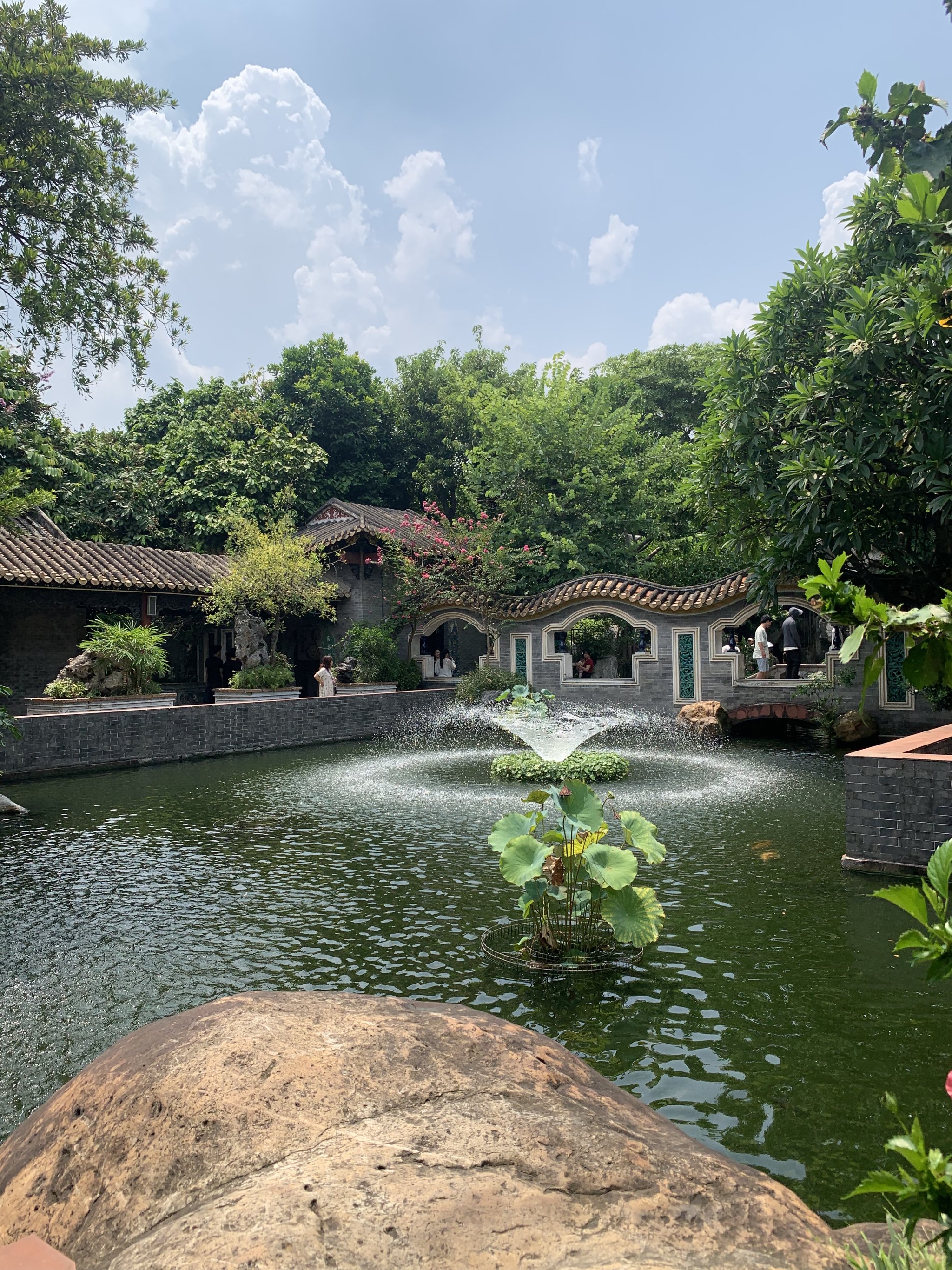
The signature Fenglai Peak rises to roughly four stories, the tallest surviving granite rockery in all of Guangdong. Visitors can wind through its mysterious grottoes and climb to the summit for sweeping water views—a vertical adventure reminiscent of scaling the rocky outcrops at Villa d'Este, though in classical Chinese style. Floating serenely at the lotus pond's heart, the octagonal Chengyi Pavilion (Clear Ripple Pavilion) offers a perfect vantage where, on misty mornings, carp swirl beneath mirrored reflections. The garden's genius lies in synthesizing Lingnan practicality with Jiangnan lyricism, achieving that enviable "greatness within smallness" through compressed spaces that somehow feel infinite.
Practical planning is refreshingly simple: admission is just 15 yuan, with daily hours from 9:00 to 17:00 and last entry at 16:30. The site holds a 4A scenic rating. For photographers and contemplative travelers alike, weekday mornings or post-rain afternoons deliver the softest light and fewest crowds; visitors dressed in neutral tones or modern interpretations of traditional Chinese clothing will capture the most striking images. No thrill rides or noisy distractions exist here—the experience is decidedly meditative, rewarding those with genuine curiosity for historic architecture, atmospheric light, and cultural heritage.
Extend your visit into a satisfying half-day by walking to neighboring Jinbang Street, Shunde's legendary culinary corridor, where you can sample double-skin milk pudding, sweet milk curds, and crispy fish skin—treats as essential to the region as gelato is to Florence. Reaching the garden is straightforward via Foshan Metro Line 3 to Dalian Zhonglou Station (Exit E), followed by a 500-meter stroll to the south gate. Holiday drivers should park at the nearby Sports Center and take a shuttle to avoid congestion. As a protected heritage site, smoking, climbing rockeries, and touching artifacts are strictly prohibited, and visitors should exercise caution on damp pond-side paths.
Step into Qinghui Garden and you walk through nearly five centuries of history, for its origins trace back to the late Ming era under Emperor Wanli, around 1600 CE—a period when Shakespeare's London was still rebuilding from the Great Plague and Galileo was refining his telescope. The estate originally belonged to Huang Shijun, a zhuangyuan (the empire's top-ranked scholar in the imperial examinations), before being expanded in the early 1800s by the Long family, scholarly gentry comparable to the cultivated landowning classes of contemporary European estates. The poetic name "Qinghui," drawn from Tang poet Meng Jiao's touching verse about a child's devotion to his mother, endows the garden with a soul reminiscent of the romantic, contemplative spirit found in English landscape gardens like Stourhead.
The garden's 2.2-hectare footprint reveals a remarkable architectural density, where every turn frames a new vista. The Ship Hall, a dry-land pleasure boat once serving as a young lady's embroidery chamber, is an architectural fantasy akin to Sanssouci's whimsical follies in Potsdam. Afternoon sunlight streaming through the precious Qing-dynasty Manchu stained-glass windows—depicting the Eight Scenes of Guangzhou in layered colored glass—paints the floor in kaleidoscopic patterns; such Sino-Western craftsmanship remains exceptionally rare in Chinese garden design. The Bixi Caotang (Green Stream Thatched Hall), the garden's oldest surviving building, features breathtaking "Hundred Longevity" wood carvings that showcase the patient artistry of master Ming-Qing craftsmen.
The signature Fenglai Peak rises to roughly four stories, the tallest surviving granite rockery in all of Guangdong. Visitors can wind through its mysterious grottoes and climb to the summit for sweeping water views—a vertical adventure reminiscent of scaling the rocky outcrops at Villa d'Este, though in classical Chinese style. Floating serenely at the lotus pond's heart, the octagonal Chengyi Pavilion (Clear Ripple Pavilion) offers a perfect vantage where, on misty mornings, carp swirl beneath mirrored reflections. The garden's genius lies in synthesizing Lingnan practicality with Jiangnan lyricism, achieving that enviable "greatness within smallness" through compressed spaces that somehow feel infinite.
Practical planning is refreshingly simple: admission is just 15 yuan, with daily hours from 9:00 to 17:00 and last entry at 16:30. The site holds a 4A scenic rating. For photographers and contemplative travelers alike, weekday mornings or post-rain afternoons deliver the softest light and fewest crowds; visitors dressed in neutral tones or modern interpretations of traditional Chinese clothing will capture the most striking images. No thrill rides or noisy distractions exist here—the experience is decidedly meditative, rewarding those with genuine curiosity for historic architecture, atmospheric light, and cultural heritage.
Extend your visit into a satisfying half-day by walking to neighboring Jinbang Street, Shunde's legendary culinary corridor, where you can sample double-skin milk pudding, sweet milk curds, and crispy fish skin—treats as essential to the region as gelato is to Florence. Reaching the garden is straightforward via Foshan Metro Line 3 to Dalian Zhonglou Station (Exit E), followed by a 500-meter stroll to the south gate. Holiday drivers should park at the nearby Sports Center and take a shuttle to avoid congestion. As a protected heritage site, smoking, climbing rockeries, and touching artifacts are strictly prohibited, and visitors should exercise caution on damp pond-side paths.