Leizhou Peninsula Volcano Geological Park
⭐ 3.80
Leizhou Peninsula Volcano Geological Park, Leizhou City, Zhanjiang City, Guangdong Province, China
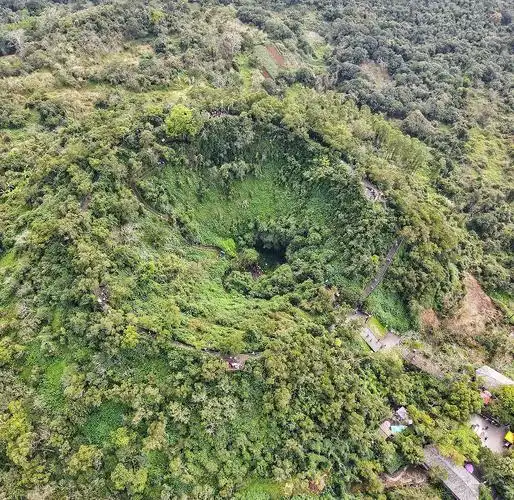 Comparable to Germany's celebrated Eifel maars—though considerably larger and older—Lake Huguang Maar formed 140,000 to 160,000 years ago when rising magma met groundwater, triggering a violent steam explosion that carved a shallow crater later filled by rainwater. Unlike Arizona's Meteor Crater, this lake was forged entirely by Earth's internal heat. Its undisturbed sediment layers, functioning like a tree's annual rings, contain an unbroken archive of Ice Age climate shifts spanning more than 140 millennia, earning it the nickname "natural chronicle of environmental change." The heart-shaped basin never floods nor dries, and surrounding air ranks among China's most oxygen-and-ion-rich.
The Lengyan Temple offers a rare cultural encounter: a Buddhist sanctuary hewn partly from volcanic rock, founded during the Sui Dynasty around 605 CE—roughly contemporary with the rise of Anglo-Saxon England or the Merovingian Frankish kingdoms. For fourteen centuries, pilgrims have gathered in this cave-like hall, where incense still curls around altars framed by raw basalt and hardened lava flows. The juxtaposition of ornate Buddhist statuary against rugged volcanic terrain creates an aesthetic unlike almost anything in Europe, where most medieval monastic sites rest on limestone or granite rather than the cooled debris of an eruption.
Climb the stone steps of Wanghai Tower, the park's 30-meter observation pavilion, for the finest vantage point over the entire maar and surrounding volcanic tableland. From here, the lake's perfect heart shape becomes unmistakable, while on clear days you can trace dark basalt scarps running south toward the South China Sea. The tower's wooden galleries recall classical Chinese pavilion architecture, similar in spirit to the pagodas of Beijing's Summer Palace, though framed here by tropical vegetation rather than imperial gardens.
Before exploring the lakeshore, begin at the Leiqiong Global Geopark Museum, a sleek modern facility that decodes the region's volcanic story through interactive displays, polished basalt samples, and cross-sectional models of the maar basin. Exhibits walk visitors through the entire timeline of Leiqiong volcanism, from ancient shield eruptions to coastal lava deltas, explaining how underground pressure—not surface impact—shaped this landscape. Geologists liken its educational clarity to Iceland's Reykjanes peninsula visitor centers, making complex magmatic processes accessible to non-specialists.
Practical visit information: the park sits in Mazhang District, about 18km from Zhanjiang city center (roughly 30 minutes by car). Adult admission runs around 50 yuan, with summer hours of 7:00 a.m. to 6:30 p.m. (last entry 4:30 p.m.); winter hours shorten slightly. Arrive before 8:30 a.m. to beat both heat and tour buses. Begin at the West Gate, visit the museum first, walk the 7-kilometer lakeshore loop counter-clockwise (2–3 hours), continue to Lengyan Temple, finish at Wanghai Tower, then exit through the West Gate. Allow half a day minimum, a full day if unhurried.
Public buses 9 and 506 reach the park, but a taxi or private car remains far more convenient—set your GPS to "Lake Huguang Scenic Area West Gate" to land near the geological core. Consider hiring a guide or downloading an audio tour; without context, the maar's significance can seem underwhelming. Sunscreen and insect repellent are essential May through September. Combine the visit with a half-day in nearby Leizhou Old Town, whose Ming-era walled streets and ancestral halls contrast beautifully with the prehistoric landscape, or the mangroves of Jiulongshan Wetland for bird-rich coastal walking.
Comparable to Germany's celebrated Eifel maars—though considerably larger and older—Lake Huguang Maar formed 140,000 to 160,000 years ago when rising magma met groundwater, triggering a violent steam explosion that carved a shallow crater later filled by rainwater. Unlike Arizona's Meteor Crater, this lake was forged entirely by Earth's internal heat. Its undisturbed sediment layers, functioning like a tree's annual rings, contain an unbroken archive of Ice Age climate shifts spanning more than 140 millennia, earning it the nickname "natural chronicle of environmental change." The heart-shaped basin never floods nor dries, and surrounding air ranks among China's most oxygen-and-ion-rich.
The Lengyan Temple offers a rare cultural encounter: a Buddhist sanctuary hewn partly from volcanic rock, founded during the Sui Dynasty around 605 CE—roughly contemporary with the rise of Anglo-Saxon England or the Merovingian Frankish kingdoms. For fourteen centuries, pilgrims have gathered in this cave-like hall, where incense still curls around altars framed by raw basalt and hardened lava flows. The juxtaposition of ornate Buddhist statuary against rugged volcanic terrain creates an aesthetic unlike almost anything in Europe, where most medieval monastic sites rest on limestone or granite rather than the cooled debris of an eruption.
Climb the stone steps of Wanghai Tower, the park's 30-meter observation pavilion, for the finest vantage point over the entire maar and surrounding volcanic tableland. From here, the lake's perfect heart shape becomes unmistakable, while on clear days you can trace dark basalt scarps running south toward the South China Sea. The tower's wooden galleries recall classical Chinese pavilion architecture, similar in spirit to the pagodas of Beijing's Summer Palace, though framed here by tropical vegetation rather than imperial gardens.
Before exploring the lakeshore, begin at the Leiqiong Global Geopark Museum, a sleek modern facility that decodes the region's volcanic story through interactive displays, polished basalt samples, and cross-sectional models of the maar basin. Exhibits walk visitors through the entire timeline of Leiqiong volcanism, from ancient shield eruptions to coastal lava deltas, explaining how underground pressure—not surface impact—shaped this landscape. Geologists liken its educational clarity to Iceland's Reykjanes peninsula visitor centers, making complex magmatic processes accessible to non-specialists.
Practical visit information: the park sits in Mazhang District, about 18km from Zhanjiang city center (roughly 30 minutes by car). Adult admission runs around 50 yuan, with summer hours of 7:00 a.m. to 6:30 p.m. (last entry 4:30 p.m.); winter hours shorten slightly. Arrive before 8:30 a.m. to beat both heat and tour buses. Begin at the West Gate, visit the museum first, walk the 7-kilometer lakeshore loop counter-clockwise (2–3 hours), continue to Lengyan Temple, finish at Wanghai Tower, then exit through the West Gate. Allow half a day minimum, a full day if unhurried.
Public buses 9 and 506 reach the park, but a taxi or private car remains far more convenient—set your GPS to "Lake Huguang Scenic Area West Gate" to land near the geological core. Consider hiring a guide or downloading an audio tour; without context, the maar's significance can seem underwhelming. Sunscreen and insect repellent are essential May through September. Combine the visit with a half-day in nearby Leizhou Old Town, whose Ming-era walled streets and ancestral halls contrast beautifully with the prehistoric landscape, or the mangroves of Jiulongshan Wetland for bird-rich coastal walking.