Zhanjiang Museum
⭐ 4.20
No. 2, Cunjin Road, Chikan District, Zhanjiang City, Guangdong Province, China
 **Historical Context**
Zhanjiang Museum, founded in 1960, preserves the memory of a city whose modern identity was forged under colonial pressure. In 1898, France leased the harbor and surrounding territory, naming it Guangzhouwan, a Pacific foothold comparable to Britain's Hong Kong or Germany's Qingdao. The lease lasted until 1946, making Zhanjiang one of the last European concessions on the Chinese coast. Its collections trace this turbulent era, from the 1898 anti-French uprising, when local militias vowed to resist the foreign flag, through the Republican and Maoist periods, when the city transformed into a major industrial port. The museum thus serves as the institutional memory of southwestern Guangdong.
**Architecture**
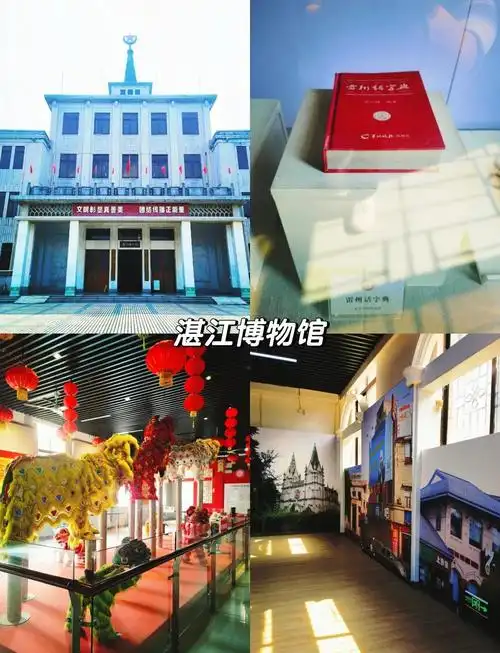
The main building is a three-story Soviet-influenced structure clad in red brick, crowned by a red five-pointed star. This Stalinist style, common in 1950s Chinese civic architecture, recalls similar utilitarian landmarks across the former Eastern Bloc, from Moscow's VDNKh pavilions to industrial academies in Leipzig. Set against Cunjin Park's greenery, the symmetrical, fortress-like block contrasts charmingly with the tropical foliage. Visitors on the second floor enjoy distant views over Zhanjiang Harbor, a reminder that the museum sits where East meets South China Sea.
**Collection Highlights**
Around 6,900 objects are held here, with 1,193 classified as culturally significant. Among the standout pieces is a remarkably preserved Eastern Han dugout canoe, hewn from a single log over 1,800 years ago, offering a tangible link to early maritime trade along the South China Sea. The Tang dynasty Kunlun female head, depicting a dark-skinned woman as portrayed in medieval Chinese art, reflects the cosmopolitan reach of Silk Road-era Guangdong. Ancient bronze drums, echoing similar instruments found from Yunnan to Vietnam, anchor the regional culture section, alongside ceramics from the distinctive Leizhou kilns.
**Cultural Significance**
The permanent galleries weave a coherent civic narrative. The Resistance Against France exhibition, opening with the dramatic 1898 oath-taking ceremony, parallels anti-colonial movements from Cuba to Indochina. Displays on intangible heritage celebrate Leizhou stone dogs, Suixi lion dancing, and traditional puppet theater, forms that survived centuries of cultural exchange with Southeast Asia. Together, the galleries position Zhanjiang not as a provincial backwater but as a dynamic maritime gateway whose Leizhou culture remains a vital, living tradition.
**Practical Information**
The museum stands at 50 Nanfang Road, Chikan District. It opens Tuesday through Sunday from 9:00 a.m. to 5:30 p.m., with last entry at 5:00 p.m.; Monday is the weekly closing day. Admission is free, and reservations can be made via the official WeChat account. Free audio guides are available by scanning a QR code on site. Allow roughly two hours for a comfortable visit. The nearest dining and refreshment options lie along Nanfang Road, and the museum is fully air-conditioned, a welcome refuge during the humid summer months.
**Why Visit**
For travelers tracing China's lesser-known coastal histories, Zhanjiang Museum offers surprising depth in an unassuming setting. Pair the visit with a stroll through neighboring Cunjin Bridge Park, where the very bridge commemorates local patriotism, then continue to the former French Consulate in Xiashan District to see where colonial administrators once worked. History-minded visitors, families, and anyone interested in Southeast Asian maritime culture will find the museum a rewarding detour well off the standard Guangdong tourist trail.
**Historical Context**
Zhanjiang Museum, founded in 1960, preserves the memory of a city whose modern identity was forged under colonial pressure. In 1898, France leased the harbor and surrounding territory, naming it Guangzhouwan, a Pacific foothold comparable to Britain's Hong Kong or Germany's Qingdao. The lease lasted until 1946, making Zhanjiang one of the last European concessions on the Chinese coast. Its collections trace this turbulent era, from the 1898 anti-French uprising, when local militias vowed to resist the foreign flag, through the Republican and Maoist periods, when the city transformed into a major industrial port. The museum thus serves as the institutional memory of southwestern Guangdong.
**Architecture**
The main building is a three-story Soviet-influenced structure clad in red brick, crowned by a red five-pointed star. This Stalinist style, common in 1950s Chinese civic architecture, recalls similar utilitarian landmarks across the former Eastern Bloc, from Moscow's VDNKh pavilions to industrial academies in Leipzig. Set against Cunjin Park's greenery, the symmetrical, fortress-like block contrasts charmingly with the tropical foliage. Visitors on the second floor enjoy distant views over Zhanjiang Harbor, a reminder that the museum sits where East meets South China Sea.
**Collection Highlights**
Around 6,900 objects are held here, with 1,193 classified as culturally significant. Among the standout pieces is a remarkably preserved Eastern Han dugout canoe, hewn from a single log over 1,800 years ago, offering a tangible link to early maritime trade along the South China Sea. The Tang dynasty Kunlun female head, depicting a dark-skinned woman as portrayed in medieval Chinese art, reflects the cosmopolitan reach of Silk Road-era Guangdong. Ancient bronze drums, echoing similar instruments found from Yunnan to Vietnam, anchor the regional culture section, alongside ceramics from the distinctive Leizhou kilns.
**Cultural Significance**
The permanent galleries weave a coherent civic narrative. The Resistance Against France exhibition, opening with the dramatic 1898 oath-taking ceremony, parallels anti-colonial movements from Cuba to Indochina. Displays on intangible heritage celebrate Leizhou stone dogs, Suixi lion dancing, and traditional puppet theater, forms that survived centuries of cultural exchange with Southeast Asia. Together, the galleries position Zhanjiang not as a provincial backwater but as a dynamic maritime gateway whose Leizhou culture remains a vital, living tradition.
**Practical Information**
The museum stands at 50 Nanfang Road, Chikan District. It opens Tuesday through Sunday from 9:00 a.m. to 5:30 p.m., with last entry at 5:00 p.m.; Monday is the weekly closing day. Admission is free, and reservations can be made via the official WeChat account. Free audio guides are available by scanning a QR code on site. Allow roughly two hours for a comfortable visit. The nearest dining and refreshment options lie along Nanfang Road, and the museum is fully air-conditioned, a welcome refuge during the humid summer months.
**Why Visit**
For travelers tracing China's lesser-known coastal histories, Zhanjiang Museum offers surprising depth in an unassuming setting. Pair the visit with a stroll through neighboring Cunjin Bridge Park, where the very bridge commemorates local patriotism, then continue to the former French Consulate in Xiashan District to see where colonial administrators once worked. History-minded visitors, families, and anyone interested in Southeast Asian maritime culture will find the museum a rewarding detour well off the standard Guangdong tourist trail.