Nanmen Park
⭐ 3.80
Nanmen Park, Wuxing District, Huzhou City, Zhejiang Province, China
 Huzhou, a Jiangnan city in northern Zhejiang, traces its roots back over 2,300 years to the Spring and Autumn period, when it served as a strategic settlement south of the great Qiantang River system. The "South Gate" name preserves the location of one of the city's original walled entrances, much as the surviving Porta San Donato still marks the medieval perimeter of Bologna. Today, fragments of Huzhou's ancient ramparts lie within a few minutes' walk of the park, offering visitors a tangible link to the Ming and Qing eras when this region flourished as the silk-and-grain heartland of China. The park itself sits on land that long guarded the southern approach to the historic prefecture.
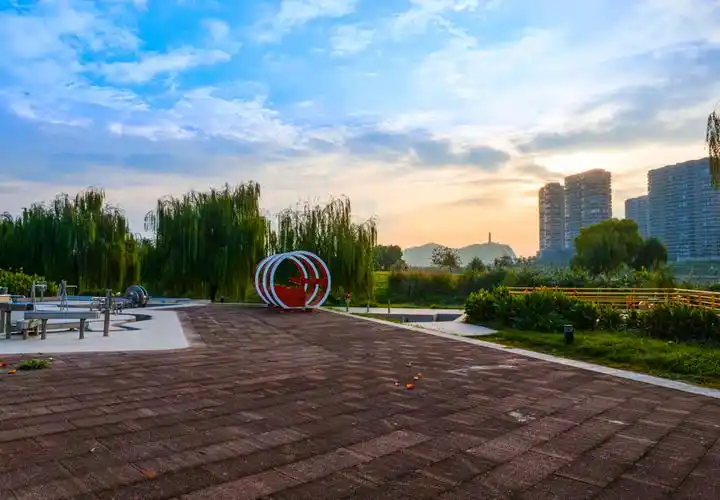
South Gate Park is laid out in the unhurried, informal manner typical of Chinese neighborhood parks, more reminiscent of a French *jardin public* than a formal English landscape garden. Winding, tree-shaded footpaths in smooth paving cut through broad lawns, with petite flower beds and slatted wooden benches tucked beneath canopies of native camphor and osmanthus trees. The compact fitness corner—equipped with low-key pull-up bars, twisting waist machines, and leg-stretching stations—mirrors the practical, no-frills approach you'd find in any small Italian *giardino pubblico*. Shade is generous year-round, and even at the height of summer the pathways remain comfortable.
What makes this park genuinely special is its atmosphere of unguarded daily life. Between roughly 7 and 9 a.m., and again from 4 to 6 p.m., retirees arrive to practice tai chi, fan dancing, and choreographed group routines, while neighbors swap greetings and children chase pigeons along the paths. For Western travelers accustomed to the staged "local color" of tourist attractions, the scene is refreshingly unscripted—a community behaving exactly as it does when no outsiders are watching. This is the kind of place where you can slow down, claim a bench, and simply absorb the pulse of contemporary Chinese urban life in a setting whose spirit has remained largely unchanged for generations.
The park is free to enter and open 24 hours a day, with no gates, no ticket booth, and no dress code beyond comfortable walking shoes. Allow one to two hours for a relaxed wander, ideally timed for the early morning or late afternoon when local activity peaks and temperatures are most pleasant. From here, a short walk north brings you to the Ancient City Wall Ruins and historic South Street, while a slightly longer stroll eastward reaches Yishang Street and Xiaoxi Street, two beautifully preserved late-Qing commercial lanes. Pair your visit with local specialties such as *qianzhang bao* (silken tofu skin parcels stuffed with pork), Zhu Laoda rice dumplings, or Ding Lianfang savory buns.
Think of South Gate Park less as a destination and more as a welcoming doorway into the authentic Huzhou that most travelers never see. While the city's headline attractions draw their own crowds, this modest green space rewards visitors with the same unsung richness found in a Roman neighborhood piazza or a Kyoto side-street garden—small, lived-in, and quietly revealing. It's the perfect place to begin or end a day of sightseeing, a green pause between temples and food streets, and a reminder that the most memorable encounters in China often unfold not behind museum walls but on an ordinary park bench, watching ordinary people live their ordinary, beautiful lives.
Huzhou, a Jiangnan city in northern Zhejiang, traces its roots back over 2,300 years to the Spring and Autumn period, when it served as a strategic settlement south of the great Qiantang River system. The "South Gate" name preserves the location of one of the city's original walled entrances, much as the surviving Porta San Donato still marks the medieval perimeter of Bologna. Today, fragments of Huzhou's ancient ramparts lie within a few minutes' walk of the park, offering visitors a tangible link to the Ming and Qing eras when this region flourished as the silk-and-grain heartland of China. The park itself sits on land that long guarded the southern approach to the historic prefecture.
South Gate Park is laid out in the unhurried, informal manner typical of Chinese neighborhood parks, more reminiscent of a French *jardin public* than a formal English landscape garden. Winding, tree-shaded footpaths in smooth paving cut through broad lawns, with petite flower beds and slatted wooden benches tucked beneath canopies of native camphor and osmanthus trees. The compact fitness corner—equipped with low-key pull-up bars, twisting waist machines, and leg-stretching stations—mirrors the practical, no-frills approach you'd find in any small Italian *giardino pubblico*. Shade is generous year-round, and even at the height of summer the pathways remain comfortable.
What makes this park genuinely special is its atmosphere of unguarded daily life. Between roughly 7 and 9 a.m., and again from 4 to 6 p.m., retirees arrive to practice tai chi, fan dancing, and choreographed group routines, while neighbors swap greetings and children chase pigeons along the paths. For Western travelers accustomed to the staged "local color" of tourist attractions, the scene is refreshingly unscripted—a community behaving exactly as it does when no outsiders are watching. This is the kind of place where you can slow down, claim a bench, and simply absorb the pulse of contemporary Chinese urban life in a setting whose spirit has remained largely unchanged for generations.
The park is free to enter and open 24 hours a day, with no gates, no ticket booth, and no dress code beyond comfortable walking shoes. Allow one to two hours for a relaxed wander, ideally timed for the early morning or late afternoon when local activity peaks and temperatures are most pleasant. From here, a short walk north brings you to the Ancient City Wall Ruins and historic South Street, while a slightly longer stroll eastward reaches Yishang Street and Xiaoxi Street, two beautifully preserved late-Qing commercial lanes. Pair your visit with local specialties such as *qianzhang bao* (silken tofu skin parcels stuffed with pork), Zhu Laoda rice dumplings, or Ding Lianfang savory buns.
Think of South Gate Park less as a destination and more as a welcoming doorway into the authentic Huzhou that most travelers never see. While the city's headline attractions draw their own crowds, this modest green space rewards visitors with the same unsung richness found in a Roman neighborhood piazza or a Kyoto side-street garden—small, lived-in, and quietly revealing. It's the perfect place to begin or end a day of sightseeing, a green pause between temples and food streets, and a reminder that the most memorable encounters in China often unfold not behind museum walls but on an ordinary park bench, watching ordinary people live their ordinary, beautiful lives.