Mount Jiuhua Scenic Area
⭐ 4.80
Mount Jiuhua Scenic Area, Chizhou, Anhui Province, China
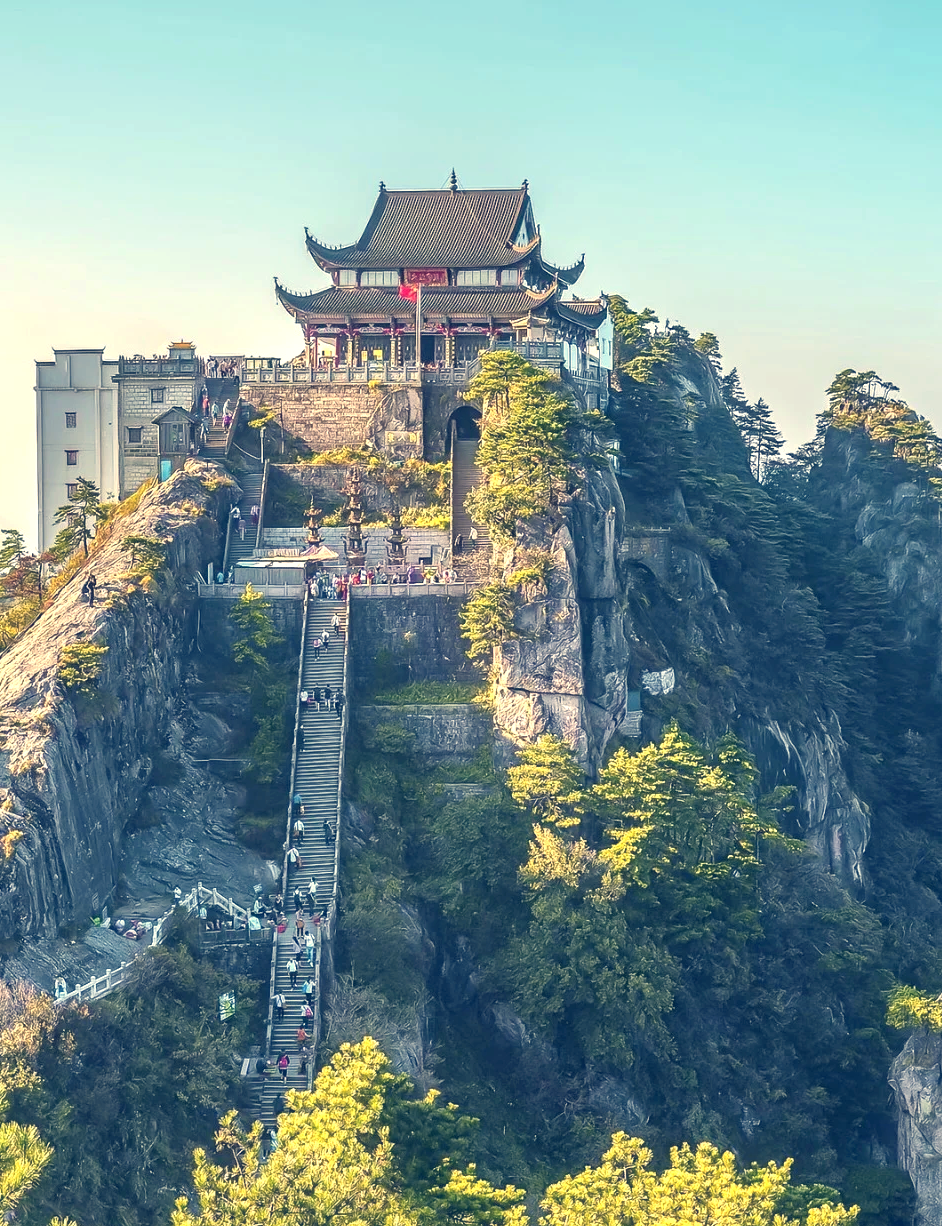 Mount Jiuhua entered the Buddhist canon in the Tang Dynasty when Kim Qiaojue (696–794), a royal-born monk from the Korean kingdom of Silla, ascended the mountain to practice solitary austerities. Like Saint Benedict founding Monte Cassino in sixth-century Italy or Saint Bruno establishing the Grande Chartreuse in France, Kim's hermitage evolved into one of Mahayana Buddhism's most influential centers. Over twelve centuries, what began as a single monk's cave dwelling expanded into a network of monasteries that received imperial patronage through the Ming and Qing dynasties, accumulating art, scriptures, and sacred relics that today form a vital archive of Chinese Buddhist history.
The 99 surviving temples integrate spectacularly with the granite topography, recalling Greek Orthodox monasteries of Meteora perched on towering rock pillars or the Benedictine abbeys cascading down Alpine slopes. The Corporeal Body Hall enshrines the mummified remains of Kim Qiaojue himself—a rarity matched only by the preserved saints of Italian churches or the relics of Saint Catherine in Siena. Nearby, the Hundred-Year-Old Palace, a five-story hillside structure, houses the remarkably intact body of the Ming-dynasty monk Wuxia. The founding Huacheng Temple displays the original pilgrim's hat and shoes of the Korean patriarch alongside a Ming-era Buddhist scripture copied in the master's own blood.
Beyond its religious significance, Jiuhua is a UNESCO Geopark where Cretaceous-era granite intrusions have been sculpted into surreal pinnacles, evoking the dolomitic spires of the Italian Alps or the hoodoos of America's Bryce Canyon. The Huatai (Flower Terrace) area explodes with alpine rhododendrons each spring, while cable cars ascend toward Tianhai Peak—often compared to Japan's Mount Koya—where visitors gather before dawn to witness billowing cloud seas and the rare "Buddha's light" halo. The 99-meter bronze statue of Kṣitigarbha at the nearby Dayuan Cultural Park rivals Rio's Christ the Redeemer in scale.
Tickets cost 160 RMB in peak season (Jan 16–Nov 14) and 140 RMB in low season; foreign visitors must present original passports at the visitor center ticket window. Mandatory eco-buses shuttle guests from parking areas into the core scenic zone for 50 RMB round-trip, while cable cars to Tianhai and Huatai charge 80–85 RMB each way. Private cars are prohibited within the core zone. Lodging clusters around Jiuhua Street, where family-run guesthouses offer simple rooms and vegetarian Buddhist cuisine. Allow at least two days to absorb both the religious sites and the mountain scenery.
Dress modestly when entering temples—shoulders and knees covered—and remove hats. Step over, never on, the raised wooden thresholds, a custom shared with traditional Japanese and Korean temple etiquette. Photography of Buddha statues is generally restricted. Mountain weather shifts rapidly: bring waterproof hiking shoes and a light rain jacket even in summer. The 81 stone steps leading up to the Corporeal Body Hall reward visitors with both spiritual focus and a panoramic view of the temple cluster below, much like the final climb to a hilltop basilica in Tuscany.
For Western travelers accustomed to Europe's cathedrals and pilgrimage routes—Santiago de Compostela, Assisi, or Canterbury—Jiuhua offers a parallel yet distinct spiritual geography, where living Buddhist practice has shaped the landscape for over a millennium. Whether you seek the Buddhist equivalent of saints' relics, the geological drama of the Alps, or simply a quieter corner of China, the mountain delivers an encounter with both transcendent beauty and tangible history. Few destinations combine active monasticism, ancient art, and alpine scenery so seamlessly.
Mount Jiuhua entered the Buddhist canon in the Tang Dynasty when Kim Qiaojue (696–794), a royal-born monk from the Korean kingdom of Silla, ascended the mountain to practice solitary austerities. Like Saint Benedict founding Monte Cassino in sixth-century Italy or Saint Bruno establishing the Grande Chartreuse in France, Kim's hermitage evolved into one of Mahayana Buddhism's most influential centers. Over twelve centuries, what began as a single monk's cave dwelling expanded into a network of monasteries that received imperial patronage through the Ming and Qing dynasties, accumulating art, scriptures, and sacred relics that today form a vital archive of Chinese Buddhist history.
The 99 surviving temples integrate spectacularly with the granite topography, recalling Greek Orthodox monasteries of Meteora perched on towering rock pillars or the Benedictine abbeys cascading down Alpine slopes. The Corporeal Body Hall enshrines the mummified remains of Kim Qiaojue himself—a rarity matched only by the preserved saints of Italian churches or the relics of Saint Catherine in Siena. Nearby, the Hundred-Year-Old Palace, a five-story hillside structure, houses the remarkably intact body of the Ming-dynasty monk Wuxia. The founding Huacheng Temple displays the original pilgrim's hat and shoes of the Korean patriarch alongside a Ming-era Buddhist scripture copied in the master's own blood.
Beyond its religious significance, Jiuhua is a UNESCO Geopark where Cretaceous-era granite intrusions have been sculpted into surreal pinnacles, evoking the dolomitic spires of the Italian Alps or the hoodoos of America's Bryce Canyon. The Huatai (Flower Terrace) area explodes with alpine rhododendrons each spring, while cable cars ascend toward Tianhai Peak—often compared to Japan's Mount Koya—where visitors gather before dawn to witness billowing cloud seas and the rare "Buddha's light" halo. The 99-meter bronze statue of Kṣitigarbha at the nearby Dayuan Cultural Park rivals Rio's Christ the Redeemer in scale.
Tickets cost 160 RMB in peak season (Jan 16–Nov 14) and 140 RMB in low season; foreign visitors must present original passports at the visitor center ticket window. Mandatory eco-buses shuttle guests from parking areas into the core scenic zone for 50 RMB round-trip, while cable cars to Tianhai and Huatai charge 80–85 RMB each way. Private cars are prohibited within the core zone. Lodging clusters around Jiuhua Street, where family-run guesthouses offer simple rooms and vegetarian Buddhist cuisine. Allow at least two days to absorb both the religious sites and the mountain scenery.
Dress modestly when entering temples—shoulders and knees covered—and remove hats. Step over, never on, the raised wooden thresholds, a custom shared with traditional Japanese and Korean temple etiquette. Photography of Buddha statues is generally restricted. Mountain weather shifts rapidly: bring waterproof hiking shoes and a light rain jacket even in summer. The 81 stone steps leading up to the Corporeal Body Hall reward visitors with both spiritual focus and a panoramic view of the temple cluster below, much like the final climb to a hilltop basilica in Tuscany.
For Western travelers accustomed to Europe's cathedrals and pilgrimage routes—Santiago de Compostela, Assisi, or Canterbury—Jiuhua offers a parallel yet distinct spiritual geography, where living Buddhist practice has shaped the landscape for over a millennium. Whether you seek the Buddhist equivalent of saints' relics, the geological drama of the Alps, or simply a quieter corner of China, the mountain delivers an encounter with both transcendent beauty and tangible history. Few destinations combine active monasticism, ancient art, and alpine scenery so seamlessly.