Bian Mountain
⭐ 3.60
Bian Mountain Scenic Area, Wuxing District, Huzhou City, Zhejiang Province, China
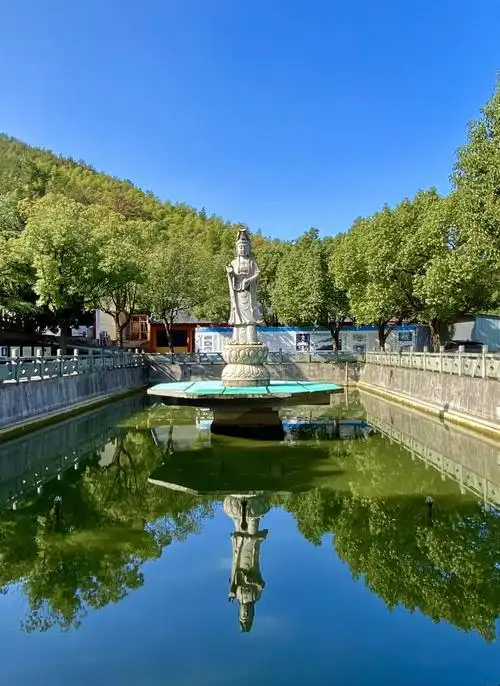 Long celebrated as "the foremost peak among Wu's noble mountains," Bian Shan has drawn literati, generals, and pilgrims for more than a millennium. Its name evokes the formal court caps worn by scholars in ancient China, a tradition that flourished alongside comparable intellectual cultures in Tang and Song dynasties. The mountain shares its lakeside setting with relics of the great Chu-Han Contention, the fourth-century BCE power struggle that established the Han Dynasty—reminiscent of how Italian hill towns preserve memories of Rome's civil wars. Stone inscriptions by Su Shi and Huang Tingjian, two figures often ranked alongside Europe's Renaissance humanists, still cling to the cliffs, anchoring the site firmly in China's golden age of poetry.
The mountain's religious architecture spans more than fifteen centuries. Fahua Temple, founded during the Southern Dynasties in the fifth century, predates many of Europe's great Romanesque abbeys, while the cliff-hugging Biyan Chan Temple rises along flagstone paths that recall the terraced approaches of Greek Orthodox mountaintop monasteries. Scattered throughout the slopes are relics tied to the warlord Xiang Yu, including a horse-watering pool and tethering stone—tangible echoes of the same era that produced Julius Caesar's campaigns across the Alps.
Culturally, Bian Shan served as a sanctuary for Song statesman and poet Ye Mengde, whose "Stone Forest Retreat" attracted scholars in a manner similar to how England's Lake District later inspired Wordsworth. The mountain is also recognised as one of the original sources of prized Taihu scholar's rocks, ornamental landscape stones that travelled north aboard the Northern Song's infamous "Flower and Rock Convoys"—a parallel to the Roman Empire's lavish transport of exotic marbles for imperial gardens.
Today the summit is dominated by a striking array of modern wind turbines, their sleek white silhouettes offering a vivid juxtaposition with the ancient temples below. From the peak on clear days, the vast expanse of Taihu—China's third-greatest freshwater lake—stretches toward the horizon, comparable in scale to Switzerland's Lake Geneva seen from the Jura foothills. The mountain remains completely free to enter, with no admission fee or main gate, though visitors should note that signage is sparse and infrastructure rustic.
Reaching Bian Shan is straightforward: drivers can navigate to "Biyan Temple" or "Yunfeng Summit Windmills," where a small parking area sits at the trailhead. Buses are infrequent, so taxis or private cars are strongly recommended from Huzhou's city centre. Hikers should begin at dawn or late afternoon to avoid summer heat, wear sturdy non-slip footwear, and carry at least 1.5 litres of water. The gentle ascent to the summit takes one to two hours, while ambitious trekkers can complete a spectacular 15 to 19-kilometre ridgeline loop past the spinning turbines.
What sets Bian Shan apart is its rare combination of accessibility, history, and untouched atmosphere. Unlike the heavily commercialised Huangshan or the crowded peaks of Mount Tai, this mountain rewards visitors with solitude, sweeping lake panoramas, and a sense of stepping into layers of Chinese legend. Whether you come for the autumn foliage, the calligraphic ghosts of Song poets, or simply the thrill of standing atop the highest point around Taihu, Bian Shan offers a quietly profound experience well worth the detour from the well-trodden tourist trail.
Long celebrated as "the foremost peak among Wu's noble mountains," Bian Shan has drawn literati, generals, and pilgrims for more than a millennium. Its name evokes the formal court caps worn by scholars in ancient China, a tradition that flourished alongside comparable intellectual cultures in Tang and Song dynasties. The mountain shares its lakeside setting with relics of the great Chu-Han Contention, the fourth-century BCE power struggle that established the Han Dynasty—reminiscent of how Italian hill towns preserve memories of Rome's civil wars. Stone inscriptions by Su Shi and Huang Tingjian, two figures often ranked alongside Europe's Renaissance humanists, still cling to the cliffs, anchoring the site firmly in China's golden age of poetry.
The mountain's religious architecture spans more than fifteen centuries. Fahua Temple, founded during the Southern Dynasties in the fifth century, predates many of Europe's great Romanesque abbeys, while the cliff-hugging Biyan Chan Temple rises along flagstone paths that recall the terraced approaches of Greek Orthodox mountaintop monasteries. Scattered throughout the slopes are relics tied to the warlord Xiang Yu, including a horse-watering pool and tethering stone—tangible echoes of the same era that produced Julius Caesar's campaigns across the Alps.
Culturally, Bian Shan served as a sanctuary for Song statesman and poet Ye Mengde, whose "Stone Forest Retreat" attracted scholars in a manner similar to how England's Lake District later inspired Wordsworth. The mountain is also recognised as one of the original sources of prized Taihu scholar's rocks, ornamental landscape stones that travelled north aboard the Northern Song's infamous "Flower and Rock Convoys"—a parallel to the Roman Empire's lavish transport of exotic marbles for imperial gardens.
Today the summit is dominated by a striking array of modern wind turbines, their sleek white silhouettes offering a vivid juxtaposition with the ancient temples below. From the peak on clear days, the vast expanse of Taihu—China's third-greatest freshwater lake—stretches toward the horizon, comparable in scale to Switzerland's Lake Geneva seen from the Jura foothills. The mountain remains completely free to enter, with no admission fee or main gate, though visitors should note that signage is sparse and infrastructure rustic.
Reaching Bian Shan is straightforward: drivers can navigate to "Biyan Temple" or "Yunfeng Summit Windmills," where a small parking area sits at the trailhead. Buses are infrequent, so taxis or private cars are strongly recommended from Huzhou's city centre. Hikers should begin at dawn or late afternoon to avoid summer heat, wear sturdy non-slip footwear, and carry at least 1.5 litres of water. The gentle ascent to the summit takes one to two hours, while ambitious trekkers can complete a spectacular 15 to 19-kilometre ridgeline loop past the spinning turbines.
What sets Bian Shan apart is its rare combination of accessibility, history, and untouched atmosphere. Unlike the heavily commercialised Huangshan or the crowded peaks of Mount Tai, this mountain rewards visitors with solitude, sweeping lake panoramas, and a sense of stepping into layers of Chinese legend. Whether you come for the autumn foliage, the calligraphic ghosts of Song poets, or simply the thrill of standing atop the highest point around Taihu, Bian Shan offers a quietly profound experience well worth the detour from the well-trodden tourist trail.