Mount Mogan
⭐ 4.70
Moganshan Town, Deqing County, Huzhou City, Zhejiang Province, China
 Mount Mogan's evocative name derives from a Spring and Autumn period (770–476 BCE) legend in which King Helü of Wu ordered the husband-and-wife swordsmiths Mo Ye and Gan Jiang to forge legendary blades on the mountain. The Sword Pool, where a dramatic four-tiered waterfall still plunges through mossy cliffs, marks the supposed site of their forge. This ancient myth predates European equivalents like the Norse forge of Weyland the Smith by centuries, lending the landscape a mythic weight that complements its natural beauty.
The mountain's modern identity took shape in the 1890s when foreign missionaries, diplomats, and Shanghai's cosmopolitan elite began establishing hill retreats here, much like the British hill stations of colonial India or the alpine resorts of Switzerland. By the Republican era, an extraordinary architectural ensemble had emerged: more than 200 villas scattered across hamlets like Wuling Village and Jianmen, displaying Victorian, Gothic Revival, English Tudor, French Provincial, and German rustic styles. The effect has been likened to a Chinese Lake Como, with stone paths weaving between villas that seem to have wandered in from an English Cotswolds village or a Bavarian forest lodge.
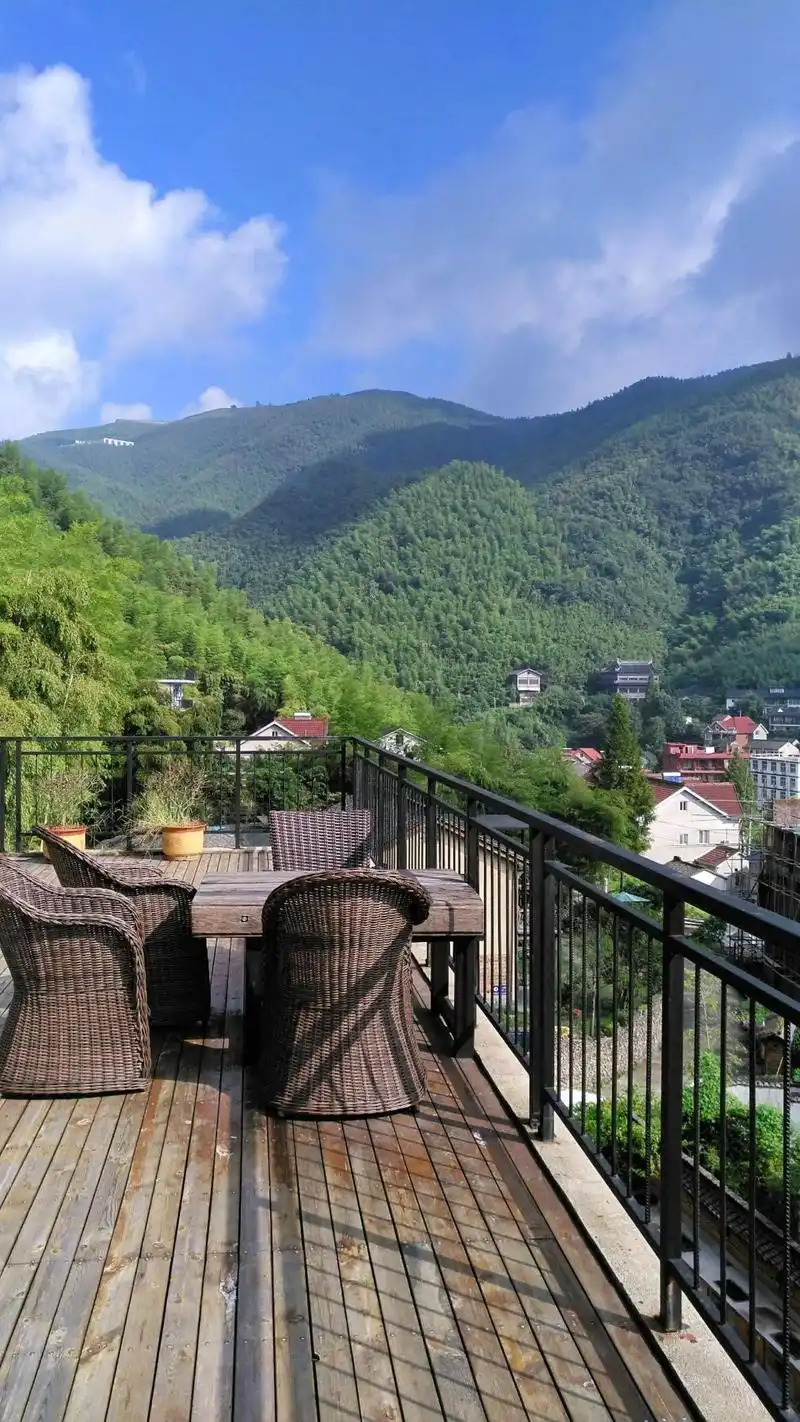
Beyond architecture, Mount Mogan carries deep 20th-century resonance. The Republican-era villas hosted political figures, foreign diplomats, and intellectuals, preserving what Chinese historians call "half the history of modern China." In 1953, Mao Zedong stayed at one of these villas, adding a layer of revolutionary memory. Today the mountain functions simultaneously as heritage site, summer resort, and creative countryside destination, where restored villas have been reborn as boutique guesthouses and design-conscious "foreign-style farm stays" (洋家乐).
Practical planning begins with tickets: entry costs around 80–85 RMB, with a shuttle-bus combo ticket at approximately 150 RMB. During peak summer weekends and holidays, private cars must park at the mountain-foot transit center and visitors transfer to scenic-area buses operating 8:00–17:30. The best seasons are June through September for cool-weather escape, and November for autumn foliage, though weekdays are strongly recommended over weekends when crowds swell.
The core scenic area centers on four main nodes: the dramatic Sword Pool waterfall, the ancient-tree-shaded Luhu荡 Park, the panoramic Xuguang Platform overlooking endless bamboo seas, and the forested Dakeng area. A classic gentle hiking loop links Sword Pool, Luhu荡, and Xuguang Platform in roughly half a day, with grades suitable for families and older travelers. At the mountain's base, the revitalized Yucun cultural market offers coffee shops, artisan boutiques, and local farm cuisine, while attractions like Giraffe Manor and the Discovery Adventure Base add family-friendly variety.
Mount Mogan rewards travelers seeking something beyond China's great imperial sights. It offers the rare pleasure of strolling through a living architectural museum set against mist-laced bamboo peaks, of sipping afternoon tea in a 1930s villa once frequented by foreign diplomats, and of escaping the coastal heat in temperatures that recall a mild European summer. For culturally curious visitors who appreciate layers of myth, history, and refined scenery, this Zhejiang highland provides an experience both distinctly Chinese and quietly cosmopolitan.
Mount Mogan's evocative name derives from a Spring and Autumn period (770–476 BCE) legend in which King Helü of Wu ordered the husband-and-wife swordsmiths Mo Ye and Gan Jiang to forge legendary blades on the mountain. The Sword Pool, where a dramatic four-tiered waterfall still plunges through mossy cliffs, marks the supposed site of their forge. This ancient myth predates European equivalents like the Norse forge of Weyland the Smith by centuries, lending the landscape a mythic weight that complements its natural beauty.
The mountain's modern identity took shape in the 1890s when foreign missionaries, diplomats, and Shanghai's cosmopolitan elite began establishing hill retreats here, much like the British hill stations of colonial India or the alpine resorts of Switzerland. By the Republican era, an extraordinary architectural ensemble had emerged: more than 200 villas scattered across hamlets like Wuling Village and Jianmen, displaying Victorian, Gothic Revival, English Tudor, French Provincial, and German rustic styles. The effect has been likened to a Chinese Lake Como, with stone paths weaving between villas that seem to have wandered in from an English Cotswolds village or a Bavarian forest lodge.
Beyond architecture, Mount Mogan carries deep 20th-century resonance. The Republican-era villas hosted political figures, foreign diplomats, and intellectuals, preserving what Chinese historians call "half the history of modern China." In 1953, Mao Zedong stayed at one of these villas, adding a layer of revolutionary memory. Today the mountain functions simultaneously as heritage site, summer resort, and creative countryside destination, where restored villas have been reborn as boutique guesthouses and design-conscious "foreign-style farm stays" (洋家乐).
Practical planning begins with tickets: entry costs around 80–85 RMB, with a shuttle-bus combo ticket at approximately 150 RMB. During peak summer weekends and holidays, private cars must park at the mountain-foot transit center and visitors transfer to scenic-area buses operating 8:00–17:30. The best seasons are June through September for cool-weather escape, and November for autumn foliage, though weekdays are strongly recommended over weekends when crowds swell.
The core scenic area centers on four main nodes: the dramatic Sword Pool waterfall, the ancient-tree-shaded Luhu荡 Park, the panoramic Xuguang Platform overlooking endless bamboo seas, and the forested Dakeng area. A classic gentle hiking loop links Sword Pool, Luhu荡, and Xuguang Platform in roughly half a day, with grades suitable for families and older travelers. At the mountain's base, the revitalized Yucun cultural market offers coffee shops, artisan boutiques, and local farm cuisine, while attractions like Giraffe Manor and the Discovery Adventure Base add family-friendly variety.
Mount Mogan rewards travelers seeking something beyond China's great imperial sights. It offers the rare pleasure of strolling through a living architectural museum set against mist-laced bamboo peaks, of sipping afternoon tea in a 1930s villa once frequented by foreign diplomats, and of escaping the coastal heat in temperatures that recall a mild European summer. For culturally curious visitors who appreciate layers of myth, history, and refined scenery, this Zhejiang highland provides an experience both distinctly Chinese and quietly cosmopolitan.