Baoguo Temple
⭐ 3.50
Baoguo Temple, Wuxing District, Huzhou City, Zhejiang Province, China
 Fahuasi Temple traces its origins to the Southern Liang Dynasty (502–557 CE), placing its founding in the same era as Pope Gregory the Great's reform of the Benedictine order and the rebuilding of Constantinople's Hagia Sophia under Justinian. While early medieval Europe was raising its first great cathedrals, this corner of Jiangnan was already flourishing as a Buddhist center. The temple's legendary importance rests on the belief that Guanyin, the East Asian Bodhisattva of Compassion venerated much as the Virgin Mary is in Catholic Europe, attained nirvana on this very ground. Most standing structures date to the Ming (1368–1644) and Qing (1644–1911) dynasties, layered atop earlier foundations.
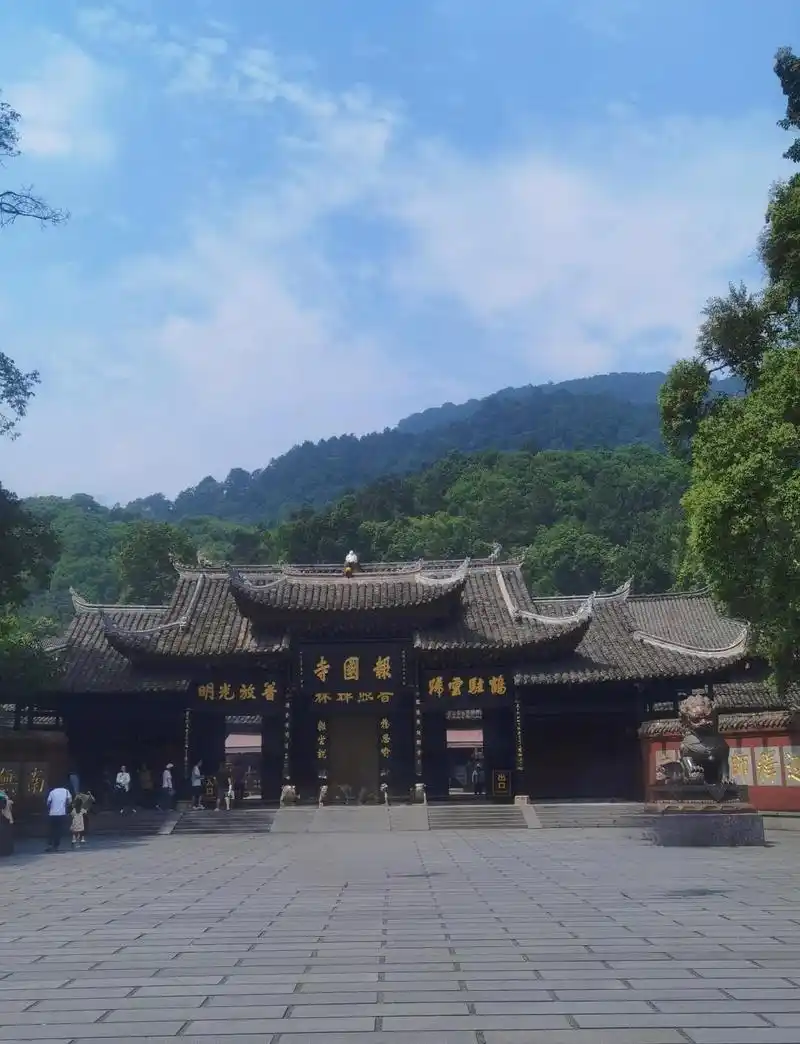
Built ascending Baique Mountain's flank, Fahuasi follows the axial plan standard to Chinese Buddhist monasticism—a layout reminiscent of terraced religious complexes such as Italy's Monte Cassino. Pilgrims pass through the Mountain Gate into the Three Saints Hall, then climb to the Mahavira Hall and finally the True Body Hall, each framed in dark timber with flying eaves that curl upward like upturned boat hulls. The carpentry exemplifies refined Jiangnan craftsmanship: mortise-and-tenon joinery assembled without nails, deep overhangs to shed monsoon rains, and muted earthen roof tiles. Ancient camphor trees line the stone pathways, lending the entire compound a hushed, contemplative air.
Fahuasi ranks among Jiangnan's most important Guanyin worship centers, drawing devotees from Zhejiang, Jiangsu, and Shanghai. On the 19th day of the second and sixth lunar months—Guanyin's birth, enlightenment, and ascension festivals—elaborate dharma assemblies fill the courtyards with chanting and incense. Beyond the main halls, a rear viewing platform reveals one of the region's finest panoramas: Lake Tai glimmering below, its sails echoing descriptions left by Song-dynasty poets, while the ridged greens of Banshan rise like the slopes ringing Italy's Lake Como. Here landscape and devotion interweave as gracefully as in the great pilgrimage sites of Europe.
Admission is free and no reservation is needed, though the temple sometimes restricts access during major dharma assemblies—check the official "Huzhou Culture and Tourism" WeChat channel before setting out. Bus Route 6 stops at "Fahuasi," but service is infrequent; a taxi or rideshare from central Huzhou, around 20 minutes, is more reliable. Self-drivers will find parking near the base of the mountain path. Crucially for international visitors: there are no English signs and no bilingual guides on site, so downloading a translation app or arranging an English-speaking guide through your hotel is strongly recommended.
The most atmospheric hours are early morning (6:30–9:00), when mist still clings to the mountain, or late afternoon (15:00–16:00), when golden light slants beneath the eaves. Dress modestly, avoid stepping on door thresholds—a taboo shared with Japanese Shinto shrines—and refrain from photography inside the halls. A recommended route proceeds through Mountain Gate, Three Saints Hall, Mahavira Hall, and True Body Hall, then ascends to the rear platform for the lake view. With extra time, combine your visit with nearby Renhuang Mountain Park and a Lake Tai waterfront stroll. Fahuasi delivers something rare: a contemplative mountain sanctuary reminiscent of Europe's quieter monasteries, where fifteen centuries of devotion remain vividly, beautifully alive.
Fahuasi Temple traces its origins to the Southern Liang Dynasty (502–557 CE), placing its founding in the same era as Pope Gregory the Great's reform of the Benedictine order and the rebuilding of Constantinople's Hagia Sophia under Justinian. While early medieval Europe was raising its first great cathedrals, this corner of Jiangnan was already flourishing as a Buddhist center. The temple's legendary importance rests on the belief that Guanyin, the East Asian Bodhisattva of Compassion venerated much as the Virgin Mary is in Catholic Europe, attained nirvana on this very ground. Most standing structures date to the Ming (1368–1644) and Qing (1644–1911) dynasties, layered atop earlier foundations.
Built ascending Baique Mountain's flank, Fahuasi follows the axial plan standard to Chinese Buddhist monasticism—a layout reminiscent of terraced religious complexes such as Italy's Monte Cassino. Pilgrims pass through the Mountain Gate into the Three Saints Hall, then climb to the Mahavira Hall and finally the True Body Hall, each framed in dark timber with flying eaves that curl upward like upturned boat hulls. The carpentry exemplifies refined Jiangnan craftsmanship: mortise-and-tenon joinery assembled without nails, deep overhangs to shed monsoon rains, and muted earthen roof tiles. Ancient camphor trees line the stone pathways, lending the entire compound a hushed, contemplative air.
Fahuasi ranks among Jiangnan's most important Guanyin worship centers, drawing devotees from Zhejiang, Jiangsu, and Shanghai. On the 19th day of the second and sixth lunar months—Guanyin's birth, enlightenment, and ascension festivals—elaborate dharma assemblies fill the courtyards with chanting and incense. Beyond the main halls, a rear viewing platform reveals one of the region's finest panoramas: Lake Tai glimmering below, its sails echoing descriptions left by Song-dynasty poets, while the ridged greens of Banshan rise like the slopes ringing Italy's Lake Como. Here landscape and devotion interweave as gracefully as in the great pilgrimage sites of Europe.
Admission is free and no reservation is needed, though the temple sometimes restricts access during major dharma assemblies—check the official "Huzhou Culture and Tourism" WeChat channel before setting out. Bus Route 6 stops at "Fahuasi," but service is infrequent; a taxi or rideshare from central Huzhou, around 20 minutes, is more reliable. Self-drivers will find parking near the base of the mountain path. Crucially for international visitors: there are no English signs and no bilingual guides on site, so downloading a translation app or arranging an English-speaking guide through your hotel is strongly recommended.
The most atmospheric hours are early morning (6:30–9:00), when mist still clings to the mountain, or late afternoon (15:00–16:00), when golden light slants beneath the eaves. Dress modestly, avoid stepping on door thresholds—a taboo shared with Japanese Shinto shrines—and refrain from photography inside the halls. A recommended route proceeds through Mountain Gate, Three Saints Hall, Mahavira Hall, and True Body Hall, then ascends to the rear platform for the lake view. With extra time, combine your visit with nearby Renhuang Mountain Park and a Lake Tai waterfront stroll. Fahuasi delivers something rare: a contemplative mountain sanctuary reminiscent of Europe's quieter monasteries, where fifteen centuries of devotion remain vividly, beautifully alive.