Feiying Pagoda
⭐ 4.20
Feiying Street, Wuxing District, Huzhou City, Zhejiang Province, China
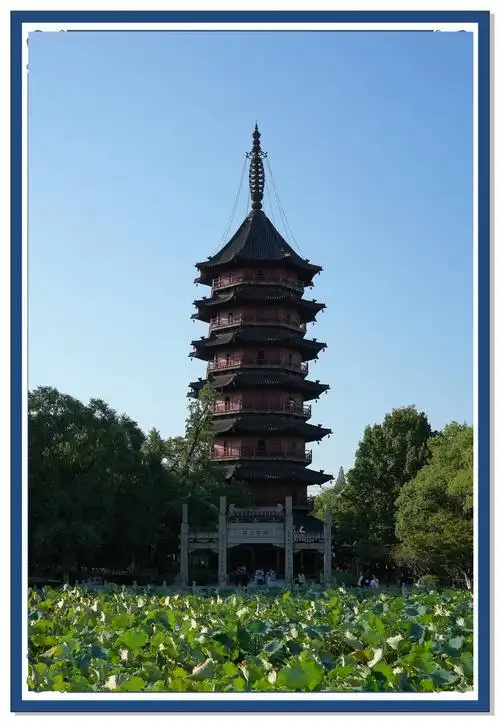 Constructed between 884 and 894 AD during the late Tang dynasty—a turbulent era when Europe endured Viking raids and the breakup of the Carolingian empire—Feiying Pagoda began as a modest stone shrine built by Buddhist monks to enshrine sacred relics. Its poetic name, meaning "the radiance of the relics shines universally," reflects the spiritual reach its founders hoped for. By the Northern Song, the site had grown so revered that a far larger brick-and-wood tower was wrapped around the original stone core for protection—an approach echoing how medieval Europeans often layered newer sanctuaries over older holy sites such as Rome's venerated martyria or Santiago de Compostela's evolving cathedral.
The inner tower is an octagonal, five-story stone pagoda measuring roughly 14.5 meters tall, its surfaces densely populated with thousands of miniature Buddha reliefs around a base ringed with the classic "nine mountains, eight seas" motif. The outer shell rises 55 meters across seven octagonal stories—taller than London's Big Ben tower or Venice's St. Mark's Campanile. Built centuries apart in contrasting materials and styles, the two distinct pagodas share the same footprint in an ingenious nesting that defies neat classification. Climbing the steep, narrow inner stairway feels like stepping upward through a thousand years of architectural ambition.
Feiying's legacy extends well beyond mere engineering novelty. In the eleventh century, the celebrated poet Su Shi (Su Dongpo), then serving as Huzhou's governor, composed verses here, and the Yuan dynasty master calligrapher Zhao Mengfu later left his brushwork on its walls. The pagoda was designated a National Key Cultural Relic in 1961, providing rare physical evidence for studying Tang and Song architecture, Buddhist sculptural art, and the urban history of Jiangnan water towns. Art historians prize its crisp carving technique as a benchmark of Song-era religious craftsmanship, while visitors still sense the spiritual aura that has drawn devotees for twelve centuries.
Feiying Park itself is open daily and free to enter, with summer hours stretching to about 8:00 PM. Climbing the outer pagoda costs 20 yuan for adults (ten yuan for students), with tickets sold between 8:30 AM and 4:00 PM, and the tower often closing Mondays for maintenance—call ahead to confirm. Flash photography is banned inside to protect ancient carvings, and visitors are asked to observe quiet reverence. From the summit, the tiled rooftops of Huzhou's old quarters unfold in every direction, while the park's lotus ponds shimmer below from June through August.
Enter through the park's west gate and head straight to the pagoda base. Wear flat, non-slip footwear; the spiral staircase is narrow, steep, and partly open to the air, making the ascent unsuitable for visitors with severe acrophobia or limited mobility. After descending, walk ten minutes to neighboring Yichang Street for Huzhou specialties like Ding Lianfang's famous thousand-layer rice parcels and Zhu Laoda's award-winning zongzi, then wander through Xiaoxi Street's revitalized historic lanes. Feiying rewards travelers who seek the unusual—few structures anywhere seamlessly fuse two great eras into one soaring silhouette.
Constructed between 884 and 894 AD during the late Tang dynasty—a turbulent era when Europe endured Viking raids and the breakup of the Carolingian empire—Feiying Pagoda began as a modest stone shrine built by Buddhist monks to enshrine sacred relics. Its poetic name, meaning "the radiance of the relics shines universally," reflects the spiritual reach its founders hoped for. By the Northern Song, the site had grown so revered that a far larger brick-and-wood tower was wrapped around the original stone core for protection—an approach echoing how medieval Europeans often layered newer sanctuaries over older holy sites such as Rome's venerated martyria or Santiago de Compostela's evolving cathedral.
The inner tower is an octagonal, five-story stone pagoda measuring roughly 14.5 meters tall, its surfaces densely populated with thousands of miniature Buddha reliefs around a base ringed with the classic "nine mountains, eight seas" motif. The outer shell rises 55 meters across seven octagonal stories—taller than London's Big Ben tower or Venice's St. Mark's Campanile. Built centuries apart in contrasting materials and styles, the two distinct pagodas share the same footprint in an ingenious nesting that defies neat classification. Climbing the steep, narrow inner stairway feels like stepping upward through a thousand years of architectural ambition.
Feiying's legacy extends well beyond mere engineering novelty. In the eleventh century, the celebrated poet Su Shi (Su Dongpo), then serving as Huzhou's governor, composed verses here, and the Yuan dynasty master calligrapher Zhao Mengfu later left his brushwork on its walls. The pagoda was designated a National Key Cultural Relic in 1961, providing rare physical evidence for studying Tang and Song architecture, Buddhist sculptural art, and the urban history of Jiangnan water towns. Art historians prize its crisp carving technique as a benchmark of Song-era religious craftsmanship, while visitors still sense the spiritual aura that has drawn devotees for twelve centuries.
Feiying Park itself is open daily and free to enter, with summer hours stretching to about 8:00 PM. Climbing the outer pagoda costs 20 yuan for adults (ten yuan for students), with tickets sold between 8:30 AM and 4:00 PM, and the tower often closing Mondays for maintenance—call ahead to confirm. Flash photography is banned inside to protect ancient carvings, and visitors are asked to observe quiet reverence. From the summit, the tiled rooftops of Huzhou's old quarters unfold in every direction, while the park's lotus ponds shimmer below from June through August.
Enter through the park's west gate and head straight to the pagoda base. Wear flat, non-slip footwear; the spiral staircase is narrow, steep, and partly open to the air, making the ascent unsuitable for visitors with severe acrophobia or limited mobility. After descending, walk ten minutes to neighboring Yichang Street for Huzhou specialties like Ding Lianfang's famous thousand-layer rice parcels and Zhu Laoda's award-winning zongzi, then wander through Xiaoxi Street's revitalized historic lanes. Feiying rewards travelers who seek the unusual—few structures anywhere seamlessly fuse two great eras into one soaring silhouette.