Mount Hua Taoist Culture
⭐ 4.60
Mount Hua Scenic Area, Huashan Town, Huayin City, Weinan, Shaanxi Province, China
 Mount Hua's Taoist heritage stretches back nearly two millennia, predating Europe's great cathedrals. Since the Han Dynasty, emperors dispatched envoys to honor the Western Peak Deity, mirroring how medieval kings sent pilgrimages to Santiago de Compostela. The Quanzhen Sect, founded here by the legendary sage Hao Datong in the 12th century, parallels the rise of monastic orders in contemporary Europe. Chen Tuan, revered as patriarch of the "Old Hua Mountain" lineage, lent the site a mystical pedigree akin to the legendary hermit saints of early Christianity. His statue at the foot of the mountain anchors over a thousand years of unbroken devotion.
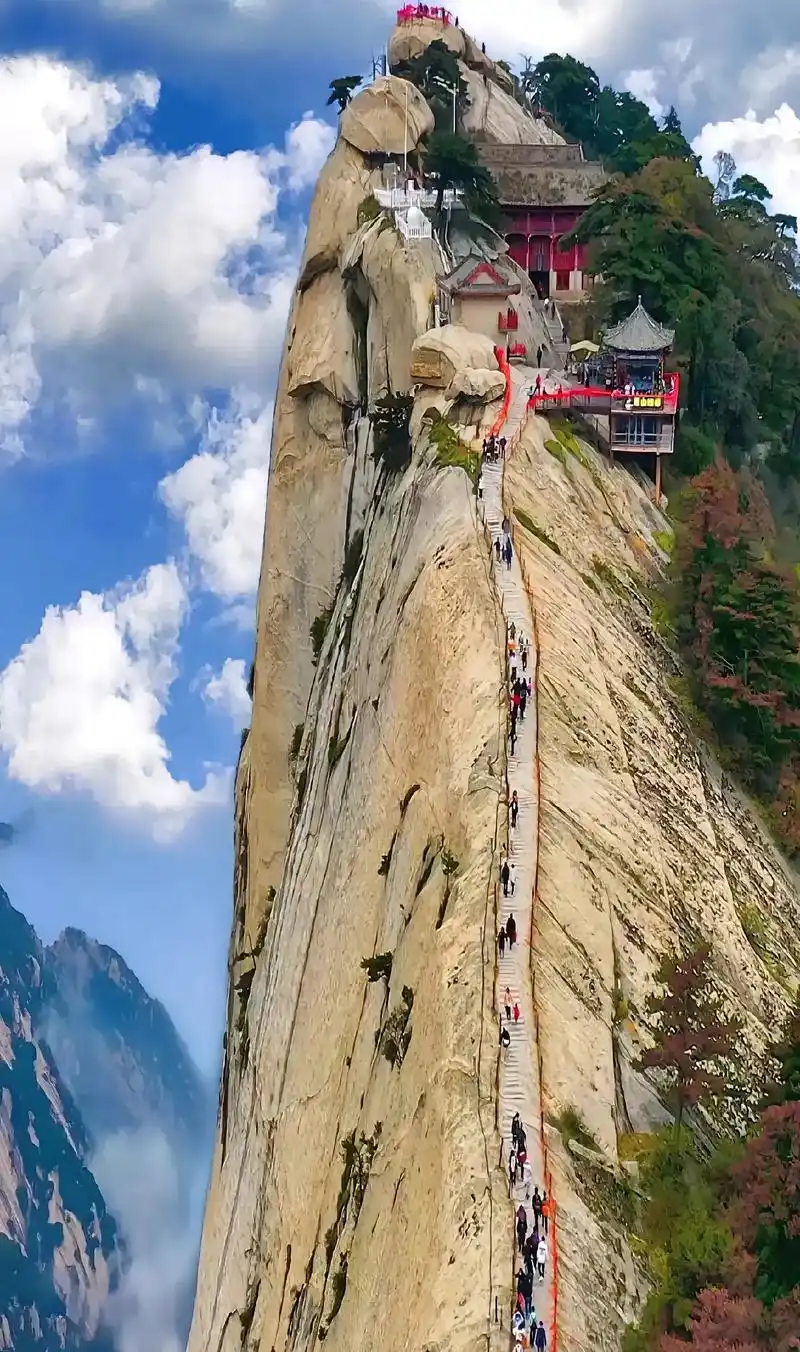
The mountain's architecture defies gravity in ways that rival the cliff-hanging monasteries of Meteora in Greece. Granite temples wedged into sheer rock faces, half-suspended meditation chambers, and palaces scattered across five jagged peaks embody the Taoist ideal of harmony between human dwelling and wilderness. The plank walk carved into vertical cliffs, the knife-edge ridge called Canglong, and the infamous Eagle's Flip section deliver adrenaline that puts even the via ferratas of the Dolomites in the shade. Walking these paths, visitors trace the same routes as Daoist hermits who once practiced fasting and alchemy in sky-bound solitude.
Mythology breathes through every stone here. The Splitting Mountain to Save Mother legend, immortalized at the Axe-Cut Boulder on West Peak, carries the emotional weight of Homeric epic. The Jade Maiden Temple on Middle Peak commemorates the fairy consort Xiao Shi and his beloved Yu Nu, whose flute-playing summoned phoenixes. These narratives, vivid and human, transform the landscape into an open-air theater of Chinese mythology. At the mountain's base, the West Yue Temple, sometimes called "Shaanxi's Little Forbidden City," showcases imperial architecture rivaling Beijing's, while hilltop hermitages preserved the folk-spiritual side.
Visiting requires planning. Foreign travelers must book tickets in advance using a passport through the official platform. Cable cars on West and North peaks offer easier access, though the thrilling plank walk, Eagle's Flip, and Zhen Yue Palace require separate timed reservations and an extra fee. Most major temples and cable stations provide English signage, but remote mountain shrines operate in Chinese only, so an offline translation app is essential. Photography of deity statues is prohibited inside temples, and visitors should maintain respectful silence near practicing monks.
Climb Mount Hua not merely for its thrills, but to experience a living tradition where two-thousand-year-old philosophical ideas meet a landscape so dramatic it has shaped Chinese imagination since antiquity. Few places on earth let you stand where emperors once sacrificed to heaven, walk paths carved by hermits seeking immortality, and gaze upon scenery described in poetry for centuries. For travelers seeking substance beyond spectacle, Mount Hua delivers both.
Mount Hua's Taoist heritage stretches back nearly two millennia, predating Europe's great cathedrals. Since the Han Dynasty, emperors dispatched envoys to honor the Western Peak Deity, mirroring how medieval kings sent pilgrimages to Santiago de Compostela. The Quanzhen Sect, founded here by the legendary sage Hao Datong in the 12th century, parallels the rise of monastic orders in contemporary Europe. Chen Tuan, revered as patriarch of the "Old Hua Mountain" lineage, lent the site a mystical pedigree akin to the legendary hermit saints of early Christianity. His statue at the foot of the mountain anchors over a thousand years of unbroken devotion.
The mountain's architecture defies gravity in ways that rival the cliff-hanging monasteries of Meteora in Greece. Granite temples wedged into sheer rock faces, half-suspended meditation chambers, and palaces scattered across five jagged peaks embody the Taoist ideal of harmony between human dwelling and wilderness. The plank walk carved into vertical cliffs, the knife-edge ridge called Canglong, and the infamous Eagle's Flip section deliver adrenaline that puts even the via ferratas of the Dolomites in the shade. Walking these paths, visitors trace the same routes as Daoist hermits who once practiced fasting and alchemy in sky-bound solitude.
Mythology breathes through every stone here. The Splitting Mountain to Save Mother legend, immortalized at the Axe-Cut Boulder on West Peak, carries the emotional weight of Homeric epic. The Jade Maiden Temple on Middle Peak commemorates the fairy consort Xiao Shi and his beloved Yu Nu, whose flute-playing summoned phoenixes. These narratives, vivid and human, transform the landscape into an open-air theater of Chinese mythology. At the mountain's base, the West Yue Temple, sometimes called "Shaanxi's Little Forbidden City," showcases imperial architecture rivaling Beijing's, while hilltop hermitages preserved the folk-spiritual side.
Visiting requires planning. Foreign travelers must book tickets in advance using a passport through the official platform. Cable cars on West and North peaks offer easier access, though the thrilling plank walk, Eagle's Flip, and Zhen Yue Palace require separate timed reservations and an extra fee. Most major temples and cable stations provide English signage, but remote mountain shrines operate in Chinese only, so an offline translation app is essential. Photography of deity statues is prohibited inside temples, and visitors should maintain respectful silence near practicing monks.
Climb Mount Hua not merely for its thrills, but to experience a living tradition where two-thousand-year-old philosophical ideas meet a landscape so dramatic it has shaped Chinese imagination since antiquity. Few places on earth let you stand where emperors once sacrificed to heaven, walk paths carved by hermits seeking immortality, and gaze upon scenery described in poetry for centuries. For travelers seeking substance beyond spectacle, Mount Hua delivers both.