Dangjia Village
⭐ 4.20
Dangjia Village, Xizhuang Town, Hancheng City, Shaanxi Province, China
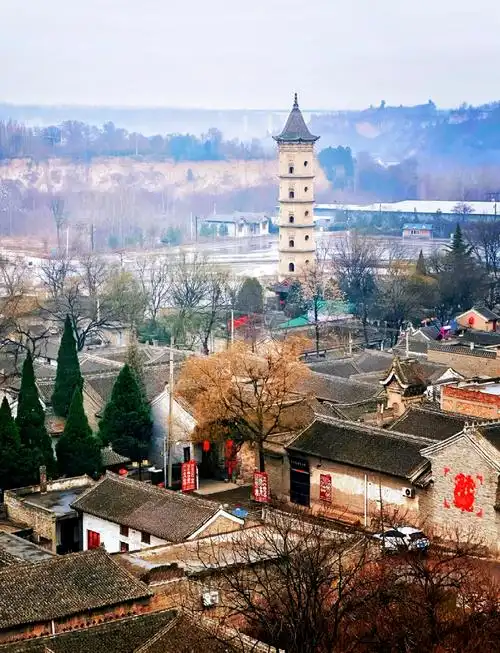 Founded in 1331 during the final years of the Yuan Dynasty—the same era when the Hundred Years' War was reshaping medieval Europe—Dangjia Village flourished during the Ming and Qing periods (1368–1911), reaching its peak alongside the European Renaissance and Enlightenment. The village's gourd-shaped feng shui layout reflects the same sophisticated town-planning principles found in contemporary Italian hill towns like San Gimignano, where every alley and home served both aesthetic and defensive purposes. As a rare surviving example of northern Chinese clan society, Dangjia offers historians a window into how extended families governed themselves for over seven centuries.
The village's architecture centers on the classic siheyuan, or four-sided courtyard, a design distant cousin to the Roman atrium house that influenced homes across the ancient world. One hundred twenty-three of these residences remain remarkably intact, their grey brick walls, dark tiled roofs, and intricately carved wooden doorways showcasing the refined craftsmanship of imperial-era artisans. Lintel inscriptions and spirit-screen family mottos throughout the village proclaim values of "farming and scholarship" that echo the European Renaissance ideal of balancing commerce with learning. Stone-paved lanes wind between the homes, and climbing the central Wenxing Pavilion rewards visitors with a panoramic view resembling an ink-wash painting, especially at dawn or after rain.
Beyond its residential beauty, Dangjia features a remarkable defensive system that rivals medieval European fortifications like those of Carcassonne in France. A cluster of chastity-and-filial-piety steles, the towering Kejia watchtower, and the Biyang Fortress together protected villagers from bandits and invaders for generations. Hidden passages, double-layered walls, and ingenious ice-storage facilities reveal the survival savvy of a community that had to defend itself in a turbulent frontier region. Today, immersive experiences allow visitors to participate in historical reenactments, create ink rubbings of family teachings, and shape traditional flower-steamed buns.
Designated a national AAAA-level tourist attraction and a Major Historical Site under national protection, Dangjia Village charges around 50 RMB for adult admission and stays open until 6:00 PM during peak season. Plan three to four unhurried hours to wander the lanes, and consider pairing your visit with the nearby Hancheng Old Town and Sima Qian Ancestral Shrine—tributes to the grand historian who chronicled China's imperial past. The combination creates a rich journey through the cultural heartland of the Guanzhong region.
Reaching the village is easiest by car, with the drive from Xi'an taking about two and a half hours—similar to traveling from Florence to Siena through the Tuscan countryside. Public transit requires a transfer in Hancheng, where local shuttle buses complete the journey. Wear sturdy non-slip shoes, as the cobbled lanes can be slick after rain, and bring sun protection and water in summer. Please respect residents by staying within designated open areas and refraining from climbing on carved architectural features, helping preserve this extraordinary village for future generations.
Founded in 1331 during the final years of the Yuan Dynasty—the same era when the Hundred Years' War was reshaping medieval Europe—Dangjia Village flourished during the Ming and Qing periods (1368–1911), reaching its peak alongside the European Renaissance and Enlightenment. The village's gourd-shaped feng shui layout reflects the same sophisticated town-planning principles found in contemporary Italian hill towns like San Gimignano, where every alley and home served both aesthetic and defensive purposes. As a rare surviving example of northern Chinese clan society, Dangjia offers historians a window into how extended families governed themselves for over seven centuries.
The village's architecture centers on the classic siheyuan, or four-sided courtyard, a design distant cousin to the Roman atrium house that influenced homes across the ancient world. One hundred twenty-three of these residences remain remarkably intact, their grey brick walls, dark tiled roofs, and intricately carved wooden doorways showcasing the refined craftsmanship of imperial-era artisans. Lintel inscriptions and spirit-screen family mottos throughout the village proclaim values of "farming and scholarship" that echo the European Renaissance ideal of balancing commerce with learning. Stone-paved lanes wind between the homes, and climbing the central Wenxing Pavilion rewards visitors with a panoramic view resembling an ink-wash painting, especially at dawn or after rain.
Beyond its residential beauty, Dangjia features a remarkable defensive system that rivals medieval European fortifications like those of Carcassonne in France. A cluster of chastity-and-filial-piety steles, the towering Kejia watchtower, and the Biyang Fortress together protected villagers from bandits and invaders for generations. Hidden passages, double-layered walls, and ingenious ice-storage facilities reveal the survival savvy of a community that had to defend itself in a turbulent frontier region. Today, immersive experiences allow visitors to participate in historical reenactments, create ink rubbings of family teachings, and shape traditional flower-steamed buns.
Designated a national AAAA-level tourist attraction and a Major Historical Site under national protection, Dangjia Village charges around 50 RMB for adult admission and stays open until 6:00 PM during peak season. Plan three to four unhurried hours to wander the lanes, and consider pairing your visit with the nearby Hancheng Old Town and Sima Qian Ancestral Shrine—tributes to the grand historian who chronicled China's imperial past. The combination creates a rich journey through the cultural heartland of the Guanzhong region.
Reaching the village is easiest by car, with the drive from Xi'an taking about two and a half hours—similar to traveling from Florence to Siena through the Tuscan countryside. Public transit requires a transfer in Hancheng, where local shuttle buses complete the journey. Wear sturdy non-slip shoes, as the cobbled lanes can be slick after rain, and bring sun protection and water in summer. Please respect residents by staying within designated open areas and refraining from climbing on carved architectural features, helping preserve this extraordinary village for future generations.