Xiyue Temple
⭐ 4.70
Xiyue Temple, Huazhou District, Weinan, Shaanxi, China
 Xiyue Temple traces its origins to 134 BCE, when Emperor Jing of the Western Han Dynasty first ordered its construction—making it older than Rome's Colosseum by nearly a century and the earliest, largest, and best-preserved imperial sacrificial temple among China's Five Sacred Mountains. Across more than 2,100 years, emperors from every major dynasty trekked here to offer rites, leaving behind an extraordinary archive of imperial calligraphy and edicts. Though repeatedly damaged by warfare, the complex was magnificently rebuilt during the Ming and Qing eras, particularly under the reigns of the Qianlong and Tongzhi emperors, whose restorations created the layout visitors see today.
The temple's architecture deliberately mirrors Beijing's Forbidden City, arranged along a strict north-south central axis like a scaled-down version of Europe's great Baroque palace complexes such as Versailles. Visitors pass through seven sequential courtyards stretching 540 meters deep, punctuated by ceremonial gates—the Haoling Gate, Five Phoenix Tower, Lingxing Gate, and Golden City Gate—culminating in the soaring Wanshou Pavilion. Flying eaves, intricate wooden bracket sets (*dougong*), and glazed yellow-tile roofs speak to the highest tier of traditional Chinese ceremonial architecture, while vermilion walls and imperial yellow accents proclaim its royal pedigree.
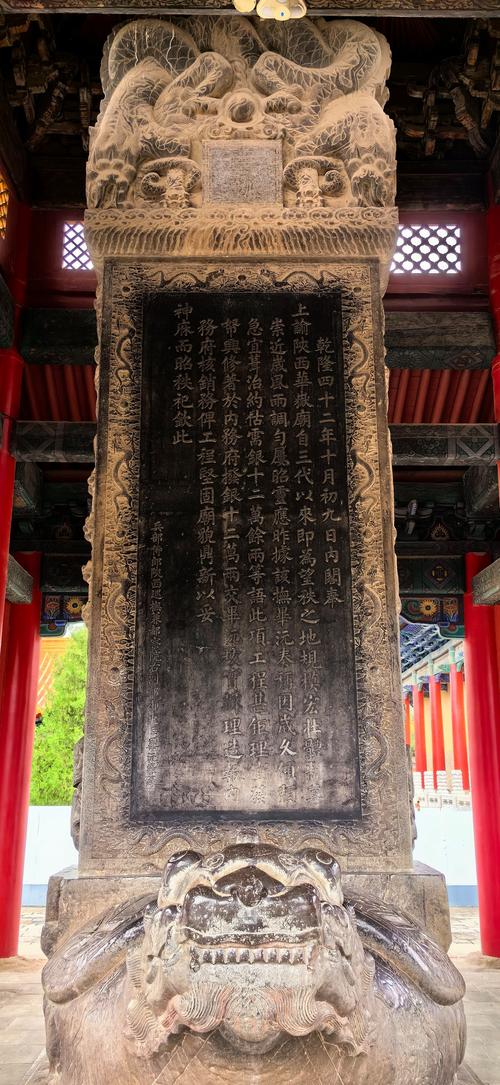
Beyond its architectural splendor, Xiyue Temple houses a remarkable open-air museum of over 130 stone steles spanning nearly 1,500 years of Chinese calligraphy. Highlights include the Northern Zhou-era "Huayue Temple Stele," an imperial inscription by Emperor Xuanzong of the Tang Dynasty, works by the legendary calligrapher Yan Zhenqing, and Qianlong's own brushwork. Comparable in significance to the epigraphic collections of Westminster Abbey or the runic stones of Scandinavia, this "Little Forest of Steles" offers an unrivaled walk through the evolution of Chinese script arts.
For the practical traveler, admission is a modest 15 yuan per person, with opening hours from 8:00 AM to 5:00 PM. Foreign visitors holding passports may purchase tickets on-site or reserve in advance. Plan for two to three hours to absorb the atmosphere, and arrive in the soft morning or late-afternoon light when the red walls glow most photogenically. Photography is permitted in courtyards but restricted inside the halls—please respect these conservation rules. Summer visitors should bring sun protection, as much of the site is exposed.
The temple is just a ten-minute taxi ride from Hua Shan North Railway Station, making it an effortless pairing with a Mount Hua hike and a visit to the adjacent Yuquan Temple. From the elevated pavilions, particularly Wanshou Pavilion and the Five Phoenix Tower, sightseers enjoy sweeping vistas of Mount Hua's five dramatic peaks framed by imperial rooftops—a composition beloved by photographers. Rather than a rushed stop, Xiyue Temple rewards those who linger: history buffs, calligraphy enthusiasts, and architecture lovers will find here one of central China's most quietly magnificent cultural treasures.
Xiyue Temple traces its origins to 134 BCE, when Emperor Jing of the Western Han Dynasty first ordered its construction—making it older than Rome's Colosseum by nearly a century and the earliest, largest, and best-preserved imperial sacrificial temple among China's Five Sacred Mountains. Across more than 2,100 years, emperors from every major dynasty trekked here to offer rites, leaving behind an extraordinary archive of imperial calligraphy and edicts. Though repeatedly damaged by warfare, the complex was magnificently rebuilt during the Ming and Qing eras, particularly under the reigns of the Qianlong and Tongzhi emperors, whose restorations created the layout visitors see today.
The temple's architecture deliberately mirrors Beijing's Forbidden City, arranged along a strict north-south central axis like a scaled-down version of Europe's great Baroque palace complexes such as Versailles. Visitors pass through seven sequential courtyards stretching 540 meters deep, punctuated by ceremonial gates—the Haoling Gate, Five Phoenix Tower, Lingxing Gate, and Golden City Gate—culminating in the soaring Wanshou Pavilion. Flying eaves, intricate wooden bracket sets (*dougong*), and glazed yellow-tile roofs speak to the highest tier of traditional Chinese ceremonial architecture, while vermilion walls and imperial yellow accents proclaim its royal pedigree.
Beyond its architectural splendor, Xiyue Temple houses a remarkable open-air museum of over 130 stone steles spanning nearly 1,500 years of Chinese calligraphy. Highlights include the Northern Zhou-era "Huayue Temple Stele," an imperial inscription by Emperor Xuanzong of the Tang Dynasty, works by the legendary calligrapher Yan Zhenqing, and Qianlong's own brushwork. Comparable in significance to the epigraphic collections of Westminster Abbey or the runic stones of Scandinavia, this "Little Forest of Steles" offers an unrivaled walk through the evolution of Chinese script arts.
For the practical traveler, admission is a modest 15 yuan per person, with opening hours from 8:00 AM to 5:00 PM. Foreign visitors holding passports may purchase tickets on-site or reserve in advance. Plan for two to three hours to absorb the atmosphere, and arrive in the soft morning or late-afternoon light when the red walls glow most photogenically. Photography is permitted in courtyards but restricted inside the halls—please respect these conservation rules. Summer visitors should bring sun protection, as much of the site is exposed.
The temple is just a ten-minute taxi ride from Hua Shan North Railway Station, making it an effortless pairing with a Mount Hua hike and a visit to the adjacent Yuquan Temple. From the elevated pavilions, particularly Wanshou Pavilion and the Five Phoenix Tower, sightseers enjoy sweeping vistas of Mount Hua's five dramatic peaks framed by imperial rooftops—a composition beloved by photographers. Rather than a rushed stop, Xiyue Temple rewards those who linger: history buffs, calligraphy enthusiasts, and architecture lovers will find here one of central China's most quietly magnificent cultural treasures.