Wuma Street
⭐ 3.80
Wuma Street, Lucheng District, Wenzhou City, Zhejiang Province, China
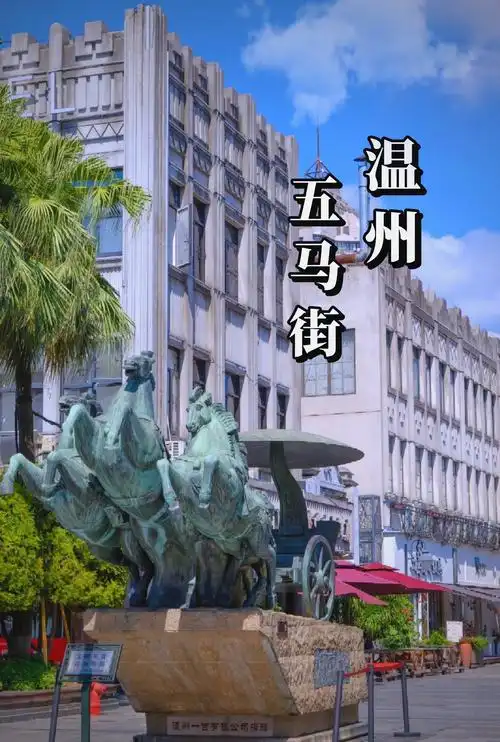 The street's name carries a literary pedigree that rivals any European old-town legend. According to local tradition, Wang Xizhi—the "Sage of Calligraphy" whose Lantingji Xu ranks among East Asia's most treasured manuscripts—served as governor of Yongjia (ancient Wenzhou) during the Eastern Jin dynasty in the fourth century and rode in a carriage drawn by five horses. A bronze sculpture of five galloping steeds at the street's western entrance commemorates this story, much as statues of Roman emperors punctuate the squares of Florence or Rome. By the Ming, Qing, and Republican eras, the lane had become the commercial heart of Wenzhou, earning its enduring "Number One Street" reputation.
The architecture is a layered conversation between East and West, comparable to Shanghai's Bund or Tianzifang in miniature. Late Qing and Republican-era buildings combine grey brick, carved wooden window lattices, and tiled roofs with Western archways, colonnades, and rounded doorways. One particularly photogenic composition frames the distant Jingguang Pagoda through the arch of the Xinguoguang Building, creating a "past-meets-present" shot reminiscent of vintage Parisian arcades glimpsing Gothic spires. After dark, the entire lane glitters under warm illumination, blurring the line between living heritage zone and contemporary shopping promenade.
Commercial heritage runs deep here, with shops that have served Wenzhou residents for generations. Names like Laoxiangshan (herbal pharmacy), Wuweihe (confections), Jinsanyi (silk and fabric), and Xianqian Tangyuan (glutinous rice ball parlor) anchor the street, much as family-run bakeries and apothecaries still define neighborhoods in Vienna or Bologna. Travelers can sample Ouyue classics such as dengzhan guo (fried rice cakes), airen songgao (steamed millet cakes), fish balls, zhuzang fen (pig offal noodles), changren wontons, and almond jelly, making the visit as much a culinary pilgrimage as a cultural one.
Beyond the main lane, a network of extensions links the street to a constellation of historical landmarks. Chan Street leads toward ancient city-gate ruins and the artistic Mochi Fang courtyard, while nearby stand the Drum Tower (Qiaolou), Huagai Mountain, and Zhongshan Park—sites that collectively trace Wenzhou's evolution from medieval administrative seat to modern metropolis. For international visitors, the district operates as a cross-border payment demonstration zone, accepting foreign cards and offering multilingual assistance, easing the logistics of independent exploration.
Plan to arrive in the late afternoon so you can capture the "Ancient Wenzhou City Map" pavement relief at the western entrance in good light, then drift eastward sampling snacks as evening falls. The Gongyuan Road and Drum Tower sections are especially atmospheric after dark, and an optional climb up Huagai Mountain rewards you with a panoramic view of the old town. The entire experience is free, requires no reservation, and typically takes 1.5 to 2.5 hours on foot. The most convenient approach is via metro to Renmin Road Station, putting you within a short walk of one of southern Zhejiang's most rewarding heritage strolls.
The street's name carries a literary pedigree that rivals any European old-town legend. According to local tradition, Wang Xizhi—the "Sage of Calligraphy" whose Lantingji Xu ranks among East Asia's most treasured manuscripts—served as governor of Yongjia (ancient Wenzhou) during the Eastern Jin dynasty in the fourth century and rode in a carriage drawn by five horses. A bronze sculpture of five galloping steeds at the street's western entrance commemorates this story, much as statues of Roman emperors punctuate the squares of Florence or Rome. By the Ming, Qing, and Republican eras, the lane had become the commercial heart of Wenzhou, earning its enduring "Number One Street" reputation.
The architecture is a layered conversation between East and West, comparable to Shanghai's Bund or Tianzifang in miniature. Late Qing and Republican-era buildings combine grey brick, carved wooden window lattices, and tiled roofs with Western archways, colonnades, and rounded doorways. One particularly photogenic composition frames the distant Jingguang Pagoda through the arch of the Xinguoguang Building, creating a "past-meets-present" shot reminiscent of vintage Parisian arcades glimpsing Gothic spires. After dark, the entire lane glitters under warm illumination, blurring the line between living heritage zone and contemporary shopping promenade.
Commercial heritage runs deep here, with shops that have served Wenzhou residents for generations. Names like Laoxiangshan (herbal pharmacy), Wuweihe (confections), Jinsanyi (silk and fabric), and Xianqian Tangyuan (glutinous rice ball parlor) anchor the street, much as family-run bakeries and apothecaries still define neighborhoods in Vienna or Bologna. Travelers can sample Ouyue classics such as dengzhan guo (fried rice cakes), airen songgao (steamed millet cakes), fish balls, zhuzang fen (pig offal noodles), changren wontons, and almond jelly, making the visit as much a culinary pilgrimage as a cultural one.
Beyond the main lane, a network of extensions links the street to a constellation of historical landmarks. Chan Street leads toward ancient city-gate ruins and the artistic Mochi Fang courtyard, while nearby stand the Drum Tower (Qiaolou), Huagai Mountain, and Zhongshan Park—sites that collectively trace Wenzhou's evolution from medieval administrative seat to modern metropolis. For international visitors, the district operates as a cross-border payment demonstration zone, accepting foreign cards and offering multilingual assistance, easing the logistics of independent exploration.
Plan to arrive in the late afternoon so you can capture the "Ancient Wenzhou City Map" pavement relief at the western entrance in good light, then drift eastward sampling snacks as evening falls. The Gongyuan Road and Drum Tower sections are especially atmospheric after dark, and an optional climb up Huagai Mountain rewards you with a panoramic view of the old town. The entire experience is free, requires no reservation, and typically takes 1.5 to 2.5 hours on foot. The most convenient approach is via metro to Renmin Road Station, putting you within a short walk of one of southern Zhejiang's most rewarding heritage strolls.