Bali Lake
⭐ 4.20
Bali Lake Scenic Area, Jiujiang City, Jiangxi Province, China
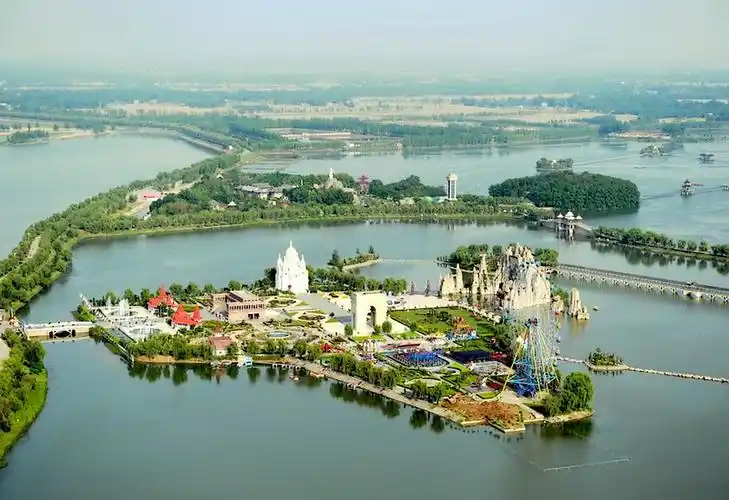 Jiujiang sits on the southern bank of the Yangtze, where the great river meets China's largest freshwater lake, Poyang Hu. Bali Lake—sometimes called Qili Lake—formed as an oxbow remnant of that ancient waterway, a quiet sibling to the mighty river that has carried merchants, poets, and emperors for two millennia. Comparable in scale and tranquility to Lake Geneva's gentler shores or Italy's Lake Trasimeno, it offers the same reflective calm without the crowds. Its 23-kilometer shoreline, broad flat lakebed, and clear waters also make it a vital stopover for herons, egrets, and other migratory waterfowl.
At the heart of the lake lies Bali Lake Park, a 4A-rated, 100-hectare expanse of open green space threaded by a 25–40 km greenway. Cyclists, joggers, and morning tai chi practitioners circle the water past tropical plant gardens, lakeside platforms, and the park's signature feature: a calm, waveless "beach" where families gather at dusk for golden-hour photographs reminiscent of a Mediterranean coastline. The man-made shore, with its soft sand and gentle slope, is one of inland China's most photogenic sunset spots.
Cultural depth comes from Jiujiang's City Museum, the Jiujiang Cultural Arts Center, and the Jiupai Poetry Corridor—a poetic tribute to the region historically described as the confluence of "nine provinces" by the great Tang poet Bai Juyi. Together they weave classical Chinese literature into a modern lakeside walk, much like how Lake Como's villas preserve Renaissance memory. For active families, the Jiupai Water Park offers jet skis, go-karts, splash zones, and pottery and woodcarving workshops that span every generation.
Since late 2025, the Jiupai Eye leisure district has transformed the southern shore into a buzzing evening destination. Visitors arrive for illuminated water shows, traditional "iron-flower" firework performances, outdoor cinema, and lakeside concerts, complemented by summer beer festivals and spring lantern fairs. The market stalls, lit boats, and shimmering lake reflections create an atmosphere somewhat reminiscent of Copenhagen's harbor celebrations or Zurich's Sechselautenplatz—only with Chinese folk flair.
The park is free to enter every day of the year and is reached directly by city bus to the Balihu Park stop; drivers find ample free parking at the entrance. Food options cluster inside the commercial district, so carrying a light picnic and water is wise, especially when traveling with children. Weekends in the afternoon see the beach and play areas fill up—early morning or after 5 p.m. offers a quieter, cooler experience. Plan a half- to full-day visit, ideally arriving before sunset to catch the lake in golden light before the night market opens.
Bali Lake is a rare combination: a working ecological sanctuary, a recreation hub, and a cultural crossroads, all within an easy hop of Jiujiang's high-speed rail station. For travelers tracing the Yangtze from Wuhan downstream or detouring from Lushan UNESCO mountain, it offers a relaxing, photogenic pause—affordable, uncrowded outside peak hours, and rich in both natural beauty and modern Chinese leisure culture.
Jiujiang sits on the southern bank of the Yangtze, where the great river meets China's largest freshwater lake, Poyang Hu. Bali Lake—sometimes called Qili Lake—formed as an oxbow remnant of that ancient waterway, a quiet sibling to the mighty river that has carried merchants, poets, and emperors for two millennia. Comparable in scale and tranquility to Lake Geneva's gentler shores or Italy's Lake Trasimeno, it offers the same reflective calm without the crowds. Its 23-kilometer shoreline, broad flat lakebed, and clear waters also make it a vital stopover for herons, egrets, and other migratory waterfowl.
At the heart of the lake lies Bali Lake Park, a 4A-rated, 100-hectare expanse of open green space threaded by a 25–40 km greenway. Cyclists, joggers, and morning tai chi practitioners circle the water past tropical plant gardens, lakeside platforms, and the park's signature feature: a calm, waveless "beach" where families gather at dusk for golden-hour photographs reminiscent of a Mediterranean coastline. The man-made shore, with its soft sand and gentle slope, is one of inland China's most photogenic sunset spots.
Cultural depth comes from Jiujiang's City Museum, the Jiujiang Cultural Arts Center, and the Jiupai Poetry Corridor—a poetic tribute to the region historically described as the confluence of "nine provinces" by the great Tang poet Bai Juyi. Together they weave classical Chinese literature into a modern lakeside walk, much like how Lake Como's villas preserve Renaissance memory. For active families, the Jiupai Water Park offers jet skis, go-karts, splash zones, and pottery and woodcarving workshops that span every generation.
Since late 2025, the Jiupai Eye leisure district has transformed the southern shore into a buzzing evening destination. Visitors arrive for illuminated water shows, traditional "iron-flower" firework performances, outdoor cinema, and lakeside concerts, complemented by summer beer festivals and spring lantern fairs. The market stalls, lit boats, and shimmering lake reflections create an atmosphere somewhat reminiscent of Copenhagen's harbor celebrations or Zurich's Sechselautenplatz—only with Chinese folk flair.
The park is free to enter every day of the year and is reached directly by city bus to the Balihu Park stop; drivers find ample free parking at the entrance. Food options cluster inside the commercial district, so carrying a light picnic and water is wise, especially when traveling with children. Weekends in the afternoon see the beach and play areas fill up—early morning or after 5 p.m. offers a quieter, cooler experience. Plan a half- to full-day visit, ideally arriving before sunset to catch the lake in golden light before the night market opens.
Bali Lake is a rare combination: a working ecological sanctuary, a recreation hub, and a cultural crossroads, all within an easy hop of Jiujiang's high-speed rail station. For travelers tracing the Yangtze from Wuhan downstream or detouring from Lushan UNESCO mountain, it offers a relaxing, photogenic pause—affordable, uncrowded outside peak hours, and rich in both natural beauty and modern Chinese leisure culture.