Dongtou Island
⭐ 4.20
Dongtou Island, Dongtou District, Wenzhou, Zhejiang, China
 Dongtou's 302 islands, scattered across roughly 2,600 square kilometres of sea, have sheltered fishermen since at least the Tang dynasty and earned it the nickname "the Hundred Islands of Dongtou." Strategically positioned along historic maritime trade routes that once linked Ming-dynasty China with Japan and Southeast Asia, the archipelago later played a surprising Cold-War role: its all-female militia, formed in 1958 by Mao Zedong himself, became national celebrities and the subject of the popular novel "Island Women." Today that legacy lives on in the Hai Xia Military Culture Park, a uniquely Chinese counterpart to the bunkers and memorials of, say, Normandy or Malta.
Architecturally, the island's most arresting landmark is the four-tiered Wanghai Lou (Sea-View Pavilion), a Song-dynasty-style tower perched on Caofeng Mountain. Rebuilt in 2007 in classical upturned-eave timber style, it functions as both a belvedere offering 360-degree views across the archipelago and a museum of fishing folk culture. Down in the harbour, the Qicai Dongtou village rewrites the rulebook: candy-pastel stone cottages reminiscent of Portofino or Burano are splashed with murals and street-art slogans, turning a former fishing hamlet into an Instagram-ready open-air gallery.
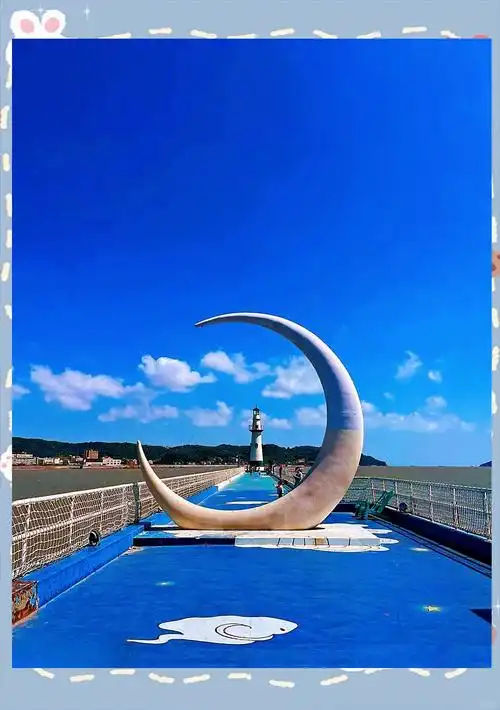
For natural drama, head to Xiandyan, where you can clamber along the so-called "Number One Cliff Walk of the East China Sea" – comparable in scale to Portugal's Ponta da Piedra – past wind-carved boulders, sea caves and a lighthouse dating from 1886. Halfway across the island, Banping Mountain stretches out into the sea with what is billed as China's longest natural rock gallery, a four-kilometre ridge walk where basalt cliffs drop into jade-green water. Sunset at Zhongyu's blue-and-white wave-breaker, nicknamed "Little Erhai," offers arguably the most photogenic seascape on the coast.
Practicalities are refreshingly simple. From Wenzhou's main bus station, direct coaches and ride-shares cross the 14-kilometre-long Dongtou Xia Bridge and Lingni Causeway in roughly 90 minutes; self-driving is even easier thanks to well-signed coastal roads. Two days are ideal: ascend Wanghai Lou at dawn, wander Qicai Village mid-morning, lunch on ginger-scallion crab at Shuanglong Food Street, then loop Banping and Xiandyan the next day. The best window is May–June or September–October, when skies are clear, the sea is at its bluest and typhoon risk is minimal; July and August bring crowds, higher prices and the need to book hotels well in advance.
What truly sets Dongtou apart, however, is its working-fishing-village soul. At dawn, fleets of gaily painted wooden boats still return to harbour, and the morning auction at the Global Seafood Market is a theatre of shout-and-slab prawns, mantis shrimp and yellow croaker – a ritual as old as the South China Sea trade itself. Visitors can roll up sleeves at the Sea-Ceramics Art Museum or East Sea Shell-Carving Museum, both offering English-friendly workshops where you can throw a pot or assemble a mother-of-pearl keepsake. With boutique guesthouses starting around 300 RMB per night and a seafood platter rarely exceeding 150 RMB for two, Dongtou delivers one of China's most rewarding – and still refreshingly under-the-radar – coastal escapes.
Dongtou's 302 islands, scattered across roughly 2,600 square kilometres of sea, have sheltered fishermen since at least the Tang dynasty and earned it the nickname "the Hundred Islands of Dongtou." Strategically positioned along historic maritime trade routes that once linked Ming-dynasty China with Japan and Southeast Asia, the archipelago later played a surprising Cold-War role: its all-female militia, formed in 1958 by Mao Zedong himself, became national celebrities and the subject of the popular novel "Island Women." Today that legacy lives on in the Hai Xia Military Culture Park, a uniquely Chinese counterpart to the bunkers and memorials of, say, Normandy or Malta.
Architecturally, the island's most arresting landmark is the four-tiered Wanghai Lou (Sea-View Pavilion), a Song-dynasty-style tower perched on Caofeng Mountain. Rebuilt in 2007 in classical upturned-eave timber style, it functions as both a belvedere offering 360-degree views across the archipelago and a museum of fishing folk culture. Down in the harbour, the Qicai Dongtou village rewrites the rulebook: candy-pastel stone cottages reminiscent of Portofino or Burano are splashed with murals and street-art slogans, turning a former fishing hamlet into an Instagram-ready open-air gallery.
For natural drama, head to Xiandyan, where you can clamber along the so-called "Number One Cliff Walk of the East China Sea" – comparable in scale to Portugal's Ponta da Piedra – past wind-carved boulders, sea caves and a lighthouse dating from 1886. Halfway across the island, Banping Mountain stretches out into the sea with what is billed as China's longest natural rock gallery, a four-kilometre ridge walk where basalt cliffs drop into jade-green water. Sunset at Zhongyu's blue-and-white wave-breaker, nicknamed "Little Erhai," offers arguably the most photogenic seascape on the coast.
Practicalities are refreshingly simple. From Wenzhou's main bus station, direct coaches and ride-shares cross the 14-kilometre-long Dongtou Xia Bridge and Lingni Causeway in roughly 90 minutes; self-driving is even easier thanks to well-signed coastal roads. Two days are ideal: ascend Wanghai Lou at dawn, wander Qicai Village mid-morning, lunch on ginger-scallion crab at Shuanglong Food Street, then loop Banping and Xiandyan the next day. The best window is May–June or September–October, when skies are clear, the sea is at its bluest and typhoon risk is minimal; July and August bring crowds, higher prices and the need to book hotels well in advance.
What truly sets Dongtou apart, however, is its working-fishing-village soul. At dawn, fleets of gaily painted wooden boats still return to harbour, and the morning auction at the Global Seafood Market is a theatre of shout-and-slab prawns, mantis shrimp and yellow croaker – a ritual as old as the South China Sea trade itself. Visitors can roll up sleeves at the Sea-Ceramics Art Museum or East Sea Shell-Carving Museum, both offering English-friendly workshops where you can throw a pot or assemble a mother-of-pearl keepsake. With boutique guesthouses starting around 300 RMB per night and a seafood platter rarely exceeding 150 RMB for two, Dongtou delivers one of China's most rewarding – and still refreshingly under-the-radar – coastal escapes.