Wenzhou Museum
⭐ 4.60
No. 11, Fuxue Lane, Lucheng District, Wenzhou City, Zhejiang Province, China
 While Wenzhou's name may be unfamiliar to many Western travelers, this maritime city has been a trading hub for over a thousand years, with merchants sailing the same waters that brought Arab dhows and later Portuguese galleons to the East China coast. Wenzhou Museum's history galleries trace that legacy, opening with Neolithic pottery shards and culminating in 20th-century artifacts like vintage rickshaws and even a Fiat sedan, charting a journey comparable in sweep to the social-history rooms of London's Museum of London. The crown jewel of the collection is a 4th-century Eastern Jin land deed attributed to a man named Zhu Man, predating the fall of the Western Roman Empire and offering a startlingly personal glimpse into early medieval land ownership along China's southeastern fringe.
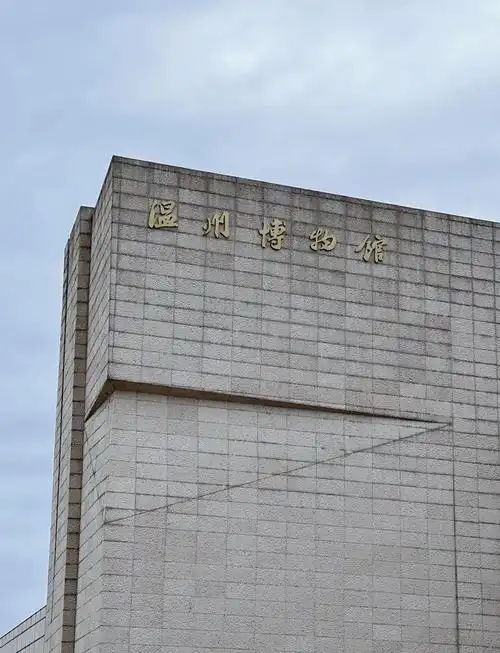
The museum's architecture itself is worth noting. Designed in a restrained, monumental style reminiscent of late-20th-century European civic museums such as Berlin's Kulturforum, the 2004 building is a stately rectangular volume sheathed in grey brick-patterned curtain walls that echo traditional Jiangnan architecture without resorting to pastiche. Its name, inscribed in calligraphy by the revered scholar Qi Gong, faces Century Square, anchoring the city's cultural quarter much as a great national museum might anchor a European capital's plaza.
Inside, four permanent halls unfold in sequence. The History Hall carries the narrative theme "Wenzhou People: Survival and Enterprise," weaving regional identity through ceramics, calligraphy, and everyday objects. The Craft Hall dazzles with treasures like the polychrome Song-dynasty Guanyin bodhisattvas from the White Elephant Pagoda, fragments of movable-type printing comparable in significance to Gutenberg-era European printing heritage, and delicate Ou celadon that holds its own against the famous Longquan wares. The Nature Hall features dinosaur fossils, a whale specimen, and dioramas popular with children, while a flexible temporary-exhibition space rotates contemporary shows.
The 2026 renovation transformed the visitor experience almost beyond recognition. Low-reflective glass vitrines now showcase artifacts with crystal clarity, while AR headsets let you rotate a celadon vase in midair or peek beneath the gilt of a Song sculpture. An AI mirror explains each piece in plain language, and a family treasure-hunt system keeps younger visitors engaged for hours. Admission remains free, though you must scan your passport or ID card at the entrance, and the museum closes on Mondays with last entry at 4:30 pm.
Plan your visit for a weekday morning to avoid school groups and weekend crowds, allowing roughly two and a half to three hours to absorb the highlights. The halls are air-conditioned, so bring a light layer for comfort. English-language guides are available by calling 0577-56988690 in advance, and group tours should book at least two days ahead. When you finish, the atmospheric Wuma Street historic district lies within easy walking distance, where Ming-era lane houses, snack vendors, and teahouses offer a perfect continuation of your journey into old Wenzhou.
While Wenzhou's name may be unfamiliar to many Western travelers, this maritime city has been a trading hub for over a thousand years, with merchants sailing the same waters that brought Arab dhows and later Portuguese galleons to the East China coast. Wenzhou Museum's history galleries trace that legacy, opening with Neolithic pottery shards and culminating in 20th-century artifacts like vintage rickshaws and even a Fiat sedan, charting a journey comparable in sweep to the social-history rooms of London's Museum of London. The crown jewel of the collection is a 4th-century Eastern Jin land deed attributed to a man named Zhu Man, predating the fall of the Western Roman Empire and offering a startlingly personal glimpse into early medieval land ownership along China's southeastern fringe.
The museum's architecture itself is worth noting. Designed in a restrained, monumental style reminiscent of late-20th-century European civic museums such as Berlin's Kulturforum, the 2004 building is a stately rectangular volume sheathed in grey brick-patterned curtain walls that echo traditional Jiangnan architecture without resorting to pastiche. Its name, inscribed in calligraphy by the revered scholar Qi Gong, faces Century Square, anchoring the city's cultural quarter much as a great national museum might anchor a European capital's plaza.
Inside, four permanent halls unfold in sequence. The History Hall carries the narrative theme "Wenzhou People: Survival and Enterprise," weaving regional identity through ceramics, calligraphy, and everyday objects. The Craft Hall dazzles with treasures like the polychrome Song-dynasty Guanyin bodhisattvas from the White Elephant Pagoda, fragments of movable-type printing comparable in significance to Gutenberg-era European printing heritage, and delicate Ou celadon that holds its own against the famous Longquan wares. The Nature Hall features dinosaur fossils, a whale specimen, and dioramas popular with children, while a flexible temporary-exhibition space rotates contemporary shows.
The 2026 renovation transformed the visitor experience almost beyond recognition. Low-reflective glass vitrines now showcase artifacts with crystal clarity, while AR headsets let you rotate a celadon vase in midair or peek beneath the gilt of a Song sculpture. An AI mirror explains each piece in plain language, and a family treasure-hunt system keeps younger visitors engaged for hours. Admission remains free, though you must scan your passport or ID card at the entrance, and the museum closes on Mondays with last entry at 4:30 pm.
Plan your visit for a weekday morning to avoid school groups and weekend crowds, allowing roughly two and a half to three hours to absorb the highlights. The halls are air-conditioned, so bring a light layer for comfort. English-language guides are available by calling 0577-56988690 in advance, and group tours should book at least two days ahead. When you finish, the atmospheric Wuma Street historic district lies within easy walking distance, where Ming-era lane houses, snack vendors, and teahouses offer a perfect continuation of your journey into old Wenzhou.