Jiangxin Temple
⭐ 4.00
Jiangxin Temple, Dongtou District, Wenzhou, Zhejiang, China
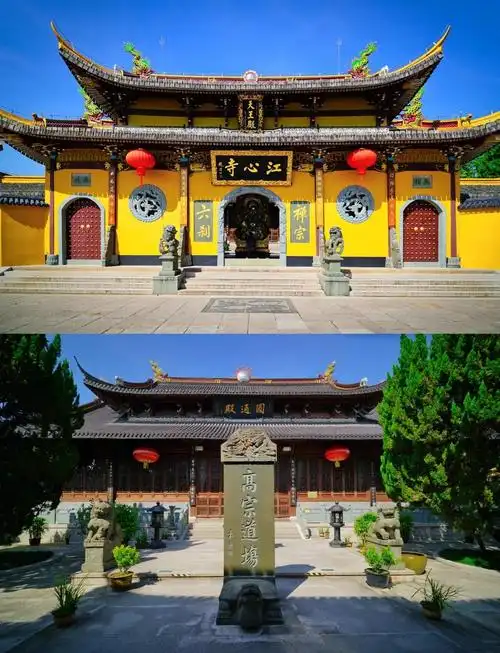 Standing on a lone island in the Oujiang River since the late Tang Dynasty (circa 860 CE), Jiangxin Temple predates many of Europe's great medieval cathedrals by a century. It rose to prominence after 1137, when two rival monasteries were merged by imperial decree into a single institution welcomed even by Emperor Gaozong of Song. At its zenith, it was counted among the empire's "Ten Great Chan Monasteries"—comparable in prestige to a Benedictine abbey of medieval Christendom. Centuries of literary pilgrims, including the great nature poet Xie Lingyun and the patriotic scholar Wen Tianxiang, composed verses here, embedding the isle in China's classical imagination.
The present complex was largely rebuilt in 1789, during the Qing Dynasty's late golden age, and covers roughly 2,870 square meters arranged along a strict central axis. Visitors pass through three successive halls—the Gate Hall, the Hall of Guanyin, and the Hall of the Three Saints—whose proportions echo the contemplative geometry of a European Carthusian charterhouse, though tempered with distinctly Jiangnan rooflines. Steles and plaques bear calligraphy by the revered Buddhist monk Hongyi, whose brushwork is to Chinese devotees what a rare illuminated Gospel might be to a Western bibliophile.
The temple's most celebrated treasure is a baffling couplet by Southern Song zhuangyuan (top scholar) Wang Shipeng, inscribed above the mountain gate: "Yun zhao zhao chao zhao chao zhao zhao san / Chao zhang zhang chang zhang chang zhang chang xiao." Read in multiple ways, it describes morning clouds parting and tides advancing and receding—a literary puzzle that has charmed scholars for eight centuries. Flanking the temple, the East and West pagodas once served as a beacon for oceangoing junks navigating the Maritime Silk Road, much as the Pharos of Alexandria guided Roman galleys, or the Tower of Hercules at A Coruña still lights the Atlantic coast.
Beyond its religious role, Jiangxin Temple is a living archive of Wenzhou's identity as a coastal trading hub. The island also hosts a shrine to Wen Tianxiang, the martyred Song loyalist, and the former British Consulate—a reminder of Wenzhou's later opening to global commerce. Together these monuments trace the arc from Tang-era Buddhism to the dawn of modern Sino-Western contact, offering a microcosm of Chinese coastal history rarely encountered by international travelers.
The site operates as part of Jiangxin Island Scenic Area, requiring a combined ticket of around 30 RMB that includes the ferry. Boats depart from the South Dock on Wangjiang East Road in central Wenzhou, with service typically running 8:00 a.m. to 5:00 p.m. and extended hours up to 10:00 p.m. for evening visitors. Allow three to four hours for the full island, and bring water and a light snack, as on-island dining is limited. Be sure to catch the last ferry back to the mainland.
The real reward lies in lingering at dawn or dusk, when the twin pagodas are mirrored in the slow Oujiang tides and the clang of the temple bell drifts across the water. Compared to the crowded temples of Hangzhou or Kyoto, Jiangxin offers a quieter, more contemplative encounter—an island monastery accessible only by boat, where Tang Dynasty stonework, Song Dynasty poetry, and Qing Dynasty craftsmanship meet beneath the same open sky. For travelers seeking a less-trodden corner of China's Buddhist heritage, it is an unmissable detour.
Standing on a lone island in the Oujiang River since the late Tang Dynasty (circa 860 CE), Jiangxin Temple predates many of Europe's great medieval cathedrals by a century. It rose to prominence after 1137, when two rival monasteries were merged by imperial decree into a single institution welcomed even by Emperor Gaozong of Song. At its zenith, it was counted among the empire's "Ten Great Chan Monasteries"—comparable in prestige to a Benedictine abbey of medieval Christendom. Centuries of literary pilgrims, including the great nature poet Xie Lingyun and the patriotic scholar Wen Tianxiang, composed verses here, embedding the isle in China's classical imagination.
The present complex was largely rebuilt in 1789, during the Qing Dynasty's late golden age, and covers roughly 2,870 square meters arranged along a strict central axis. Visitors pass through three successive halls—the Gate Hall, the Hall of Guanyin, and the Hall of the Three Saints—whose proportions echo the contemplative geometry of a European Carthusian charterhouse, though tempered with distinctly Jiangnan rooflines. Steles and plaques bear calligraphy by the revered Buddhist monk Hongyi, whose brushwork is to Chinese devotees what a rare illuminated Gospel might be to a Western bibliophile.
The temple's most celebrated treasure is a baffling couplet by Southern Song zhuangyuan (top scholar) Wang Shipeng, inscribed above the mountain gate: "Yun zhao zhao chao zhao chao zhao zhao san / Chao zhang zhang chang zhang chang zhang chang xiao." Read in multiple ways, it describes morning clouds parting and tides advancing and receding—a literary puzzle that has charmed scholars for eight centuries. Flanking the temple, the East and West pagodas once served as a beacon for oceangoing junks navigating the Maritime Silk Road, much as the Pharos of Alexandria guided Roman galleys, or the Tower of Hercules at A Coruña still lights the Atlantic coast.
Beyond its religious role, Jiangxin Temple is a living archive of Wenzhou's identity as a coastal trading hub. The island also hosts a shrine to Wen Tianxiang, the martyred Song loyalist, and the former British Consulate—a reminder of Wenzhou's later opening to global commerce. Together these monuments trace the arc from Tang-era Buddhism to the dawn of modern Sino-Western contact, offering a microcosm of Chinese coastal history rarely encountered by international travelers.
The site operates as part of Jiangxin Island Scenic Area, requiring a combined ticket of around 30 RMB that includes the ferry. Boats depart from the South Dock on Wangjiang East Road in central Wenzhou, with service typically running 8:00 a.m. to 5:00 p.m. and extended hours up to 10:00 p.m. for evening visitors. Allow three to four hours for the full island, and bring water and a light snack, as on-island dining is limited. Be sure to catch the last ferry back to the mainland.
The real reward lies in lingering at dawn or dusk, when the twin pagodas are mirrored in the slow Oujiang tides and the clang of the temple bell drifts across the water. Compared to the crowded temples of Hangzhou or Kyoto, Jiangxin offers a quieter, more contemplative encounter—an island monastery accessible only by boat, where Tang Dynasty stonework, Song Dynasty poetry, and Qing Dynasty craftsmanship meet beneath the same open sky. For travelers seeking a less-trodden corner of China's Buddhist heritage, it is an unmissable detour.