Qingyuan Maglev Train
⭐ 3.80
Qingcheng District, Qingyuan City, Guangdong Province, China
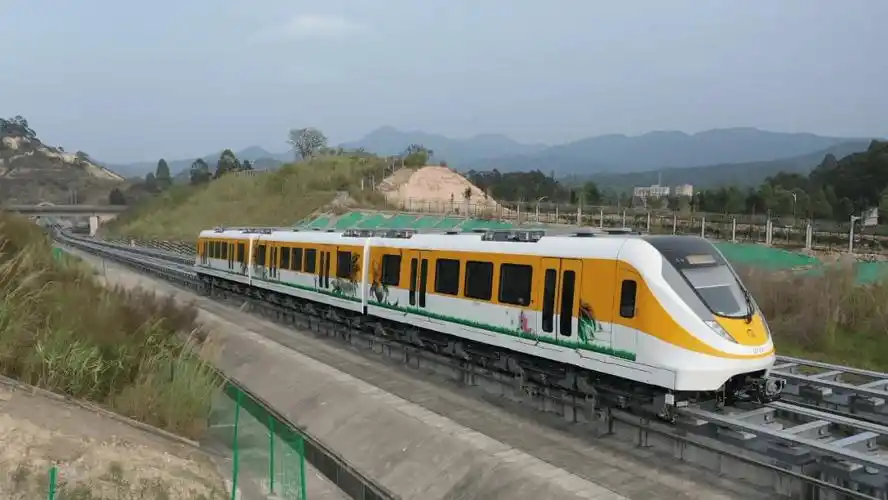 Maglev, or magnetic levitation, was first proposed by American engineer Robert Goddard in 1906, but it took nearly a century for the technology to leave the laboratory. The Birmingham Maglev in England briefly operated as the world's first commercial maglev from 1984 to 1995, while the famous Shanghai Transrapid—still the fastest in regular service—began whisking passengers to Pudong Airport at 431 km/h in 2004 using German technology. Qingyuan's line, entering passenger service on 25 January 2025, marks China's first deployment of medium-low-speed maglev purely for tourism, showcasing domestic EMS technology developed jointly by CRRC Tangshan and CRRC Changchun.
Unlike the dramatic high-speed Transrapid of Shanghai, where passengers rocket through suburban tower blocks, the Qingyuan experience is deliberately gentle and scenic. The three-car trains carry up to 500 riders at a leisurely 120 km/h, suspended just 6 to 10 millimeters above the track by electromagnetic forces that eliminate wheel-on-rail friction entirely. The result is a cabin noise level of only 62 decibels—softer than normal conversation—allowing travelers to chat, photograph passing farmland, or simply marvel at the sensation of gliding. Three stations punctuate the eight-kilometer route: Yinza, Hudie Bay, and the terminal at Qingyuan Chimelong.
The interior design transforms a technical achievement into a thematic adventure. Cabins are dressed with motifs of red-crowned cranes, giraffes, and other wildlife, foreshadowing the safari encounters waiting at Chimelong Forest Resort. This deliberate blending of transportation and storytelling reflects a broader Chinese strategy of packaging infrastructure as destination experiences—similar to how Switzerland markets the Glacier Express or Japan promotes its Romancecar as part of the journey itself. The pastoral views outside the panoramic windows, with rice paddies and forested hills rolling past, complete the immersive effect.
Practicalities favor spontaneous travelers: one-way tickets cost 15 yuan, a day pass 35 yuan, and a three-day pass 55 yuan, with half-price discounts for children and students. Trains generally run from 09:30 to 18:00 at roughly 20-minute intervals, though the line closes every Monday for routine maintenance—holidays excepted. Station signage and announcements feature Mandarin, Cantonese, and English, but frontline staff speak limited English, so a translation app is advisable. The recommended approach is to arrive on the Guangqing intercity rail, transfer to the maglev at Yinza, and ride into the Chimelong complex.
For Western visitors accustomed to crowded metros and screeching commuter trains, the Qingyuan Maglev offers something genuinely novel: a glimpse of the silent, frictionless transport that engineers have promised since the space age. It is not a thrill ride in the roller-coaster sense, but a smooth, almost meditative twelve minutes where the boundary between train and aircraft seems to dissolve. Combined with a day at the Chimelong safari park next door, it makes an easy and memorable excursion from Guangzhou—roughly comparable in scale to a scenic ride on Italy's Ritten railway, but with a distinctly 21st-century technological twist.
Maglev, or magnetic levitation, was first proposed by American engineer Robert Goddard in 1906, but it took nearly a century for the technology to leave the laboratory. The Birmingham Maglev in England briefly operated as the world's first commercial maglev from 1984 to 1995, while the famous Shanghai Transrapid—still the fastest in regular service—began whisking passengers to Pudong Airport at 431 km/h in 2004 using German technology. Qingyuan's line, entering passenger service on 25 January 2025, marks China's first deployment of medium-low-speed maglev purely for tourism, showcasing domestic EMS technology developed jointly by CRRC Tangshan and CRRC Changchun.
Unlike the dramatic high-speed Transrapid of Shanghai, where passengers rocket through suburban tower blocks, the Qingyuan experience is deliberately gentle and scenic. The three-car trains carry up to 500 riders at a leisurely 120 km/h, suspended just 6 to 10 millimeters above the track by electromagnetic forces that eliminate wheel-on-rail friction entirely. The result is a cabin noise level of only 62 decibels—softer than normal conversation—allowing travelers to chat, photograph passing farmland, or simply marvel at the sensation of gliding. Three stations punctuate the eight-kilometer route: Yinza, Hudie Bay, and the terminal at Qingyuan Chimelong.
The interior design transforms a technical achievement into a thematic adventure. Cabins are dressed with motifs of red-crowned cranes, giraffes, and other wildlife, foreshadowing the safari encounters waiting at Chimelong Forest Resort. This deliberate blending of transportation and storytelling reflects a broader Chinese strategy of packaging infrastructure as destination experiences—similar to how Switzerland markets the Glacier Express or Japan promotes its Romancecar as part of the journey itself. The pastoral views outside the panoramic windows, with rice paddies and forested hills rolling past, complete the immersive effect.
Practicalities favor spontaneous travelers: one-way tickets cost 15 yuan, a day pass 35 yuan, and a three-day pass 55 yuan, with half-price discounts for children and students. Trains generally run from 09:30 to 18:00 at roughly 20-minute intervals, though the line closes every Monday for routine maintenance—holidays excepted. Station signage and announcements feature Mandarin, Cantonese, and English, but frontline staff speak limited English, so a translation app is advisable. The recommended approach is to arrive on the Guangqing intercity rail, transfer to the maglev at Yinza, and ride into the Chimelong complex.
For Western visitors accustomed to crowded metros and screeching commuter trains, the Qingyuan Maglev offers something genuinely novel: a glimpse of the silent, frictionless transport that engineers have promised since the space age. It is not a thrill ride in the roller-coaster sense, but a smooth, almost meditative twelve minutes where the boundary between train and aircraft seems to dissolve. Combined with a day at the Chimelong safari park next door, it makes an easy and memorable excursion from Guangzhou—roughly comparable in scale to a scenic ride on Italy's Ritten railway, but with a distinctly 21st-century technological twist.