Lianzhou Confucian Temple
⭐ 1.50
Lianzhou Confucian Temple, Liannan Yao Autonomous County, Qingyuan City, Guangdong Province, China
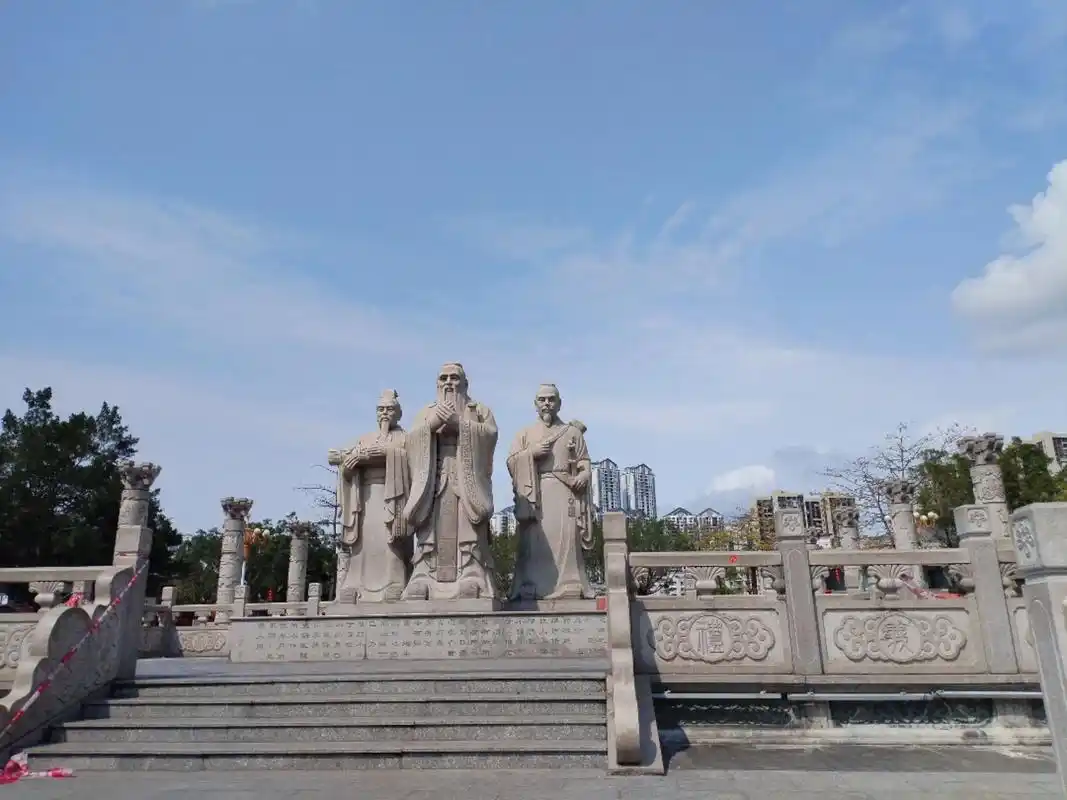 Long before the lecture halls of Europe's first universities—Bologna, Oxford, and Paris—began shaping Western intellectual life, China had already perfected its own model of state-sponsored learning: the Confucian temple-academy, or xuegong. The Lianzhou Xuegong, founded during the Ming Dynasty (1368–1644), served precisely this dual function, combining a sacred space for honoring Confucius with classrooms for educating local elites. Think of it as a hybrid of Oxford's medieval colleges and a Catholic cathedral—a place where civic identity, moral philosophy, and architectural grandeur converged under one roof.
The architectural vocabulary that survives here speaks to a broader tradition of Ming-era public building across Lingnan, the culturally distinct southern region encompassing Guangdong. The Liexiu and Jingyi Pavilions feature the gently upturned eaves and gracefully sloped ridges characteristic of southern Chinese design, an aesthetic cousin perhaps to the curving rooflines found in Japan's contemporary temples or even the dramatic pitches of Scandinavian stave churches, though rooted in entirely different traditions. Original wooden carvings and stone reliefs, though weathered and fragmentary, offer valuable clues to the decorative ambitions of Ming craftsmen working far from the imperial capital.
For travelers familiar with Confucian sites such as Beijing's grand Guozijian or Qufu's towering Temple of Confucius, the Lianzhou remains will appear humble indeed. Yet their very modesty tells a poignant story—this was a county-level institution, a grassroots outpost of an educational philosophy that, for nearly seven centuries, underpinned civil service examinations across an empire of sixty million people. Surviving in an era when many such temples have vanished entirely, these pavilions are essential physical evidence for scholars tracing how Confucian ideals reached even remote mountain prefectures.
Practicalities favor the casual visitor. The site lies within Zhongshan Park, which is free to enter and open to the public throughout the day. There are no dedicated English signage, audio guides, or interpretive panels, so travelers are strongly encouraged to read up on the site's history before arriving—otherwise the few remaining structures may seem underwhelming. Photography is welcome, and the surrounding park offers pleasant shaded benches ideal for quiet reflection.
Half a day is sufficient to absorb the atmosphere, and the temple pairs naturally with the nearby Hui Guang Pagoda, a striking sixth-century Buddhist tower predating the Tang Dynasty and predating much of Europe's Romanesque architecture by several centuries. Those with extra time should continue to the Lianzhou City Museum for broader regional context, or wander the historic flagstone lanes of Dongpi Ancient Street, where centuries-old merchant houses still line the thoroughfares. Plan 30 to 45 minutes for the temple itself.
Long before the lecture halls of Europe's first universities—Bologna, Oxford, and Paris—began shaping Western intellectual life, China had already perfected its own model of state-sponsored learning: the Confucian temple-academy, or xuegong. The Lianzhou Xuegong, founded during the Ming Dynasty (1368–1644), served precisely this dual function, combining a sacred space for honoring Confucius with classrooms for educating local elites. Think of it as a hybrid of Oxford's medieval colleges and a Catholic cathedral—a place where civic identity, moral philosophy, and architectural grandeur converged under one roof.
The architectural vocabulary that survives here speaks to a broader tradition of Ming-era public building across Lingnan, the culturally distinct southern region encompassing Guangdong. The Liexiu and Jingyi Pavilions feature the gently upturned eaves and gracefully sloped ridges characteristic of southern Chinese design, an aesthetic cousin perhaps to the curving rooflines found in Japan's contemporary temples or even the dramatic pitches of Scandinavian stave churches, though rooted in entirely different traditions. Original wooden carvings and stone reliefs, though weathered and fragmentary, offer valuable clues to the decorative ambitions of Ming craftsmen working far from the imperial capital.
For travelers familiar with Confucian sites such as Beijing's grand Guozijian or Qufu's towering Temple of Confucius, the Lianzhou remains will appear humble indeed. Yet their very modesty tells a poignant story—this was a county-level institution, a grassroots outpost of an educational philosophy that, for nearly seven centuries, underpinned civil service examinations across an empire of sixty million people. Surviving in an era when many such temples have vanished entirely, these pavilions are essential physical evidence for scholars tracing how Confucian ideals reached even remote mountain prefectures.
Practicalities favor the casual visitor. The site lies within Zhongshan Park, which is free to enter and open to the public throughout the day. There are no dedicated English signage, audio guides, or interpretive panels, so travelers are strongly encouraged to read up on the site's history before arriving—otherwise the few remaining structures may seem underwhelming. Photography is welcome, and the surrounding park offers pleasant shaded benches ideal for quiet reflection.
Half a day is sufficient to absorb the atmosphere, and the temple pairs naturally with the nearby Hui Guang Pagoda, a striking sixth-century Buddhist tower predating the Tang Dynasty and predating much of Europe's Romanesque architecture by several centuries. Those with extra time should continue to the Lianzhou City Museum for broader regional context, or wander the historic flagstone lanes of Dongpi Ancient Street, where centuries-old merchant houses still line the thoroughfares. Plan 30 to 45 minutes for the temple itself.