Xunyang Old Street
⭐ 4.20
Xunyang Old Street, Xunyang District, Jiujiang City, Jiangxi Province, China
 **Historical Context**
Xunyang Old Street traces its roots to the Ming Dynasty, accumulating six centuries of mercantile tradition before being officially named in 1928. Like Marseille's Vieux-Port or Liverpool's historic Albert Dock, it stands as a living monument to the era when treaty-port cities opened China to global trade. Foreign consulates and trading houses—including a surviving former Japanese Consulate and Standard Oil office—dot the district, recalling the cosmopolitan world of early-20th-century river ports along the Yangtze.
**Architecture**
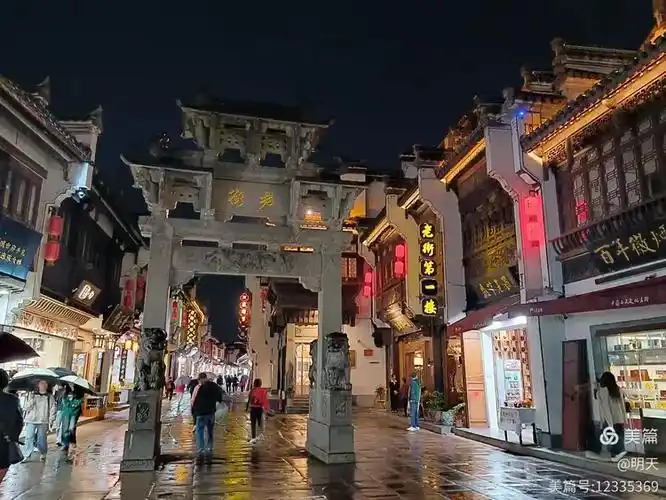
Stretching 2.1 kilometers, the street showcases 44 protected heritage buildings, dominated by Republic-era qilou (arcade) structures whose ground-floor walkways and tiled balconies echo the shophouse traditions of Singapore and Penang. Baroque pilasters, arched windows, and carved stone lintels mix with traditional Chinese ornamental motifs, all resting on weathered flagstone paving. The result is a streetscape reminiscent of Havana's old Malecón or Naples' Spaccanapoli—an architectural dialogue between East and West.
**Cultural Significance**
The 2024 revitalization followed a "one-building, one-strategy" preservation philosophy, breathing new life into century-old firms like the Tianbao Silver House. Today the street hosts immersive performances, traditional craft workshops, and dozens of legacy food brands, striking a balance comparable to how Kyoto's Gion or Barcelona's El Born districts safeguard heritage while embracing contemporary culture. It serves as Jiujiang's flagship cultural-tourism destination and a window into the city's evolution from regional market town to modern port.
**Practical Visit Information**
Entry is completely free and unrestricted around the clock, though individual shops generally operate from 10:00 to 22:00. The street lies in Jiujiang's Xunyang District, bordered by the Yangtze River to the north and scenic Gantang Lake to the south. Numerous city buses serve the area, and parking facilities are available. The neighborhood connects easily with nearby cultural landmarks—Xunyang Tower, Pipa Pavilion, and Gantang Lake's Yanshui Pavilion—for a rewarding half-day heritage circuit.
**Why Visit**
Xunyang Old Street offers travelers something rare: an authentic, unembellished glimpse of Chinese commercial history without the crowds of better-known sites like the Bund or Lijiang. Arriving in the late afternoon allows visitors to admire architectural details by daylight, then witness the street transform under atmospheric evening illuminations. Visitors should wear comfortable flat shoes, as the entire district is pedestrianized and rewards slow exploration—sipping tea in a restored teahouse, sampling Jiangxi rice noodles, or watching artisans practice centuries-old crafts just steps from the Yangtze.
**Historical Context**
Xunyang Old Street traces its roots to the Ming Dynasty, accumulating six centuries of mercantile tradition before being officially named in 1928. Like Marseille's Vieux-Port or Liverpool's historic Albert Dock, it stands as a living monument to the era when treaty-port cities opened China to global trade. Foreign consulates and trading houses—including a surviving former Japanese Consulate and Standard Oil office—dot the district, recalling the cosmopolitan world of early-20th-century river ports along the Yangtze.
**Architecture**
Stretching 2.1 kilometers, the street showcases 44 protected heritage buildings, dominated by Republic-era qilou (arcade) structures whose ground-floor walkways and tiled balconies echo the shophouse traditions of Singapore and Penang. Baroque pilasters, arched windows, and carved stone lintels mix with traditional Chinese ornamental motifs, all resting on weathered flagstone paving. The result is a streetscape reminiscent of Havana's old Malecón or Naples' Spaccanapoli—an architectural dialogue between East and West.
**Cultural Significance**
The 2024 revitalization followed a "one-building, one-strategy" preservation philosophy, breathing new life into century-old firms like the Tianbao Silver House. Today the street hosts immersive performances, traditional craft workshops, and dozens of legacy food brands, striking a balance comparable to how Kyoto's Gion or Barcelona's El Born districts safeguard heritage while embracing contemporary culture. It serves as Jiujiang's flagship cultural-tourism destination and a window into the city's evolution from regional market town to modern port.
**Practical Visit Information**
Entry is completely free and unrestricted around the clock, though individual shops generally operate from 10:00 to 22:00. The street lies in Jiujiang's Xunyang District, bordered by the Yangtze River to the north and scenic Gantang Lake to the south. Numerous city buses serve the area, and parking facilities are available. The neighborhood connects easily with nearby cultural landmarks—Xunyang Tower, Pipa Pavilion, and Gantang Lake's Yanshui Pavilion—for a rewarding half-day heritage circuit.
**Why Visit**
Xunyang Old Street offers travelers something rare: an authentic, unembellished glimpse of Chinese commercial history without the crowds of better-known sites like the Bund or Lijiang. Arriving in the late afternoon allows visitors to admire architectural details by daylight, then witness the street transform under atmospheric evening illuminations. Visitors should wear comfortable flat shoes, as the entire district is pedestrianized and rewards slow exploration—sipping tea in a restored teahouse, sampling Jiangxi rice noodles, or watching artisans practice centuries-old crafts just steps from the Yangtze.